
How different countries approach assisted dying
Dear Debriefers,
The subject of assisted dying is emotionally complex and can quickly become dystopian. For many, it is disturbing and dangerous, seen as a slippery slope to becoming a state-sanctioned eugenics programme.
But at the same time as parts of the disability movement protest against assisted dying, other disabled people have been at the forefront of demanding access to it. Indeed, the rapid expansion of assisted dying in Canada came about after a campaign by two disabled people to expand eligibility of those who could qualify for it.
I’m writing this article as an academic who’s been studying questions around how we die for many years. I have had a temporary experience of disability (thanks long Covid) but I’m not a disabled person. Like many people, I'm trying to figure out how I think about these issues. And in this piece I don’t take a position for or against assisted dying.
Rather, I share the way different countries approach assisted dying, and the issues raised in the national debates around it, ongoing in several European countries. Examining these alongside the words of the people most affected, we can see the fundamental questions of dignity and autonomous choice that the subject of assisted dying raises.
About this edition
Joe Wood is a researcher focusing on how we talk about pain, grief and loss, particularly at the end of life.
Disability Debrief is a reader-supported publication. Thanks to Claire for a new contribution.
This article also had support from the Assisted Lab project at the University of St Gallen. Assisted Lab looks at the impact of stories we tell about assisted dying, and does not take a position for or against it.
“Is it too easy to die in Canada?”
Canada has become an international reference point for its loose rules about who can access assisted dying and the speed at which eligibility has been opened up. Less than a decade after legalisation, over 4% of Canadian deaths now occur through Medical Aid in Dying (MAiD).
From initial legalisation in 2016, assisted dying has been mainstreamed within the healthcare service. In 2021 eligibility was extended to include non-terminal conditions such as some disabilities. And it’s scheduled to be extended again to certain mental illnesses in 2027.
A recent documentary critiquing MAiD is, perhaps rightly, titled ‘Is it too easy to die in Canada?’. There’s a 24/7 phoneline and people can be helped to die within a week or two of requesting it.
Both Canada and the US State of California legalised forms of MAiD in 2016. They have similar population sizes, but in 2022, more than 15 times more Canadians died via MAiD than Californians.
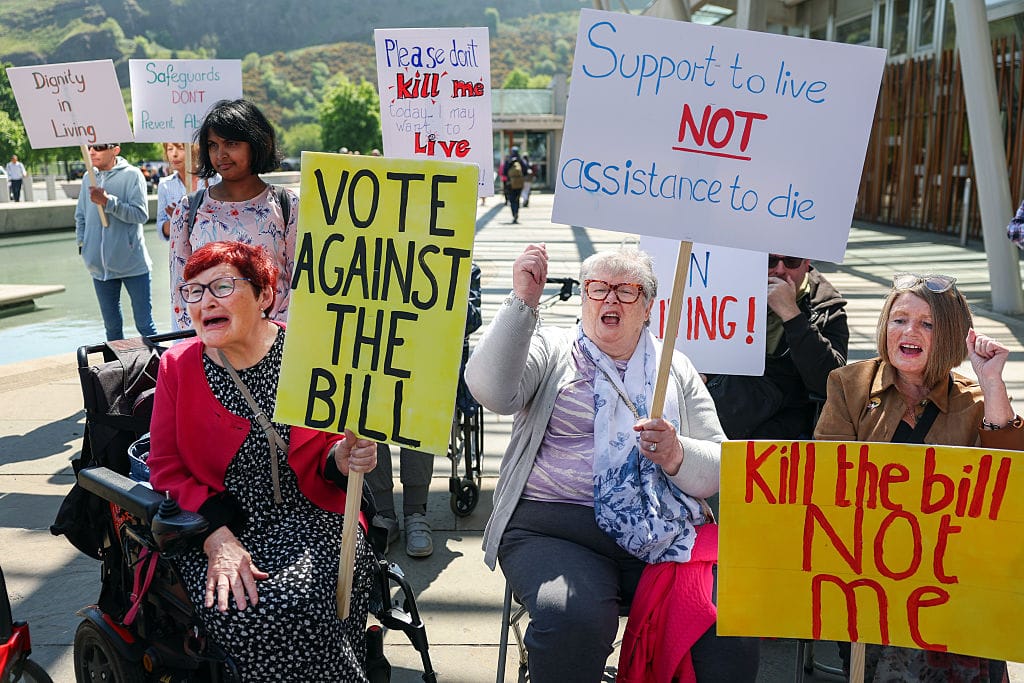
Assistance to die, but not to live
When the UN sent a special rapporteur to explore the Canadian approach to disability rights in 2019, she was “extremely concerned” about the way MAiD risked covering up for an “absence of community-based alternatives and palliative care”.
People have ended their lives through MAiD for issues like hearing loss or self-neglect during an episode of mental illness. Others appear to have pursued MAiD because they cannot afford adequate long-term care or secure social housing.
There are several reports of disabled people having MAiD suggested to them by carers and medical professionals. This has happened even when they weren’t previously considering it and what they really needed were better care packages.
As former Paralympian Christine Gauthier puts it, “Are you serious? Like that easy, you're going to be helping me to die but you won't help me to live?”.
The system is currently being challenged in the courts by disability campaigners, and others are appealing for the right to MAiD-free treatment spaces (clinics or hospitals where MAiD isn’t available and won’t ever be suggested).
The slippery slope
Canada appears to be a real-life example of the slippery slope scenario that many fear when assisted dying laws are discussed.
The slippery slope is the idea that after initial legalisation the number and scope of assisted deaths will only increase. This possibility is particularly a concern for disabled people who have learned to mistrust the medical profession and question society’s intentions towards them more generally.
Making disability a legally valid reason to request to end your life is disturbing because it calls into question the value of disabled lives. And the end result of expanding access to assisted dying can seem to be a state-sanctioned eugenics programme.
The Canadian model is loosely based on the laws of the Netherlands which follows a similar story. Dutch law initially aimed at preventing suffering in people who were very close to death. But it is now used by older people and those without terminal conditions. (An important difference though is that, before legalisation in 2002, Dutch police had rarely prosecuted doctors for euthanasia since high-profile cases in the 1970s.)
Uptake of assisted dying can also increase even if the law stays the same. In the Netherlands there was a 20% increase in assisted deaths for purely psychological reasons in 2023 (albeit the numbers remain small). In the same year, Belgium also saw a 15% increase in euthanasia cases.
Eligibility and how it can expand
One of the factors that makes the slope slippery is the criteria used when legislating for assisted dying. Recent Spanish law focuses on people who are experiencing “serious, chronic and impossible suffering or serious and incurable illness” (Translation, as are many following quotes.) Dutch law hinges on “hopeless and unbearable suffering”. Definitions like these are much more open to interpretation and widening of who they may include.
Advocates for the bill currently going through the UK parliament point out that the proposed law is restricted to people with six months or less to live (following the model of US States like Oregon). This is a specific and limited eligibility, and indeed would include less than half of Brits who travel to Switzerland for an assisted death.
Canada’s example shows why clarity matters. The first iteration of the law only specified that a person’s death had to be “reasonably foreseeable”. But terms like this, or the word “terminal”, are always arguable. In Canada, the phrase “reasonably foreseeable” ended up leaving the door open for broader eligibility criteria in the future.
Given the context of assisted dying in Canada today, I was amazed to learn that it was actually a campaign by two disabled people which brought about the controversial 2019 Truchon Decision, which expanded the criteria of access.
The Truchon Decision ruled it was against the Canadian Charter of Rights and Freedoms to limit MAiD to only those at the “end of life”. Following that, MAiD was extended in 2021 with eligibility criteria now requiring applicants to have “a grievous and irremediable medical condition”, which is far more flexible terminology.
“The question of how to accommodate vulnerability”
Many disability groups, like this Spanish cerebral palsy charity, want the wording of laws in their countries to be more specific, or limited to those who are terminally ill and actively dying.
As disability activist Marc Henri d'Alès puts it, when describing concerns with the current debate in France:
“Even though I am not at the end of my life, I feel concerned by the bill, because in reality, it raises the question of how to accommodate vulnerability in our lives and how society as a whole views dependent people.”
Vague criteria in assisted dying laws can equate disability with terminal illness and encourage the idea that living with disability is always enough to request assisted dying.
However, despite its controversial rollout, some disabled Canadians still actively support MAiD. This diversity of opinion raises further questions around agency and social attitudes to disability. On both sides of the assisted dying debate is the importance of being able to decide for yourself whether your own life is worth living.
Ableism and devaluing disabled lives
For some, assisted dying re-enforces a medical model of disability and represents a decision made by others that disabled lives are worthless. Indeed, as we saw in Canada, this can be seen in terms of the lack of support available for disabled people to live full lives.
For instance, in France, blogger and disability sex therapist Laetitia Rebord initially supported the right for someone to choose an assisted death. But then she realised the reason for her opinion:
“My internalized ableism had already strongly developed […] ever since I’d heard my grandfather openly declare, on several occasions, that in my situation, he would shoot himself.”
Rebord now campaigns against assisted dying, believing it perpetuates the ableism she experiences in everyday life and that it could lead to people like her grandad exercising subtle forms of coercion and influence.
Prominent French anti-assisted dying campaigner Celine Extenso agrees, quoting the eligibility criteria in discussions around the law:
‘When our access to housing, transportation, education, work, leisure, family life and even the most basic care is legally obstructed every day, who would not experience "refractory psychological suffering"?’ [“refractory” means not responsive to treatment]
Increasing legalisation of assisted dying without great leaps in care and provision for disabled people is surely unfair.
Many reckon assisted dying might even be an economic decision. As Spanish disability commentator Alberto de Pinto Benito puts it: “It is much easier to kill a person than to support them with benefits.” And as German disability blogger Marianne Karner writes, “There is no such thing as an undignified life. What does exist are undignified circumstances”.
“It should be a right”
Yet having the right to assess your own life’s worth is also the point made by those who want the right to die.
Take the prominent case of Vincent Humbert in France (where assisted dying isn’t currently legal). A car crash made him paraplegic and he lost his sight and speech. Humbert was supported by his mother and his doctor to pursue an illegal assisted death in 2003. His decision became a cultural reference point in French debates as a symbol of self-determination.
Similarly, Dutch blogger Lauren Hoeve died through euthanasia in Jan 2024 having lived for several years with ME as well as autism and ADHD. She reached the point of feeling that she was no longer able to live in a way that she recognised or identified with, writing:
“I cannot force anyone to help me die, but I do believe that a dignified, self-chosen (but well-considered) end of life should be a right.”
Humbert’s or Hoeve’s decisions may have been affected by systemic ableism or their own prejudices. But the experiences that led them to end their lives were real for them. And so, although it is disturbing, it also feels like they claimed agency through their decisions.
A similar (and, for me, just as unsettling) argument for assisted dying is made on the basis of “completed life” for people who feel they’ve done all they want do to in life and see no point continuing. This case is often associated with older people who fear ill health or boredom in their final years. It is already legal in certain circumstances in Switzerland and the Benelux countries.
“I’d rather go out with dignity”
Beyond the question of life’s ongoing worth, for many assisted dying comes down specifically to the issue of autonomy over end-of-life scenarios.
In France, the law currently being considered has been heavily influenced by writer turned campaigner Anne Bert, who lived with ALS. In 2017, she travelled to die in Belgium.
Bert’s decision was based on autonomy. She didn’t want to be “at the mercy of others” and wanted to choose the timing and manner of her death to avoid the long painful death she anticipated her condition would lead to. Belgian law, which legalised euthanasia in 2002, was itself effectively changed through the similar campaigns of Jean-Marie Lorand.
The relative openness in Switzerland and Belgium allows foreign nationals to come from outside the country to seek an assisted death. For example, Sabine travelled to Belgium to die aged 56. Having lived with complications from chronic arthritis since the age of five, she said:
“I’ve taken back control of my life. I’ve chosen how it’s going to end. I’d rather go out with dignity, in peace and quiet surrounded by my family, than in hospital, prodded all over.”
Bert and Sabine had enough money to make the trip over the border to Belgium. But others can feel forced to end their lives through improvised means. This option can be more lonely and less likely to work. In this light, some see legalising assisted dying as a matter of equity because anyone should be able to access the same standard of assistance in their own country.
Autonomy and agency in different administrations
Switzerland, often seen as the home of assisted suicide, is kind of a special case. Assisted suicide was legalised in Switzerland in 1941 and the law has been in regular use since the 1980s.
But the service is performed through co-op associations of active supporters. Doctors are still involved, but the process is led by a not-for-profit organisation rather than standard medical institutions. This is unlike most other countries – like Canada, Belgium or Australia – which run their assisted dying programmes through the healthcare system.
There are also grey areas in some countries where assisted dying isn’t officially allowed. For example, in Austria and Italy, doctors aren’t technically allowed to help patients die, but there is precedent that they are unlikely to be prosecuted in certain circumstances. And in some places, like the UK or Sweden, “passive euthanasia” – refusing treatment or stopping life-support – is a legal option.
Countries also differ in who carries out the procedure. In Switzerland, the person has to administer the drugs themselves. In the Netherlands or Canada, a medical professional will most likely administer them.
Some of these differences may appear to be technicalities. But they have important consequences in terms of who has the capacity to decide and/or to administer their own drugs. And they also have a symbolic importance in terms of the autonomy that lies behind an individual’s decision.
“No one lives completely autonomously”
For me, these questions of capacity and how we use it lie at the heart of assisted dying.
We should certainly have a level of autonomy over our own life and consequently our death, but I’m not so sure that our own sense of autonomy is particularly objective. In the words of Austrian politician and disabled activist Franz-Joseph Huainigg, writing about autonomy:
“We must be clear that no one lives completely autonomously and that we influence each other - including in decision-making.”
And there is definitely a tension between allowing certain people to exercise their autonomy and looking after marginalised members of society. Celine Extenso opposes the current legislation being considered in France, but seems to look towards a time when better provision for disabled people might change her mind when she says:
“In an ideal world, where disabled people would be helped to live with dignity, assisted dying would be a given.”
Reaching other feelings
Discussions on assisted dying often assume that we can make a final decision about whether we want to carry on living. But what is often missing in the debate is the fact that many people who pursue an assisted death don’t actually go through with it.
Nicole Gladu was one of the two disabled people who successfully changed Canada’s law on assisted dying to include disabled people in 2021. But in the end she didn’t access MAiD and died of natural causes in 2022.
I want to leave you with this article about Romy, a young Dutch woman with trauma and addiction issues who wanted an assisted death. After years of failed therapy and treatment, she was approved for the procedure. Romy said goodbye to everyone, but, at the final moment when she was asked again whether she was sure, she changed her mind.
It may seem counterintuitive, but once approved for an assisted death, some people can relax and carry on with life. The centre that treated Romy claims 40% of patients with psychological distress withdraw their requests after discussions with the centre’s professionals. And some “are so focused on euthanasia that they can only reach other feelings after the ‘green light’”.
Romy herself is undergoing therapy and is optimistic: “I survived death, so I'll survive life too.”
Conclusion
Assisted dying is a topic that can confuse and terrify and, for some, console. I know that for me it brings up a whole set of emotions and can be challenging to research for long periods of time.
What for one person is the option of a deeply private act of autonomy is, for another person, a disturbing challenge to their very existence. But as more countries join the road to legalisation, it feels increasingly important to understand the complexity of what’s at stake.
It’s a hard subject to read and write about, so thanks for reading to the end.
All the best,
Joe
Corrections
An earlier version of this article incorrectly mentioned Colombia among the countries where doctors aren’t technically allowed to help patients die. However assisted dying has been regulated there since 2015. (Thanks Maria!)
An earlier version of this article said that MAiD had been extended in 2020, but the legislation in fact passed in 2021. (Thanks Kurt!)
Further Reading
Check out the Assisted Lab’s website for recommendations of books, films etc. from different sides of the politics debates around assisted dying. If we’ve not covered it, you can also share an important story or piece you’ve come across.
The Disability Debrief library has curated links on Assisted Dying and Euthanasia.
And for more general information on the legal situation on assisted dying:
- BBC News, What is assisted dying and how could the law change? (regularly updated, including details of the current situation in UK law and differences between assisted dying, assisted suicide and euthanasia)
- British Medical Association, Physician assisted dying legislation around the world, 2022 (a few years old now but still a useful map)
- Luke Hurst and Camille Bello, Euthanasia in Europe: Where is assisted dying legal?, euronews, 2022
Outro
Let your friends know. Sharing the newsletter is how people find it!
See more from Joe: his book Cicely Saunders and Total Pain: Holism, Narrative and Silence at the End of Life.
Help us do more. The Debrief is free thanks to reader support.
Acknowledgements
Thanks to my colleagues at Assisted Lab who encouraged me to write this article, especially Vanessa Rampton and Anna Elsner for their trust and support.
Thanks to Peter for leading me through writing an article for the Debrief with perspicacity and good humour, both much needed when writing about this topic.
Thanks to Celestine Fraser for reviewing an earlier version of this piece.
Thanks to the organisations and readers (including you) who support the Debrief so it can share the stories that matter.
Part of my time on this essay was supported by Assisted Lab, where I was a researcher. That research was supported by an H2020 European Research Council grant (101040399) and funded by the Swiss State Secretariat for Education, Research and Innovation under contract MB22.00067.
And photograph by Jeff J Mitchell/Getty Images.