You can’t pick palm nuts without your hands getting oily
Dear Debriefers,
I am Deaf – an identity I ran away from for a long time – but the eventual acceptance of which turned out to be my salvation.
The turning point came for me when I got into contact with other Deaf people and the Nigerian Deaf community. These connections were the making of me.
But the further I got into the community the more frustrated I became. I got irritated at the disunity, a stereotyped notion of ‘Deaf way’, power games, and more.
To understand these tensions more I examined my own experiences and got talking with Deaf friends and leaders.
My reporting shows me the transformations we get from coming together, but also the disconnections and corruption in our community.
Our community has great fruits, but some of them make a mess in the picking.
About this edition
Support from readers lets us tell disabled stories in our own words. Thanks to Amanda, Clydesider Creative, and Impel Consultancy for new contributions.
Alexander Ogheneruemu is a disability issues writer, advocate and special educator in Nigeria.
Kinanty Andini is an illustrator and digital artist from Indonesia.
Struggling in solitude
Prior to my association with Deaf groups, I endured my Deaf odyssey in solitude, wandering in a hearing world where I just managed to hang in.
The disillusionments of having to struggle with deafness in solitude had stifled my hope of a university education – which, logically, should have been my next move after completing secondary school in 2004.
My mother operated a restaurant, she needed helping hands, and my circumstances made me a nice fit. I worked long hours waiting on cups, plates and pots. I fetched water, boiled rice, beans, and prepared stews and sauces to be served to hungry customers.
Lip-reading helped me cope to a certain extent. But my deafness threw up frictions and frustrations even here. I encountered all kinds of customers – some empathetic towards my deafness; others, cold-hearted. From the latter, I tried to keep a distance.
My existence revolved around the business. Often, I teetered dangerously on the brink of nervous breakdown from the stress of daily grinds. But there was a silver lining to those years: I pored over pages of literature, and that wove in me inspiration for the future.
Discovering Deaf connections
It was a decade later that I was introduced to Deaf space. A friend of my mum showed up at the restaurant, a Jehovah’s Witness. Through our friendship she connected me with other Deaf people. One connection led to another and I found myself in a Deaf Whatsapp group.
My introduction, couched in delicate English created a stir in the group. One person remarked in pidgin: “this one no go dabaru [will bring down] the house with grammar”.
These new connections shortly led me to the Initiative for Later Deafened Adults (ILDA), for people who’d acquired speech and language exposure before they became deaf. For the first time, I met a group of Deaf people for whom deafness was both identity and a spur to attainment. It was a whole new world.
First impressions of unity
My connection with the ILDA led me to receiving a scholarship. It was granted by an organisation called Strategies for Advancing and Networking Deaf Africans for Ubuntu (STAND-U).
The term Ubuntu was new to me, and I found that it symbolised a shared and united community. This ideal shaped my first impression of Deaf groups in Nigeria.
In those early days, the community appeared cohesive. One clear example I remember is where STAND-U and other Deaf elites came together to protest a university that had deregistered a Deaf student on unjustified grounds.
Resisting sign language
The scholarship gave me fresh motivation to resume my stalled education. And I gained admission at the Federal College of Education (Special) in Oyo, a teaching college focussed on special education.
I suddenly found myself in an environment steeped in Deaf culture – and surrounded by Deaf folks across a broad continuum. It was quite a culture shock. Assimilation was a slow process, and a struggle especially from the language standpoint.
I still had passable speech and residual hearing, and, to my embarrassment now, I had originally looked down on sign language as crude, suitable only for the profoundly deaf. Many avoided me, considering me a ‘hearie’ (a Deaf person with a hearing mindset, or who doesn’t value Deaf culture).
Members of the Deaf groups I had joined admonished me to learn sign language. They told me to keep an open mind, and that it would open doors for me. I did, and it went on to become a catalyst for self-discovery and deeper connections. My growing skill in sign language restored the previously lost joys of in-person communication.
I went on to learn that the sign language we used is in fact a mixture of different independent languages: American Sign Language, and Nigerian Sign Languages, comprising Yoruba, Hausa and Igbo variants. As well as these undocumented sign languages there are community signs based on natural gestures, as I’ve written more about over at Disability Justice Project.
Disenchantment, money politics and corruption
Slowly, and over time, I began to realise that there was a growing feel of disenchantment with the community as a whole. Despite the Ubuntu philosophy bringing us together, there’s little unity in the Deaf community.
Deaf associations seem to operate more like political parties, getting drunk on power and replete with mudslinging and subterfuge. Many of us share concerns about how leaders in the Deaf community dodge accountability or are failing to set a good example.
There are allegations of corruption, as leaders appear to corner funds meant for general development. And recent elections to a powerful association saw the use of money to determine the outcomes: through influence of votes with money, and disenfranchising qualified candidates who couldn’t afford the nomination costs.
Scams and money laundering
Some of these scandals are common knowledge, but they rarely get into the press. However one exception to this was in 2024 when a national (and international) leader in the Deaf community was indicted by the United States government.
The US Attorney’s Office indicted three individuals (residents in the US) for a “Conspiracy to Launder Over $1 Million from Online Fraud Scams”. One of those charged was the (now ex-) president of the Nigerian National Association of the Deaf, who also held a position in a regional body of the World Federation of the Deaf.
A microcosm of the bigger community
Our community was brought together with noble aspirations. There wasn’t one person I spoke to who didn’t acknowledge that community was a source of blessing.
But as some of the old guard told me, when Deaf folks lose trust in it then we will distance themselves. Ubuntu, and collective spirit, benefitted many and brought me out of my wilderness. I worry that we are now less guided by them.
Speaking with others, they sought to put these concerns into context. Afolayan Muyiwa, a civil servant in Abuja, told me how “Deaf groups are but a microcosm of the bigger community”. He points to its complexities and how we then choose to mix with those that “align with our dreams”, picking some lessons and discarding others. “It is like sieving.”
Many of those I spoke with agreed that Deaf groups are repeating the dynamics in wider society. Regarding corruption, one leader told me:
“Money has always been the motivating factor behind all human endeavours, and that does not exclude the Deaf community.”
Pressures of community
Certain quirks of the Deaf experience, and the smallness of our community, mean that our foibles and their impact are magnified.
There are pressures to behave in certain ways, to conform to certain stereotypes of a Deaf person, to follow a “Deaf Way”. If you differ from the norms of the community you are seen as undeafly, you are labeled “fake”, “proud”, or “hearie” – in some cases drawing enmity and opposition.
This puts pressure on those who stand out. In Nigeria (and other neighbouring countries) we label this a “Pull Him[/Her] Down” syndrome, an envy and critique of those who are successful and stand out in ways many consider un-Deafly.
The PhD syndrome refers to the tendency not to see your peers rise above you, and the sinister actions often employed to stop them doing so, or bring them down. So pervasive within the Deaf community is the PhD syndrome that Deaf E3 designed a series of empowerment workshops to tame its menace.
Connection or advocacy?
The habitual drift of discussions within Deaf groups is another subject of debate. For many groups, the greater interest is in socializing, catching up on society’s trends, and side gossips.
Personally, I feel the need for more discussions targeted at deaf-centric topics or development of the community. Ezekiel Okeh, a close friend, agrees that there’s a lost potential here:
“These groups can play the pivotal role of filling the advocacy gap as they [have] members [sufficiently] equipped to communicate with both the larger society and the community. They are Deaf enough to understand Deaf issues and proffer solutions, and at the same time, are literate enough to communicate the needs and solutions to the wider society.”
Diction, diaspora and domination
Another area that politics and difference play out in the Deaf groups is in relation to the English language. “Typical” deafies, those who became deaf before acquiring language, often struggle with English.
But among post-lingual deafies are some refined users of English. While that’s a good thing in itself, it’s unfortunate when it becomes, as some see it, a tool for show-off and dominating group conversations.
Some have found me wanting in this regard. With a mixture of commendation and sarcasm, people describe me with words like “chief scribe”. I admit I am culpable here, or as one person put it, I am one of the “migraine-giving grammarians in the group”.
Questions of language are reinforced by the diaspora factor. Undue prestige is given to comments from group members simply because they are based abroad or have schooled there. Indeed, one elder told me that my contributions in the group, however substantial, would pack more power if I had some overseas exposure backing them.
“Nigerian Deaf men don’t give women leeway”
By default, gender relations in Deaf groups takes on the traditional Nigerian template – men dominate. This is especially true in leadership positions.
Edirin, a lawyer who’s been frustrated out of her political ambitions in Deaf space, captured the sentiments of many that I spoke to:
“I hate talking about Deaf issues, especially politically…because no matter how they paint it, Nigerian Deaf men don’t give women leeway in Deaf politics…even positions like women leader [exists] only in mouth – they don’t really have any power.”
Edirin went on to explain the tensions in who get ahead:
“Women aspiring to political leadership in Deaf community are those who have come into their own […] educated, not easily pushed around… but these women are hardly allowed to win. The ones being [enabled] into political posts are those who are easy prey for male exploitation.”
Unfortunately, one issue in power dynamics between the genders is the issue of sexual exploitation. I’ve been shocked by the stories I’ve heard and their frequency. Men in positions of responsibility harass or take advantage of often younger women.
All too often these behaviours get ignored. Power often resides with the predators. And the concerns are dismissed by the community with a “it’s happening everywhere”.
Women not finding their place in Deaf groups led to the creation of the Deaf Women Association of Nigeria (DWAN). It was founded over two decades ago by Adedoyin Beyioku-Alase, also known as Mama Deaf. In her words:
“DWAN was a child of necessity, born to fill a gap – the absence of women in Deaf leadership.”
Over the years, including through the influence of DWAN and their empowerment initiatives, more Deaf women are finding their feet in the community and leadership roles.
Evolution and growth
I started my reporting on this article peeved at the many things that’ve gone wrong in a community that was my salvation. My frustration drew from the wide gap between my first impressions of Deaf groups and the flaws I discover along the way.
While I’m not alone in the discontent with the current state of Deaf groups, it’s been interesting to come across folks who choose to still see the bright side. Their equanimity is infectious.
As Dami, DWAN’s national secretary who teaches at the Federal College of Education puts it, “you get what you are looking for”. Or as Femi, an award-winning civil servant calls it, an “evolutionary stage”. He’s optimistic things will take shape.
Talking with others about these flaws brought some reassurances that Deaf groups are still evolving. In the words of Richard Ezekiel, a videographer and film maker, “We are still on a path of growth and I’m sure we will get there.”
You can’t pick palm nuts without your hands getting oily
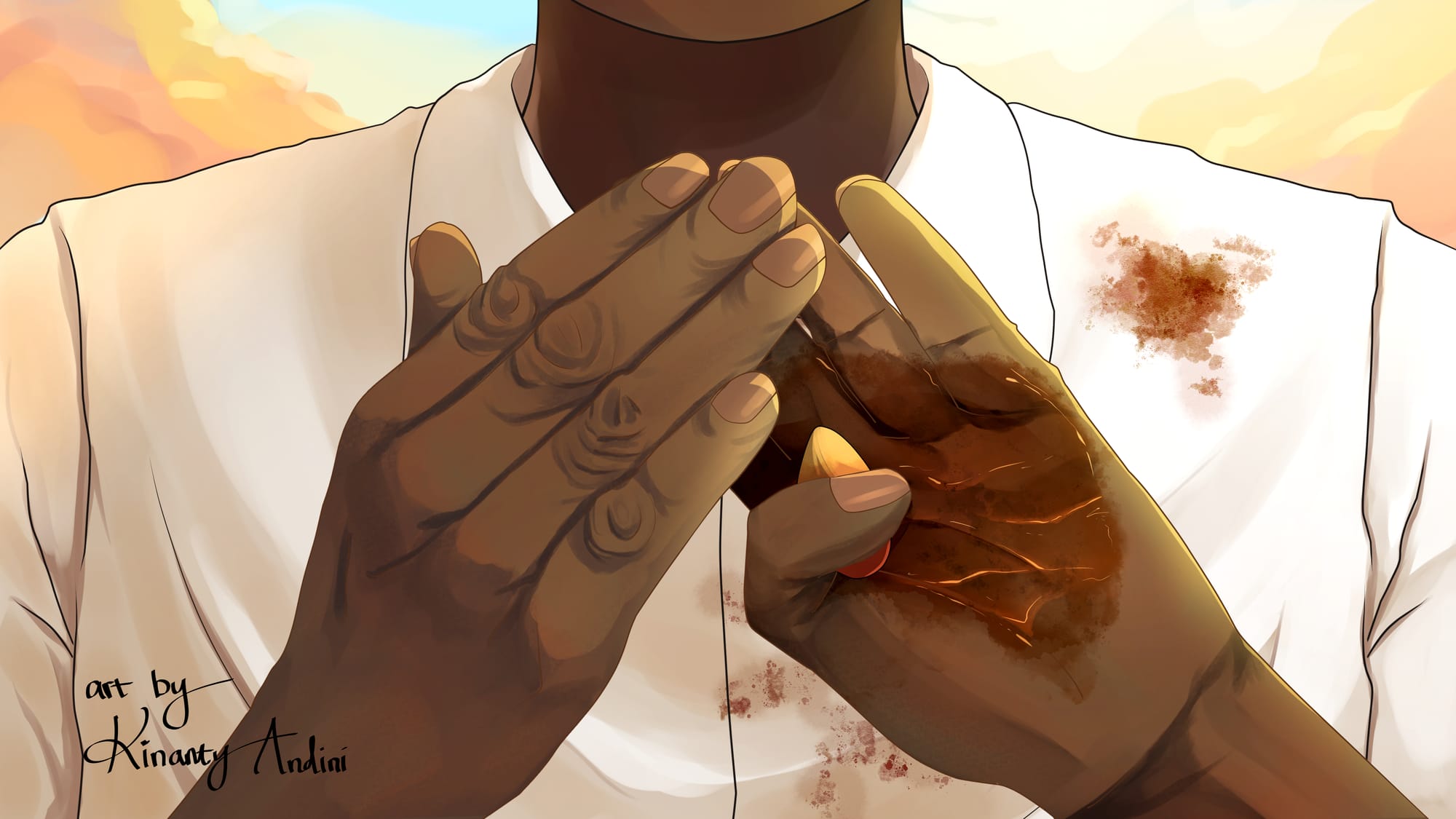
There’s a proverb in Igbo that goes “Ị gaghị ewere mkpụrụ nkwụ ma ọ bụrụ na aka gị adịghị mma na mmanụ”: “you can’t pick palm nuts without your hands getting oily”. Success or achievements usually requires some sort of effort or risk.
Relating that to Deaf groups, I see one of the lessons I took from writing this article. To partake in the blessings of community means I must also share in its pains.
But there are different ways of being in community. I will not follow a “Deaf way”, but commit to be being a “Deaf me”. I believe in a freedom to identify as Deaf without conforming to prevailing assumptions about deafness and Deafies.
My place in the community will be dictated by conscience and a commitment to paying forward the blessings received.
Seeing the bright side has taught me to be more accommodating to imperfection. And it helped renew my resolve to stay the course within the flawed community that made me.
O dabo, good-bye,
Alex
Outro
See Alex's previous writing on the Debrief: Schisms in the Church, explores the disconnect faced by Deaf worshippers in Nigeria.
For more from Alex, find him on Linkedin.
For more from Kinanty, see her website.
Let your friends know. Sharing the newsletter is how people find it!
Help us do more. The Debrief is free thanks to reader support.
Acknowledgements
Thanks to Peter for being such a patient editor and mentor – working with you has been one of the best encounters of my writing journey. And to Celestine Fraser for editing support.
Thanks to Kinanty Andini for bringing together the Igbo proverb and Nigerian Sign Language in her illustration.
To everyone, both friends and thought-leaders of the community (too numerous for naming) who were part of the conversations that shaped this article, a big thank you!
Finally, special acknowledgements to the readers and organizations whose donations keep this great newsletter going.