
Safety concerns and marketing stunts
Hey everyone – thanks so much for helping us find an even bigger audience for the Debrief, and welcome to new readers! This edition is the first that's going out to over 5,000 people.
And please join me in welcoming Han back to the Debrief, who wrote first sharing her vision of a disability future. – Peter
Dear Debriefers,
I am Han, a journalist from China, who writes on social issues. I now live in Europe, and write under this shorter, less traceable name, so I do not have to worry about what I can say.
A few years ago I had a short period using a wheelchair, and a longer one using crutches. It gave me an interest in disability issues. And it showed me how individuals or social groups offer help when needed, or when institutions fail.
As I started to follow disability news from China, I found several stories relating to wheelchair users that showed how institutions do and don’t accommodate them there. They range from a shocking case where an 87-year-old woman was denied entry into a public hospital, to a viral social media story of non-disabled people using electric wheelchairs to go to work.
These stories show how wheelchair-use can be reduced to questions of battery safety, rather than seen in the discrimination framework set in Western countries. And they show how disabled people navigate this context to advocate on social media.
Han is now based in Europe, where she works for an NGO.
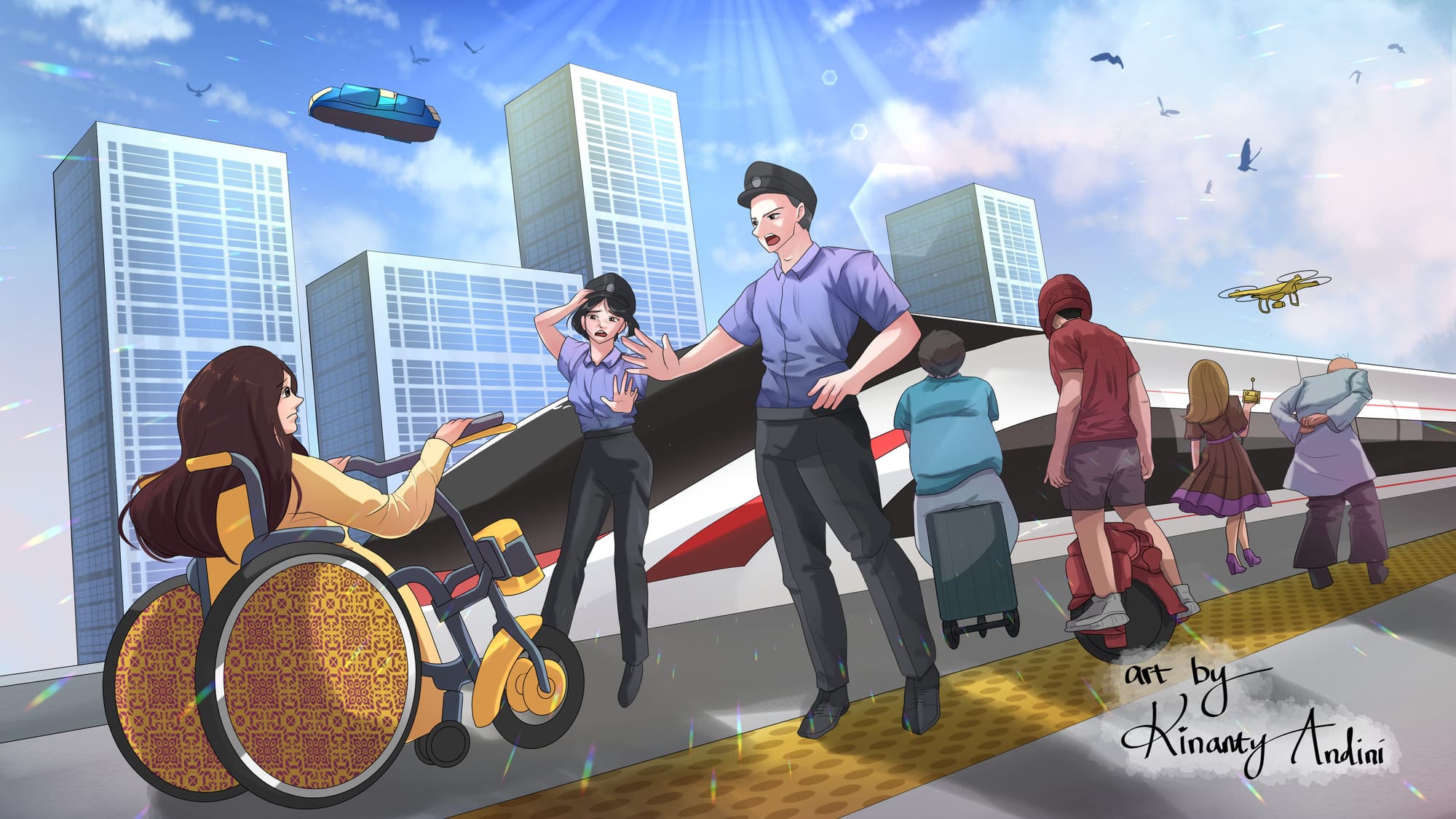
Kinanty Andini is an illustrator and digital artist from Indonesia.
With thanks to Ashton and Visala for new contributions to the Debrief.
Refused access over supposed safety concerns
Reporting from Li Bingjie on Beijing News gathers together striking examples of wheelchair-users refused access because of supposed safety concerns.
In December 2025, Ms Su’s 87-year-old grandmother came to a hospital in Guangzhou with an electric wheelchair for a follow-up appointment, and was denied entry because of fears over battery safety.
Rather than use her own chair, they ended up having to rent a wheelchair from the hospital. However, according to Ms Su, these hospital wheelchairs are dirty, and with faults. With difficulty after her recent operation, it took several people to help her grandmother transfer from her own wheelchair to a hospital one.
After the family complained, the hospital did apologise, even as it insisted that the forbidden entry fell within the scope of the regulations.
In the name of safety control
Currently in China there are no mandatory national standards on electric wheelchairs and their batteries. Property management, hospitals, and public transportation services have their own interpretation of access and entry rules in the name of safety control. Social media posts suggest that such experiences of being denied entry are far from rare.
However, there are safety risks due to unclear manufacturing standards and missing safety features for mobility scooters or electric wheelchairs. Several incidents in China illustrate these risks.
In January 2024, an electric wheelchair with an unauthorised lithium battery retrofit caused an explosion in Sichuan, injuring three people; in 2025, one person was rescued after his electric wheelchair battery fire; and another man died in an electric wheelchair fire at his home in Shenyang.
Traction devices no-go on trains
Another frequently-mentioned moment where there are disputes over batteries is when wheelchair users using traction devices seek to board trains.
Some manual wheelchair users add a power-assist traction device to travel longer distances and navigate difficult surfaces. Notably, in China, it is not defined as an electric wheelchair. The same reporting from Beijing News shares the case of Liang, who was refused entry to one train station in Beijing.
After breaking her arm, she added a power-assist device to her manual wheelchair. Even though she presented the certification of the device to railway staff, they denied her boarding. Batteries over 100Wh are prohibited on trains, except in the case of electric wheelchairs.
However Liang’s traction device was not recognised as electric wheelchair and so she had to leave it behind in baggage storage. A few months later she was rejected boarding again. This time, she was told that, even without a battery, her traction device is still forbidden for train travel.
Liang told Beijing News that for persons with disabilities, it takes a huge effort to go out:
“We worry about bringing hassle to others, or becoming a burden to others. We need to accept help, and we don’t know what challenges are in front of us.” (Translation)
“Why do you need to be so fast?”
Another wheelchair user, Zhishi, recently shared her experience with different models of wheelchairs through the years. She started with a large medical wheelchair, and then, via more flexible ones, an expensive wheelchair customised to her.
Her new wheelchair gives her lower back proper support and doesn’t cause her pain like the previous models did. While the mainstream market only provides functional products, users have to pay much more to find a suitable one.
Her current wheelchair costs 20,000 RMB (about $3,000), which is more than three times the average monthly wage of employees in the urban private sector. The price keeps many people from getting the appropriate chairs, and so does the perspective of how mainstream society sees disabled groups and accessibility issues.
Wheelchair users post these challenges on social media to complain, or as a form of protest. But there aren’t always understanding or positive reactions. Harsh voices are quite common among Chinese social media posts or news comment sections: “Why isn’t an electric wheelchair enough for you?”, “You are already depending on a wheelchair, why do you need to be fast?”
In an ableist world, disabled people are expected to prove that existing policies do not meet their needs. They have to educate others about the barriers they face. As Zhishi wrote:
“We are fighting for the most basic rights: to be free from unnecessary pain, to be free from being restricted by one-size products, and to be free from feeling like a burden to society every time we move.
“A wheelchair that prevents injury and fits the body should never be a 'luxury' that only a few can afford. Instead, it is a basic need, just like well-fitting glasses or shoes. We need different wheelchairs, just as someone chooses running shoes or hiking boots – this should be the most natural thing.” (Translation)
Responding to barriers in different terms
The discussions on Chinese social media are different from those that might appear in Western countries.
An example of the different approach comes from the UK, when earlier in the year Maddie Haining was asked to leave a bar because she and her wheelchair were a supposed “safety risk”. Her response was to show the manager a copy of the UK’s Equality Act on her phone, and to say “you can't make me leave because I'm in a wheelchair – this is discrimination”.
In contrast, most of the Chinese discussions on social media relate to battery standards and entry policies. I have not seen any related to a claim of discrimination. Some people speak up, and share their experiences, like Liang and Zhishi; others choose milder ways to address such discrimination.
On rednote, a popular Chinese lifestyle social media platform, wheelchair users share how to avoid such hassles, for example, how to register with train services in advance with detailed steps, and how to make official suggestions on the railway website and in disability communities. One user shared in an awareness-raising video, a practical, non-confrontational approach to these issues:
“Prepare safety certification and product information; communicate friendly, and don’t fight or argue with others because it won’t solve any problems.”
Non-disabled people using wheelchairs
These cases reminded me of a controversial social media image. Over the past few years, videos have gone viral of, supposedly, non-disabled people using electric wheelchairs.
The videos show young people in their 20s and 30s, wearing casual or sporty clothing and driving electric wheelchairs in a line to subway stations, across roads, or to office buildings. Some fold and carry the wheelchair up stairs. The captions package wheelchairs as a commute game-changer free of traffic rules for the last miles, and safer choices.
The trend was reported on unquestioningly by international media, including an article in Time, or Think China and Straits Times from Singapore. The reporting contextualised this by saying non-disabled people are using electric wheelchairs as an alternative form of transportation in response to tighter regulations on electronic bicycles.
But does this really make sense?
Looking again, the videos had several similarities: while there are different models of wheelchairs, they have the same identifiable brand. And the videos were often published by companies or industry accounts.
Indeed, reporting from Southern Weekly in 2023 showed that these videos were a staged marketing ploy. According to that reporting, one brand began producing such videos with its own employees using wheelchairs during company retreats. The founder of the company clarified that wheelchairs are not suitable for non-disabled people commuting, as overcrowded wheelchairs can affect public accessibility and are also considerably dangerous on roads.
This is closer to wheelchair users’ reality. Even so, images of able-bodied young people commuting in wheelchairs continue to draw waves of attention.
New standards on the way
With so many of these stories revolving around standards and regulation, there is good news: the national mandatory standard of electric wheelchairs and their batteries is on the way.
What does it mean to wheelchair users in China? A national mandatory standard will provide a strong basis for pushing public services to revise their access rules. The change will not happen overnight, but if hospitals or others refuse to do so, they would need to justify why they are not following the national standard, which would be legally challenging.
This March, the Ministry of Industry and Information Technology finished the draft national mandatory standard Safety Technical Specifications for Batteries in Electric Wheelchairs. After the public consultation period and approval, it will come into effect on June 1st of 2027.
It also covers the batteries of power-assist traction devices. Theoretically, with the support of the mandatory standard, Liang and other users might board trains without the previous disruption. Or, at the least, a legal foundation will be a positive step towards doing so.
Speaking up and justifying rights
Years ago, in my social work in China, I got tired of writing advocacy. As well as the endless censorship, comments from the public did not help either. It led me to self-censorship.
While preparing this article, I came across voices from the Chinese disability community working to secure our rights through institutional change and public education. I am very inspired. To me, these disabled people speaking up about social issues are so brave, exposing their personal experiences to hostile comments, and justifying their very much deserved rights.
Working on such articles motivated me to keep speaking up. I am glad to share voices from China and the disability community with you. We are here to cross the swamp, not to fight all the alligators.
Writing after my physiotherapy,
Han
Outro
See Han's previous piece on the Debrief in Broken then Blooming, our collective imagining of a future where disability rights are real.
For more from Kinanty, see her website.
Let your friends know. Sharing the newsletter is how people find it!
Help us do more. The Debrief is free thanks to reader support.
Acknowledgements
Thank you, Peter Torres Fremlin, for building this amazing community and making this article happen. I learned a lot from our topic discussions and editing process; I appreciate your professional guidance.
Thank you, Kinanty Andini, for your instantly recognizable illustrations in Disability Debrief. It is great to see your visual version of this article.
Thank you, Disability Debrief’s readers and supporting organisations, for making diverse voices and lived experiences visible all around the world.
Thank you, Disability Without Borders and its dedicated contributors, for the enormous, precious discussion and inspiration. Thank all those who spoke up about their situation and made others’ situations better.