
Help the Debrief reach 5,000 readers
Disability Debrief explores the world through a disability lens. The articles are open and available to all thanks to a pay-what-you-can model.
Dear Debriefers,
This Debrief is being sent to 4,922 people. Help us reach 5,000 readers with these disability stories each week: forward this edition or share the newsletter with your friends.
In today's edition I highlight some favourite quotes from recent reading. We go back into the past to visit Helen Keller's (inaccessible) birthplace, see how disabled people are hidden in history, and hear Gandhi's vision of self-rule from 1930.
Back in the present day we see the heartbreak of disability community, how disabled journalists do their work and what is hidden between outward appearances. Plus, a chair that climbs stairs.
Peter Torres Fremlin is editor of Disability Debrief and is from the UK.
Sonaksha is an illustrator and designer from India.
With thanks to Disability Rights Fund and the Disability Rights Division at Human Rights Watch for renewing their subscriptions.
“Let's see if we can get that up to 5,000”
Back in 2022, I interviewed Yazmine Laroche, the then Canadian Deputy Minister for Public Service Accessibility. The Debrief had just reached 1,000 readers. “That's really good,” Yazmine closed the interview by saying, “let's see if we can get that up to 5,000.”
In the four years since then I thought finding new readers would get easier, but it turns out with the internet going the way it's going, it's just getting harder.
More and more of what people consume online is through algorithmic feeds on platforms owned by billionaires. Those platforms increasingly close off links to external articles, and AI-summaries reduce the number of people that find websites by search.
So, sure, I share the Debrief on Linkedin (and you can help by amplifying this post). But the best way to bypass the feeds is if you can share this directly with your friends and colleagues who have a connection to disability, or who might be disability curious.
Each week the Debrief explores the world through a disability lens, sharing stories you won't read anywhere else. We develop and publish original writing and art from disabled people all over the globe. Help broaden the audience for this work:
“The water pump had no water”
When Rachel Kolb visited Helen Keller's birthplace, the inaccessibility in the museum there made her feel “a deep sense of insult and even betrayal”. In an interview with Haben Girma, who is Deafblind, Kolb found that Girma had a similar experience. As Girma told her:
“Like you, I stopped by on a road trip hoping to learn more about Helen Keller. At the ticket counter, my request for a Braille copy of the brochure baffled the receptionist. She conferred with her manager and confirmed that they only provide brochures in print. It was all downhill from there.
“The museum placed Helen’s prized artifacts under glass, preventing me from feeling her typewriter and other treasures. The bedrooms and many other rooms were roped off, preventing a blind person from getting any sense of the historical furniture and art. Worst of all, the water pump had no water.”
“An assumption that disabled people have never done anything”
Celestine Fraser interviewed David Turner, who just published Disability: A History of Resistance, a history of disabled people in Britain over the past five hundred years. Turner explains why disability so often becomes a siloed topic:
“There’s an assumption that disabled people have never done anything, or that everything that’s happened around disability has been about care or welfare – things being done to or for disabled people rather than disabled people doing anything themselves.
“I think there’s also a myth that disability is somehow hidden in history. But there’s actually disability everywhere once you start reading things from the past. I don’t like the term hidden history very much because in reality, I think it’s more a suppressed history or a forgotten history – something which actually reflects deliberate choices about whose histories matter, rather than something that’s hidden in obscurity or archived somewhere that requires specialist skills to find it.
“Another thing is to do with difficulties disabled people have in being able to access history, whether that’s through being able to access archives, lack of representation in academia, or in publishing more generally. That has held back the study of disability.”
“One of the most beautiful and heartbreaking communities”
Malaika Erasmus has ME (Myalgic encephalomyelitis, or chronic fatigue syndrome), and writes from the Netherlands about the toxic side of the ME community, “one of the most beautiful and heartbreaking communities I have ever been a part of”:
“Every time I have little improvements (that usually don’t last long until taken away) I feel afraid to share. Afraid for the reaction of ‘see you aren’t that sick after all’. This is something I feel very strongly in ablebodied spaces where people immediately expect me to be fully recovered. But I have also noticed this within this community where people react as if improvement makes my illness less real. I can gain the ability to listen to an audiobook while lying down and suddenly my ME isn’t real or severe?
“Being aware of my privileges doesn’t make the suffering I experience any less significant. I know how much worse things can get and yet my situation is still abominable. Both can be true.
“I wish we would be able to hold multiple truths at once in this community, because so many others are unwilling or unable to do so.”
“An award like this may contribute to more inaction”
Also in the Netherlands, Anil van der Zee, who also has ME, received a royal honor for his “long-standing commitment to the interests of ME patients” (translation from Dutch).
However, he shared his mixed feelings about the award with David Tuller. As well feeling gratitude, van der Zee is concerned. First, that there are many others doing the same, or more, without recognition. And also;
“I don’t especially care for awards in general, nor do I enjoy doing this ‘work.’ It’s not a new calling in life. I’m not an activist or patient advocate, although I realize others might label me that way. I have better things to do than having to fight for basic healthcare, debunking shoddy science and so on. It’s borne out of sheer desperation as a patient in the hope of getting better or at least being sick with proper care. Just being sick without having to fight for other things we’re currently dealing with as patients would already be amazing.
“I try to get people to care about our situation so they get up and help us. An award like this may contribute to more inaction because the awarded and designated ‘activist’ patient will do it. Therefore I’m not sure if it’s all positive, but maybe I’m being too pessimistic. Overall there are mostly really positive aspects to this as well.”
“People see this outward appearance”
In a series on Autistic Lives, Unmasked, Julie Green spoke to Eric Michael Garcia on his experience working as a reporter:
“A lot of people say that it’s easy to speak about autism because I live independently. But they don’t see just how draining executive functioning is living independently on everything from taking out the trash to picking up dry cleaning. I also have my flatmate to help with regular chores or reminders to tidy up the place. I also have a professional cleaner come twice a month. Even the simplest stuff like going to the doctor can be overwhelming. Even just this Saturday, I picked up my dry cleaning and got my hair cut, and it wiped me out for the rest of the day. I think a lot of people see this outward appearance where I have a job and I don’t live at home and somewhat independently. But they miss that doing my job and staying on top of my professional life means I require tons of help with my personal life and basic upkeep.”
Garcia has also recently started writing The Political Spectrum, a US-based newsletter about politics, policy and autism.
“Unsolicited advice from Britain’s first newspaper columnist sat in a wheelchair”
Frances Ryan, is writing a Substack, Press Access, sharing an insider view on journalism. She is a Guardian journalist who writes every column “on an iPhone in bed”.
In 5 things I’d like every disabled journalist to know she says that you “don’t have to work constantly”:
“The drive to be ‘productive’ as a disabled person runs deep. After I got post-viral fatigue on top of my genetic muscle weakness and my energy nose-dived, it took me years to feel able to change my working hours. I now finish at 3pm and split my morning in half to make sure I pace. Do you know what? I get more done than I did when I worked full time. Having limited hours to use means I’m able to be more efficient and focused. Colleagues are actively freaked out by how quickly I write and edit copy (I don’t want to brag). Besides, there’s no shame in doing less. Work as little or as much as suits your body. Writing constantly is not the same as writing well, at least if some of the British press is anything to go by.”
“The Deaf Renaissapocalypse”
In the United Sates, Sara Nović writes about the The Deaf Renaissapocalypse:
“It’s an exciting time to be a Deaf artist and lover of the arts midst what feels a bit like a renaissance for the community.
“And yet. Simultaneously outside forces have never been stronger in their attempts to eradicate not only our art, but our very existence.”
And for more from Nović see also, What's up with the internet's fascination with disabled animals?
The resurgence of the R-word
In the United States, Sadie Dingfelder sees the R-Word Is the Defining Slur of the Trump Era:
“The resurgence of the R-word, I have come to believe, is fueled by a foundational American contradiction. We insist that every human life has equal worth. Then, when deciding who deserves the government’s help, we make clear that a person’s worth is something you earn. The intellectually disabled — many of whom, through no fault of their own, can’t support themselves — force us to confront that contradiction.”
And, writing of Dawn, who is 57 years old and has an intellectual disability:
“Dawn will never write code or start a company. She will never pay taxes or hold a job. And none of that has anything to do with what she is owed: food, health care, community, safety, dignity and respect. Until we can say that — and mean it and fund it — we haven’t ended the slur. We’ve only kept it from being pointed at us.”
“Swaraj is to be for all”
In colonial India, Swaraj referred to self-governance or self-rule. It was a concept and movement popularized by Mahatma Gandhi, who in 1930 wrote in Young India:
“But the Swaraj of my—our—dream recognises no race or religious distinctions. Nor is it to be the monopoly of lettered persons nor yet of moneyed men. Swaraj is to be for all, including the former, but emphatically including the maimed, the, blind, the starving tolling millions.”
This quote is via Vijay K. Tiwari who on India's 80th independence day asked what Swaraj means to India's Disabled Community.
“Conditional inclusion”
Kirstie Stage wrote about the history of the UK's Radar Key. Since the 1980s it has been used to open access to accessible public toilets... for those that have the key:
“The Radar Key materially symbolises what has been termed ‘conditional inclusion’. Although the Radar Key facilitated access to public toilets, universal access was not granted to all. Instead, access was given to people who could obtain a Radar Key.”
“Bad for your brain”
Lucy Webster wrote about how being disabled can be really, really lonely:
“Ableism is bad for your brain because it means you’re constantly on edge, constantly arguing for your own humanity, constantly denied opportunities, choices and belonging.”
“The new support model is very simple”
In New Zealand, the new Disability Support Services Bill was first introduced with a principle that “responsibility for care of disabled people rests in the first instance with family and whānau [extended family group]”.
In a sit-down comedy skit, Juliana Carvalho translates what this means:
“So the government's new disability policy can be summarized as: have you asked your sister? neighbor? Have you asked the church pastor, your gym buddy, that Tinder creep?
“The new support model is very simple: you transfer the government responsibilities to whichever relative answers the phone first.”
“The Chair Climb stairs”
And to close out, back to the the US, where Joel Chapman performs his satirical song “The Chair Climbs Stairs”:
“'Cause the chair climbs stairs,
Yeah, the chair climbs stairs,
Up and down and sideways to the moon and back,
Like a rocket, heated seats, the wheelchair has it all,
$50,000, the whole thing out of pocket,
You're on your own to cover the repairs,
But the chair climbs stairs,
Yeah, the chair climbs, stairs,
And the people say, ‘Wowee!,’ ‘Me Oh My,’ ‘Ooh La La,’
This is the future,
This is the future,
This is the future.
Finally, there's a guy who solved it,
Meanwhile, look at me
Still got months left 'till I'm rolling,
My wheelchair is on the fritz and in the shop.
It of course had just replaced
the old one which was stolen.
These are pretty typical affairs,
So, pardon when I chuckle when the video declares,
That the chair climbs stairs.”
And that's all for today folks. Thank you for sharing the Debrief with your friends and colleagues, and helping us continue to grow our work.
With gratitude,
Peter
Outro
Further reading. There is a back catalogue of Debrief newsletters online, as well as a library of disability news from 170+ countries.
Let your friends know. Sharing the newsletter is how people find it!
For more from Sonaksha, see their website.
Connect. Get in touch. You can find me on Linkedin and Bluesky.
Help us do more. The Debrief is free thanks to reader support.
Acknowledgements
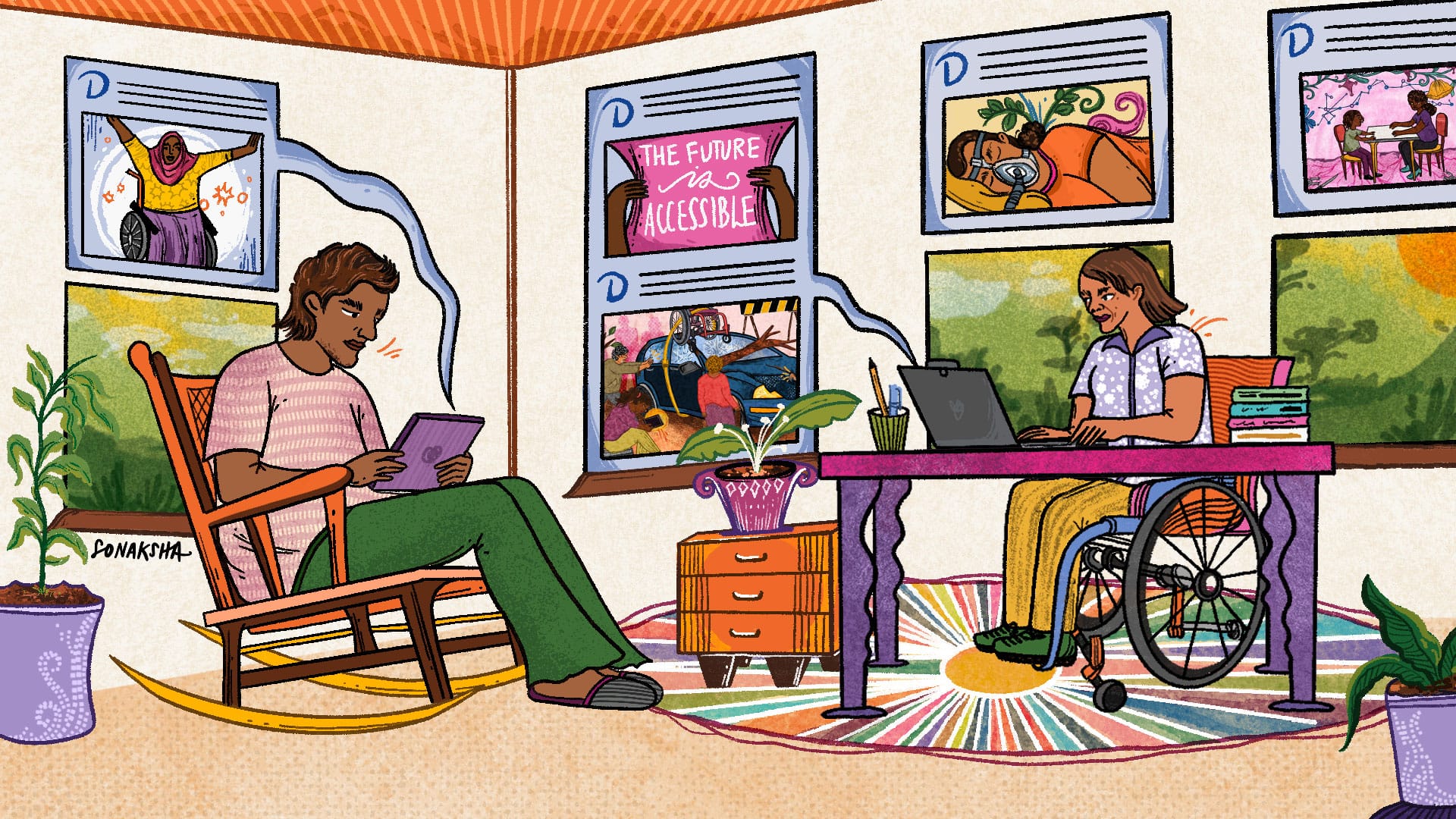
Thanks to Sonaksha for the portrait of Debrief readers, and to all of you who come back each week!
Thanks also to Celestine Fraser for help with this edition, and of course to all the readers and organisations who support this work.