Disability Debrief Annual Report 2025 - 2026
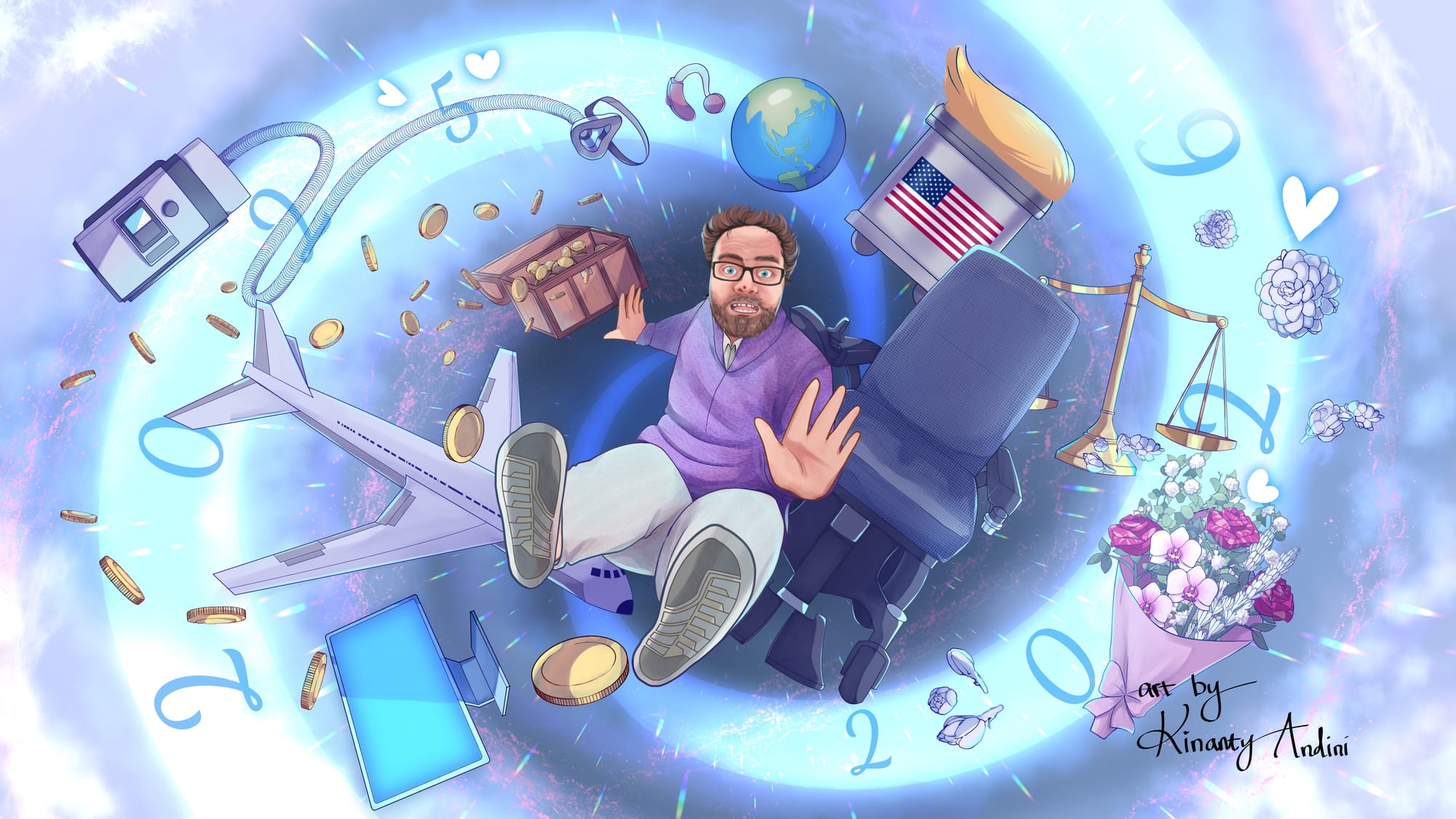
Weathering the storm
In an increasingly challenging context, the Debrief reported exclusively on disability in a changing world and served as a hub for a community reeling from cuts and backlash.
This period saw severe funding cuts across international disability work, and a newly-hostile context given the US-led backlash against diversity issues. And a challenging news and media environment saw increased news avoidance.
Despite this context, the Debrief continued to grow the audience for its work, secure more investment in disability media, and produce wider-ranging content from around the world.
And the Debrief did this on an annual budget of £106,659.
See also:
- The accompanying newsletter: Weathering the Storm.
- The accounts for the year.
- The previous year's annual report.
Help us continue this work
If you're comfortable to join those supporting financially, please contribute:
- One-off support of any amount.
- Subscribing, monthly at £5, £10 or £20, or annually at a discount.
See also information on subscribing as an organisation or, for amounts of $1,000 more, on making that as a charitable donation in the US.
Contents
Overview
- Over four thousand people now receive the weekly newsletter. Newsletter subscribers grew 14%, to 4,306, from 3,762.
- Tens of thousands of people visit the website each year. There were 30,100 unique visits, a decrease from the previous year of 4%, from 31,300.
- The audience is loyal and highly committed. 10% of subscribers contributing financially, as individuals or through their organisations.
- More resources were secured for making disability media. Revenue increased 17% to £106,659 from £91,395 the previous year.
- The Debrief increased its investment in unique writing and art. Sixteen authors were published from twelve countries, and a total of £15,174 was spent on commissioning work, a 23% increase from last year.
Back to contents.
What readers said
The Debrief is followed and trusted by leading figures working on disability. Here's what they said:
“A pleasure to read.”
Alice Wong, Disability Visibility Project
“Unique and essential.”
Hervé Bernard, Humanity & Inclusion
“I strongly recommend signing up to the Disability Debrief. It has lots of different perspectives and there's something to learn from every edition.”
Stephen Thompson, Institute of Development Studies
“Your newsletter has enabled us to keep up to date on disability world news, but also learn more about lived experiences and connect with organizations of persons with disabilities who could become potential partners.”
Nathaly Guzmán Figueroa, United Nations Population Fund (UNFPA)
“It’s rare that a media project aimed at policy is as endlessly readable as Peter’s.”
John Loeppky, writing at Disabled Journalists Association
“Disability Debrief offers thoughtful, global reporting on disability, policy, and power [...] Reading that kind of work makes my accessibility practice stronger and, honestly, makes my understanding of the world better too.”
Anna E. Cook, product design leader
Back to contents.
Content
The Debrief published exclusive reporting on disability in a changing world. This year it frequently covered the changes in the US, and provided a global context for the political, economic and climate changes transforming the world. For example:
- “This should not be happening”, by Gabor Petri, about lessons on how backsliding democracy curtails disability rights.
- A chainsaw to disability rights, by Eduardo Quiroga, on Argentina’s government is attacking disability benefits and the disability movement responding.
- We’re the ones that save ourselves, by Alessandra Sousa, on solidarity after the floods in Rio Grande do Sul, Brazil.
The Debrief published unique stories and narratives to explore diverse stories of disabled people in new ways. These included:
- Roots of belonging, by Nyuki Msimulizi, on the strengths and violence in Tanzanian culture and special education.
- You can’t pick palm nuts without your hands getting oily, by Alexander Ogheneruemu, coming to terms with Deaf community in Nigeria.
- Going off script, Celestine Fraser on moving through shame to find pride in disabled and queer identity
The Debrief provides one of the only spaces for dedicated reflection and hard conversations in the disability sector. We covered key moments in global disability work, including the Global Disability Summit, limitations of UN work on disability, and obituary of Alice Wong.
The Debrief hosted reflections and analysis from leading voices in the movement, including:
- We Wanted to Change the World, Alberto Vásquez Encalada on the risks professionalisation poses to an authentic disability movement.
- “You have to do something”, IK Ero reflecting on leadership after leaving the advocacy frontlines.
- “Without us, you won't move forward”, an interview with Luciana Viegas on the need to open the disability movement to black people with disabilities.
This role in holding (and being trusted to hold) hard conversations in the disability sector is reflected in the Zero Project inviting me (Peter) onto the main stage to bring a critical view on awards in the disability sector.
As well as these features, the Debrief continued its (also unique) curation of international disability news. The monthly curated news updates feed into the Library, which now contains over 7,300 from 172 countries.
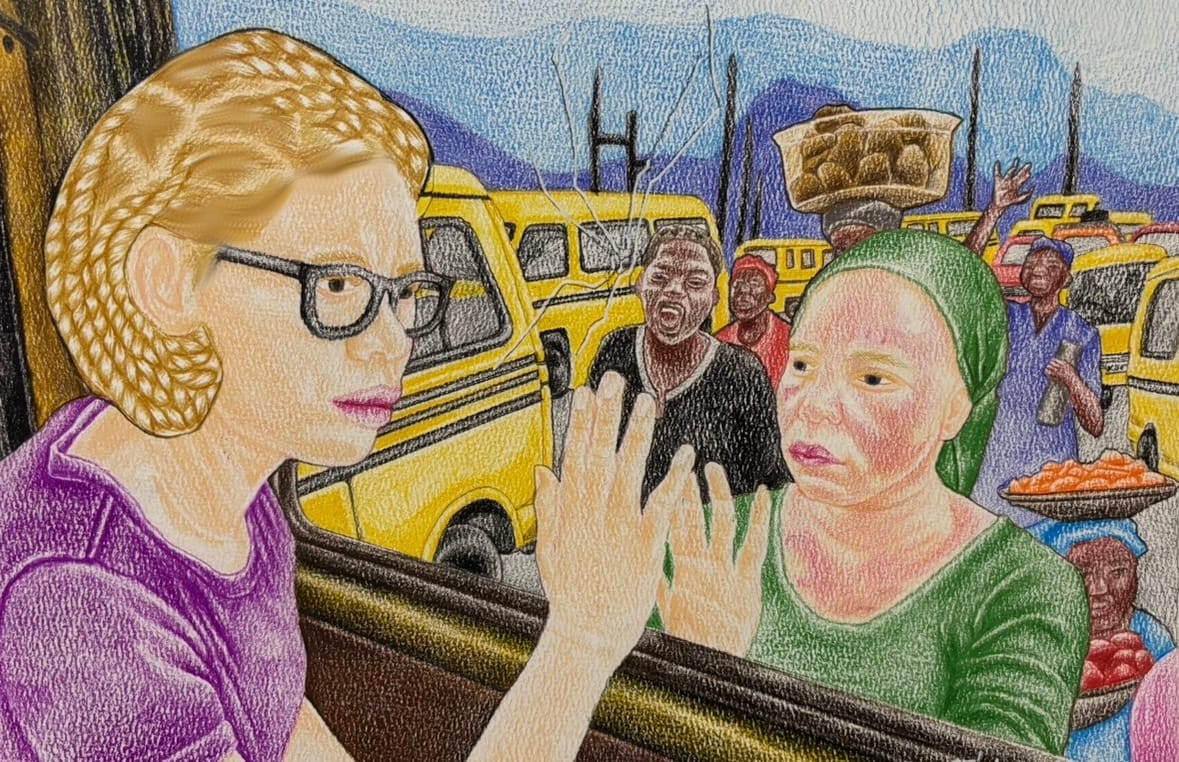
The visual component of the Debrief was consistently established. Every edition either had a commissioned-illustration or a press photograph. The majority of illustrations were made by Kinanty Andini in Indonesia, and artists from India, South Africa and the United States were also published.
Back to contents.
Audience
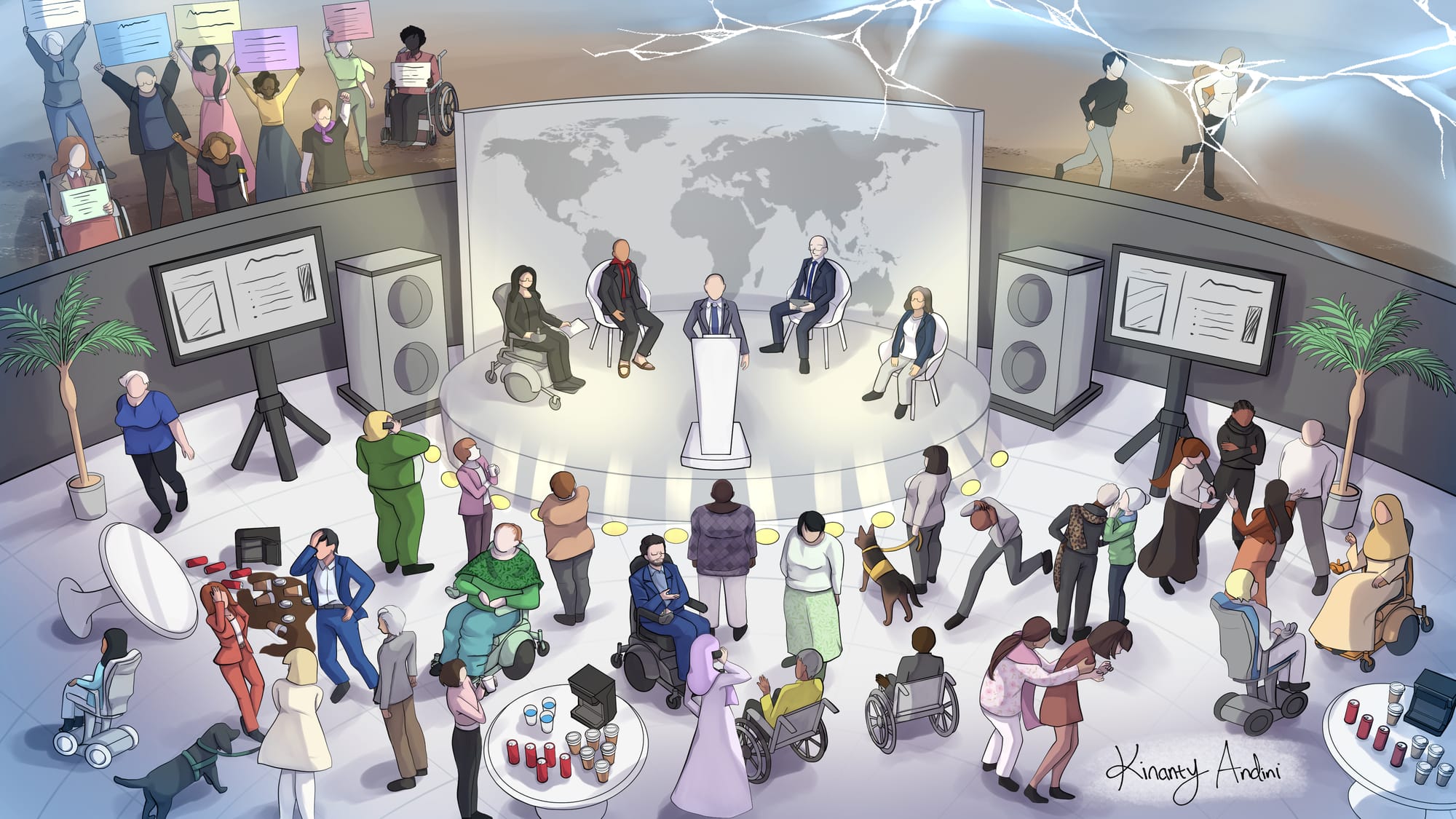
The Debrief continued as a weekly newsletter, publishing 44 newsletters in the period. 16 were written by authors other than me, who came from 12 countries. (An increase on 14 authors from 9 countries in the previous year).
The newsletter audience continues to grow, but growth is slowing. The growth of 14% was a slow-down on the previous year's growth of 36%.
Key sources of web-traffic decreased. Direct visits (people going directly to the link) are the main source of Debrief visitors online, and these increased by 36%. However the next three main sources all decreased: Google, down 19%, the newsletter itself, down 50%, and Linkedin, down 15%. (Despite a larger audience on Linkedin in this period.)
Wider trends show the same shifts in audience behaviour. Reuters Institute reports on record news avoidance. AI summaries limit visits from Google, and social media visitors are dropping for many platforms (a trend of some years). A couple of other disability newsletter writers report the same trends of growth plateauing.
A reader survey also demonstrates a shift in reader behaviour too. One of the telling results of the Debrief survey this year was that it had much fewer respondents than the survey in 2024: 40 people, compared to 132. This might be because many felt they had already shared in the previous survey, or I advertised it less prominently. But I get the cumulative sense of reader forms of engagement shifting.
Back to contents.
Behind-the-scenes

The Debrief had its first open call for writing. It received over 70 submissions coming from Kashmir to Peru. It published six of these entries and is currently working with two of those winners on further articles.
I recently did a stock-take on use of AI in Debrief work. Articles and illustrations are made without AI. However we do use it behind the scenes (especially in translation and some other operations work). And it’s complicated to navigate this with potential contributors, not all of whom appear to be transparent.
The Debrief invests in the wider eco-system of disability media. As well as spotlighting work and facilitating exchange, the Debrief invested £1,943 (2% of its income) into other writers, through micro-grants and subscriptions.
One of the recipients of a micro-grant from the past two years is Tanmoy Goswami from India, who said:
“The biggest gift that the Debrief has given me is the feeling of community and solidarity. I have been writing Sanity for 5 years now, and it can get really lonely. Having the Debrief in my corner makes me feel seen. It inspires me to stay true to my values as a creator.”
We continue to adjust the website, and with that, address accessibility issues. I was able to get further specialist help in a mini access audit, address a range of the limitations, and update the accessibility statement.
Some of the web accessibility issues are due to the underlying software. The Debrief uses Ghost, an open source publishing software and host. Our developer has started to make code contributions to Ghost so all sites using it can benefit from the fixes. (Sadly there does not seem to be a big appetite for this from Ghost, so in some areas we just did workarounds for the Debrief site).
I (Peter) am at the centre of Debrief work, with a growing set of collaborations. As well as collaborating with writers and illustrators, Celestine Fraser is providing more intense support (currently a couple of days a month). Cathy Sarisky helps adjust the web-theme, and Sarah Fossheim has helped review web accessibility issues.
I run the Debrief as a freelancer in the UK. I am registered as a sole-trader. Currently this is the most efficient model for a project of this size, where the largest expense is still my time.
Fiscal sponsorship is provided by Center for Inclusive Policy in the United States. Thanks to CIP we can receive grants from the larger funders and charitable donations from US readers.
Back to contents.