
How do I know if I'm being used?
Dear Debriefers,
Since I was a child, I’ve loved traditional advice columns for their heartwarming stories of real people, and the opportunity to see the world through somebody else’s eyes.
But I was always left with a prickly-hot feeling that people like me were never featured. Now I have words for this feeling: exclusion, lack of representation, ableism.
As an undiagnosed tween, I was given the impression that my problems were too complicated, too agonising, too problematic even to be mentioned. My wordless shame was confirmed at every doctor’s appointment, by every teacher, and every “friend”.
It wasn’t until I started sharing my story online that I realised I am not as alone as I thought. Through creating online spaces for the disability community, it became clear how many people experience the same problems without the words to express them. The absence of stories like ours is a symptom of systematic oppression.
Our isolation is not inevitable. This edition introduces my new advice column Dear HB. I am an agony aunt… in constant agony, and sharing the advice I wish I'd been given myself. Today I'll be answering questions exploring friendship, dating, mobility aids, and beyond.
If you have a question you'd like answered, send it to me here.
About this edition
Disability Debrief can write from a disability perspective thanks to support from readers. Thanks to Brendan, Genevieve and Disability Rights International for new contributions.
Blossom (HB) is a disabled writer from England, and creator of Tea with HB and Poetry Orchard.
Kinanty Andini is an illustrator and digital artist from Indonesia.
How do I know if I'm being used?
Dear HB,
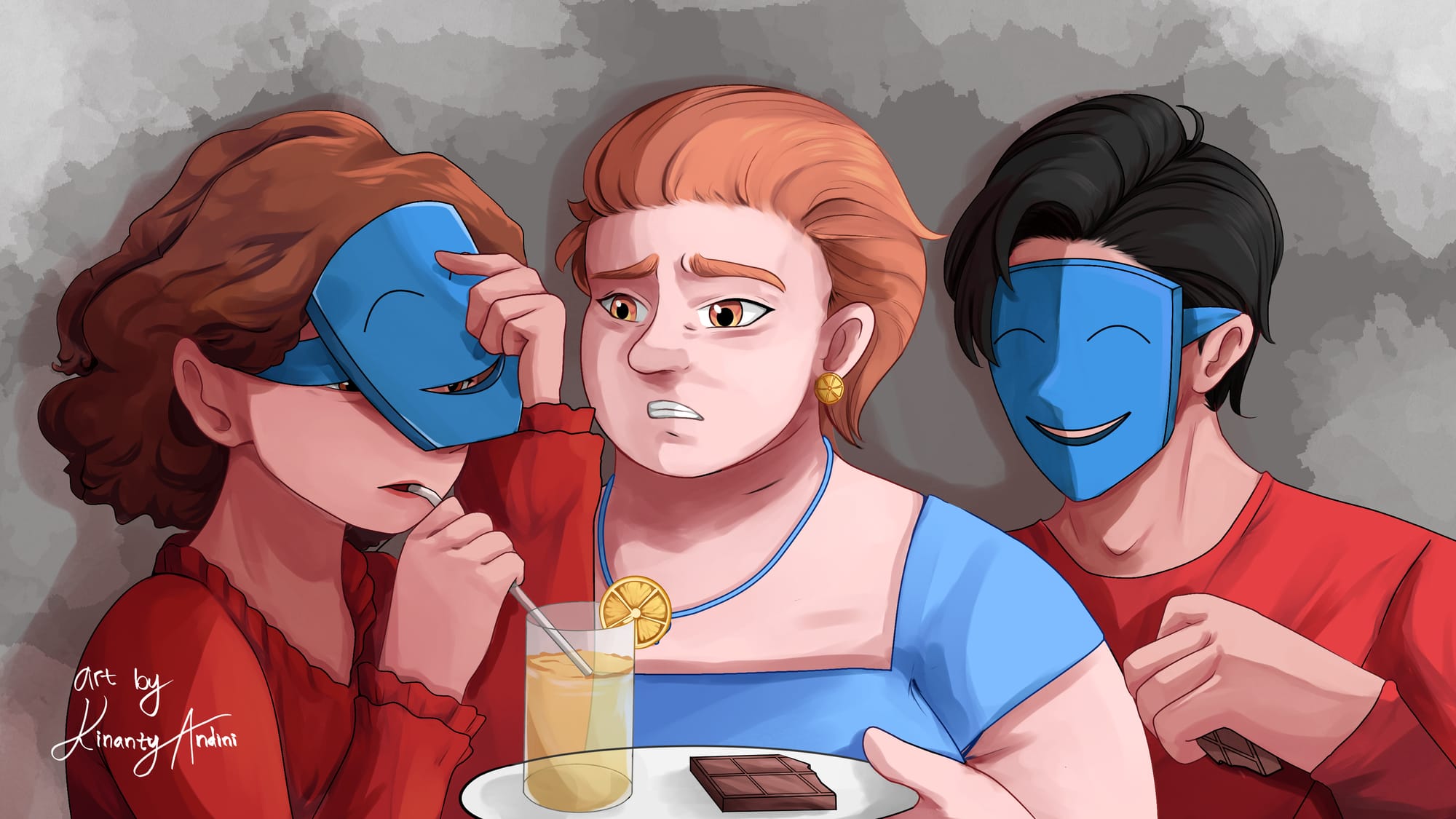
As a young autistic woman, how can I figure out if someone is using me or if they are genuine? I don’t want to go around being bitter and not trusting anyone but it is so hard to keep getting hurt like this. – Young and Bitter
Dear Young and Bitter,
Some of the best things in life are bitter: dark chocolate, fresh lemonade on a hot summer day, or that hit of coffee on a groggy morning. But they do not have a choice about being bitter. We do.
Bitterness comes for us all at one point or another. It is good to acknowledge, as it can guide you how to treat others, as well as how you would like to be treated. But that doesn’t mean you have to embrace it as a lifestyle.
I am a golden retriever, bounding up to people seemingly care-free, I truly can’t help it. “Everyone is a friend!” …until they’re not. Some days I long for bitterness, after all, couldn’t it protect me from a multitude of malice and pain?
But I think it would also prevent me from the deep joy in finding kindred spirits. I am not willing to sacrifice that. Are you?
Regardless of how many times you have been hurt, it doesn’t mean it was your fault. It doesn’t mean you have to change. It means someone chose to be unkind, and that says more about them than it ever could about you.
You could make a list of non-negotiables in your friendships, things that have happened in the past that you know should not be repeated. Make a list of some desirable qualities too! The friends you need are those who make you feel good!
There are a few questions I try to ask myself when I am around new people: How do I feel? Do they bring out the best in me? Do I feel safe? Is my nervous system dysregulated during or after hanging out with them?
You will never know if someone is using you until it is too late. It is not on you to figure it out. Be yourself, and trust that this will attract others like you.
Love,
HB
My date jokes about switching off my life-support
Dear HB,
I’m super new to the whole dating-with-a-disability thing and I had a really bad flare up recently that caused a lot of injuries. In an effort to keep serious topics light on dating apps, one of my prompts is “Believe it or not I died once!”
I went on a date where this guy commented on it, saying it seems like I get injured a lot. I told him that I was in the ER 4x in two days, and he responded “No offence, but if I was the ER doctor I would have pulled the plug.”
My first instinct is to gloss over it and try to take it as a joke, a throwaway comment, but then I was like, y’know what, actually, that was a really hard time for me! So I am proud of myself for telling him it wasn’t okay, and he did apologise. Now I am wondering if I am being too harsh… my instinct is to write him off but should I give him another chance?! – Dying to Date
Dear Dying to Date,
Plenty of disabled and chronically ill people use dark humour as a coping mechanism. I don’t know where I’d be without threatening to run away and my mother responding “with what legs?” Nevertheless! It is important it is on our terms, and from people who know our boundaries.
I am glad you got an apology, and even more glad you had the confidence to communicate your discomfort. Whether or not it is a throwaway comment matters less than how it made you feel – especially when it comes to romance!
Women are often told we are overreacting and conditioned to put our needs last. This might be why you are doubting your gut instinct and feeling like you are being “harsh”.
Your date took the joke too far. He might genuinely have found the concept of switching off life-support funny, or bad humour might be how he deals with someone opening up to him. Either way, the plug needs to be pulled on this relationship. Trust your gut!
Love,
HB
“Why am I pretending I need this?”
Dear HB,
I feel like an imposter for using a cane. I just feel like I am able to walk and as I use it I can’t stop thinking “why am I pretending I need this”. Rationally I do think it might actually help me on a long day. But I feel like an impostor trying to be disabled. I just don’t feel disabled enough. Am I still allowed to use a mobility aid when I don’t need it all the time?? – Imposter with a Cane
Ohhhh, dear one, how I feel this!
I was 17 when I first started using a wheelchair. Not the kind of puberty you expect! I thought I was finally giving up. This was it. I’m trapped. Wheelchair “bound” and I can’t even use it by myself.
Surely I need to wait until my legs stop working completely? When will the police catch me? Lock me up for taking it away from someone who “really” needs it.
But I was missing school and sick of bed being my only option. So, I gave myself a thought experiment: What is the worst that could happen if I really am faking it?
Maybe I have a bit more energy at the end of the day. Maybe somebody sees me who does need it and feels able to try it for themselves. Maybe somebody meets me and their stereotypes and assumptions about disability are challenged, and the next person they meet who is “truly” disabled won’t have to spend their energy educating them? Maybe my legs will hurt… less. Maybe, just maybe, this could give me my life back?
It did. Using a mobility aid gave me freedom, and confidence, and a whole new hatred for English cobblestones.
A common phrase passed around our community is “If you are thinking of using a mobility aid, that is the sign that you need one!”. Because that would not cross the mind of someone who has never had their body let them down.
As disabled people we are made to feel awful for needing “more” but this is only because our needs are not automatically met like everybody else. I don’t know of any truly disabled people who have not had this internal battle. So if anything, these complicated, vicious cycles are more evidence that you are not an imposter.
We need to expand our definition of “need”. Are you allowed a sweater even though you might take it off when you get too hot? Are you allowed a mobility aid “just” because it will help you sometimes? Yes, my love.
There are no requirements necessary. These resources are not finite, in fact it is quite the opposite. Providing demand for access means more places will realise it is needed.
And a stick has many more uses than helping you walk, it is a distinguished accessory, a self-defence tool, a cat-pointer-outter. Go forth and swing that cane!
Love,
HB
How do you ask for help without feeling guilty or embarrassed?
Dear HB,
I need to work on ways to ask if anyone will give up an accessible seat for me. Even when I use a walker or wheelchair, people don’t notice on their own and I have to ask them to do things like move their bag or stop manspreading across 2 seats. They probably wouldn’t give me a hard time but I don’t know how to just announce my need to, say, a bus full of people? How do you ask for help without feeling guilty or embarrassed? – Helpless on a Bus
Helpless on a Bus,
I’m no stranger to asking for, and being denied help. I asked for help repeatedly when I first became ill as a child. Instead, shame was instilled in me for expressing my needs.
“Do you mind carrying my bag for me?” It’s lunch time and my shoulder has just subluxed. That means leaving its socket in an undecided sort of way.
“What do we get in return?” My so-called “friends” laugh derisively. My bag, new, a gift from my mother, is now dragging along the horrible school tarmac, its beautiful pattern being marked irreparably. I can still feel the sting in the centre of my chest, the all too familiar misunderstanding of how this world apparently works, the disappointment.
My own answer to this question became avoidance. Simply, don’t ask. I would sublux at a birthday party, and hold in my scream. I would walk back carrying my bigger-than-I-was school bag and collapse on the concrete ten minutes from home. I masked my pain for so long that I lost my identity.
If you are disabled, you are not only comparing yourself to other people, you are comparing yourself to a standard that was not designed with you in mind. You are forced to feel like you are asking for exceptional treatment when you have no other choice. Asking for help needs a prepared justification, armour on for the battle ahead.
Until you realise: You need not justify! Ask with confidence and explain as little as possible, you don’t need to share your medical history with every stranger to be given support. Giving yourself permission to ask without explanation changes everything, and saves a lot of time.
I tried to get comfortable with embarrassment, and to… befriend! my guilt. I decided that I could not be embarrassed or awkward without first consenting to it. I practiced asking for help and made a note of every time it went well.
“Please tell the driver to put the ramp down at the next bus stop” six strangers leapt to it!
“Could you reach that for me please?” a laugh is exchanged in a supermarket, an interaction I would never have had otherwise.
“Has anyone else struggled with x?” I ask on social media, and dozens of people all over the world send stories of solidarity and wisdom.
I wondered how I would want someone to feel if they asked me for help, and channelled that. Rather than internalising guilt and shame from being denied help, I chose to feel sorry for those who weren’t interested in helping me. How lonely! What a missed opportunity for connection.
From being an “invisibly” disabled child to using a wheelchair now, here’s something I want you to know: In public, outside of school and hospital, I have never been denied help by a stranger. Maybe some funny looks, sure, maybe a comment that was unnecessary.
People love to help. Asking for help is not weak, or embarrassing, or wrong. It is brave, and it reminds others that they too are safe to ask, and be helpable, when they need to be. We all need to be.
Love,
HB
Outro
Blossom is creator of TeawithHB.com, a movement for social equity through storytelling and authentic disability representation, and co-founder of PoetryOrchard.com, where she runs inclusive, intersectional, online creative writing workshops and Open Mics. Send her further questions here.
For more from Kinanty, see her website.
Further reading. There is a back catalogue of Debrief newsletters online, as well as a library of disability news from 170+ countries.
Let your friends know. Sharing the newsletter is how people find it!
Connect. Get in touch. And you can find the Debrief on Linkedin and Bluesky.
Help us do more. The Debrief is free thanks to reader support.
Acknowledgements
Thank you to Peter, for the opportunity to bring this years-long project to life and for his editing skills, Kinanty Andini, for illustrating this piece, and to my Tea with HB communi-tea, who shared their stories and allowed me to publish them in the hopes it helps just one other person feel less alone.
Thanks also to Belinda, Michael, and Patrick, for igniting the “agony” aunt idea and giving me endless support and encouragement. Special thanks to everyone at Poetry Orchard, you know who you are!
And, of course, thanks to the readers and organisations whose presence makes the Debrief possible, it is thrilling to be part of this incredible project.