
Listen and smell intently
Dear Debriefers,
Today's edition shares my favourite quotes from the past months of disability reading.
We've got blind cats, Braille Playboy, and governments abandoning disabled people. And the history of disability rights, plus a wedding conducted in sign language in the sixteenth century.
There's inspirational stories (and the problem with them), North American elevators (and the problem with them), and more in an edition that goes to the moon and back.
About this edition
Disability Debrief is funded through a pay-what-you-can model. With thanks for new contributions to El, Rosemary and Thomas.
Peter Torres Fremlin is editor of Disability Debrief and is from the UK.
Kinanty Andini is an illustrator and digital artist from Indonesia.
“Listen and smell intently”
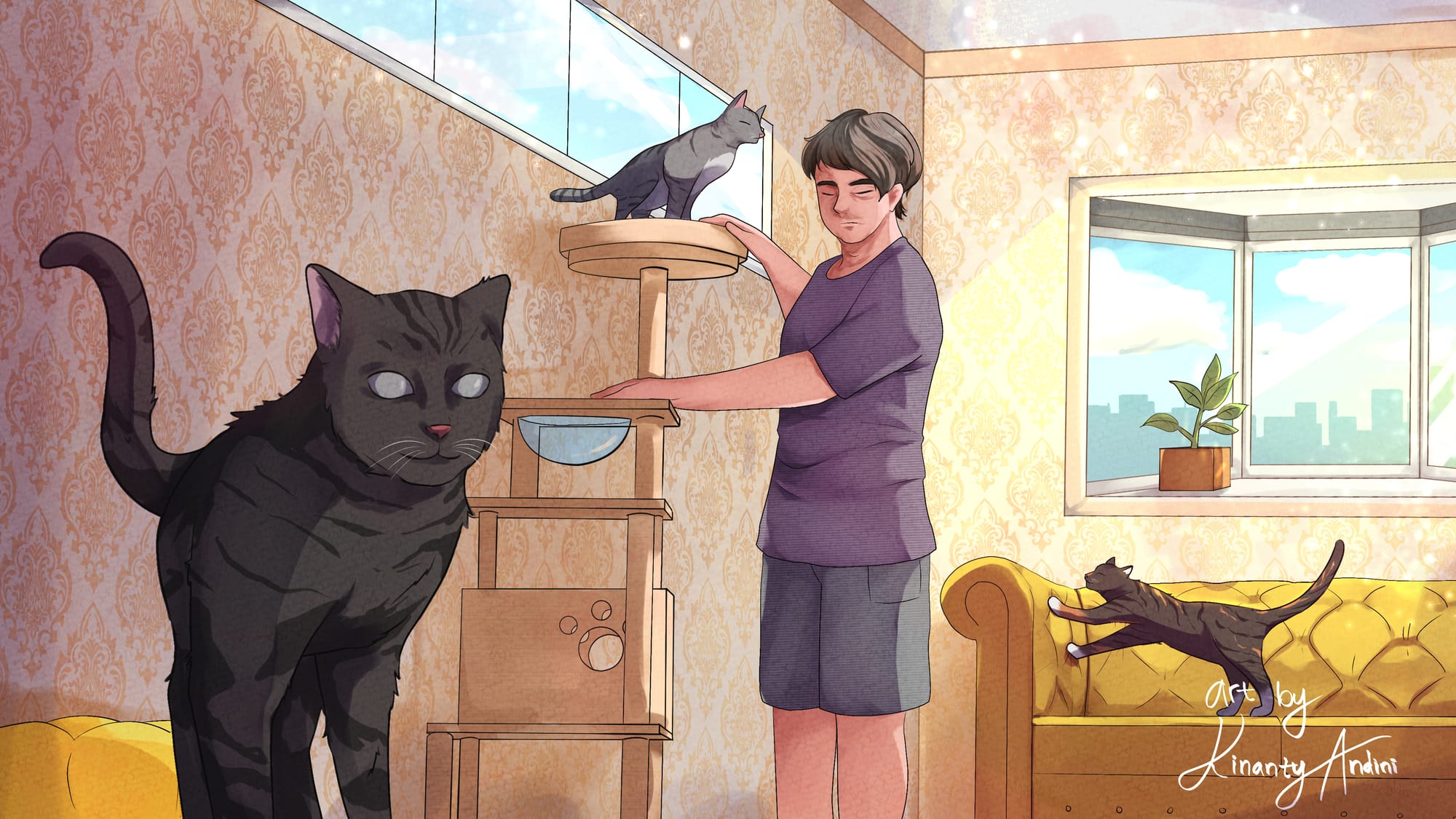
In the United States, Paul Jaeger writes about his family, which includes: “three blind cats and one visually impaired human”. He shares how the adaptations he makes in the house for himself (like keeping things consistently placed) also benefit his cats, and the other parallels they have in navigating their disabilities:
“Grace and I navigated through the world in very similar ways: use memorized paths to walk, count steps, listen and smell intently to orient, and use hands/front paws to find something familiar when disoriented. When she encountered something new, Grace examined it thoroughly with her paws and her nose. The main difference between us was that she also scent marked the furniture to help her find it. Cats have those extremely useful whiskers and a much more pronounced sense of smell than humans, which seems to make them better prepared to live without sight.”
“Undesirable activities”
Over on the Accessibility Apprentice, Kristian writes about making sex accessible. He shares how in the US the National Library Service for the Blind and Print Disabled collection included, for over a decade, braille editions of Playboy magazine. (With the articles, no advertisements or photographs.)
However, back in 1985, a group of Republican politicians led a debate to cut funding for this, with one congressman justifying a cut of support by saying:
“I believe that promoting the reading of Playboy in this way does lead to undesirable activities.”
A contemporary report from the Los Angeles Times condemned this view in terms of freedom of speech:
“That is the pious cant of born censors. Censorship and discrimination by Congress are activities much more undesirable and far-reaching than any inspired by Braille editions of Playboy.”
A federal court agreed with the LA Times, and overturned the Senate funding cut on grounds of the first amendment, which guarantees free expression.
“An era of sickness caused by political choices”
Last year, Disability Rights UK responded to the government's budget with harsh critique of lack of investment in public services:
“We are living in an era of sickness caused by political choices. Many are getting more ill under the weight of poor working conditions, inadequate incomes, precarious housing and overstretched health and social care services. The fault for this lies squarely at the feet of successive governments who have chosen profit over people.”
Also last year, Tressa Burke, CEO of Glasgow Disability Alliance shared similar sentiments when she turned down an honour from the government for her services to people with disabilities:
“I feel that I cannot accept a personal honour because disabled people are being so dishonoured at this time. In fact we are being demonised, dehumanised and scapegoated for political choices and policy failures by consecutive governments.”
Meanwhile historian Lucy Delap, who has written on the Debrief, shares that this position from the government is nothing new:
“The UK state has a history of creating and amplifying disability stigma. Politicians have regularly stoked public fears of disabled people, through talk of shirkers and scroungers. Lower-level officials have casually and harmfully judged, ignored and discriminated against disabled people.”
“Because of their sacrifices”
In the United States, Alex Green interviewed Bob Williams on his decades-long activism on disability rights. Looking back at the way the Americans with Disabilities Act (ADA) came to be, Williams said:
“[There] are many stories about how and why the Americans With Disabilities Act (ADA) was enacted that are barely known. The main narrative is that in the 90s, disabled folks brought it about ourselves.
“That is understandable, though also ahistorical, like much of our culture today. It obscures, if not completely erases, the fact that disabled people, especially those deported to institutions and other hell holes, have been abused, killed, violated, and forcefully silenced throughout our history. It is because of their sacrifices that we have the law, that we have the laws we have, and that we must persist.
“Another thing that should be built on is that everything we did to gain passage of the ADA, we did in unison with the wider civil rights, women, faith, sexual identity, and labor communities. Whenever we met with Senate and House members, we did so in unison. When we strategized and made tough judgment calls, we did it as a coalition. When we celebrated a victory or lamented a setback, we joined together. Not just because there is strength and wisdom in numbers, but because we knew that the ADA has to be about justice for all.”
“A fairy tale”
In India, the popular understanding of the path of disability rights is also questioned, by Vijay K. Tiwari, Sanjay Jain and Shrutika Pandey. In their article on Maharashtra State's questioning of employees with disabilities, they write:
“The history of the disability rights movement in India is a history of modest victories alongside some crucial setbacks. However, in recent years, mainstream historiography has valorised these victories to such an extent that it appears as though India is firmly on a progressive path of disability discourse that cannot be reversed. This belief resembles a fairy tale. As if at a time when several minority groups have faced violent ‘othering’, bulldozer justice and the force of authoritarian politics, middle-class, apolitical disabled persons have been able to secure certain rights through the instruments of liberal legalism.”
“Took her by the hande”
Leicester Cathedral, in the UK, has shared the certificate of a wedding in 1576 that was conducted using sign language. The groom, Thomas Tilsye, was deaf, and used sign in his marriage to Ursula Russel. The certificate records that “for the expression of his minde instead of words”:
“First he embraced her with his armes, and took her by the hande, putt a ring upon her finger and layde his hande upon her harte, and held his hands towards heaven; and to show his continuance to dwell with her to his lyves ende he did it by closing of his eyes with his hands and digging out of the earthe with his foote, and pulling as though he would ring a bell with divers other signs approved."
For more, see Rosamund Oates who contextualises the wedding in an article on the history of sign as a legal language.
Disabled with a capital D
In the United States, the Disabled Journalists Association (DJA) capitalises the word “Disabled” in their coverage. Founder Cara Reedy explains why:
“It is a political choice, absolutely, as are most things in journalism and I think that because DJA is a disability-justice organization, we capitalize it because we value being Disabled as an identity. Just like I value being Black and capitalize Black, just like the Associated Press does.”
“What I hoped for was for people to listen”
At the end of last year, Giles Duley completed his term as the first UN Global Advocate for Persons with Disabilities in Conflict and Peacebuilding Situations. He left with a stark message:
“I did not expect in my three years here for everything to change. What I hoped for was for people to listen – and that’s where I feel I failed, and that’s where I feel the system failed.”
Even in his role as a global advocate, people preferred to hear him tell his story, and be an inspiration himself, rather than share the stories of those with disabilities he had seen on the frontlines of conflict.
He warns that stories around disability are still “too often romanticised”, and that the inclusion of people with disabilities is symbolic, rather than substantive:
“I have been to many conferences where on stage there will be somebody who is a landmine victim or a survivor of sexual violence… and again and again it’s performative. Everybody clapping, everybody saying ‘I’m really inspired’… but how often do those people then get involved in the conversation about true policy change?”
Sitting on a gold mine
In Switzerland, Debrief-favourite Malick Reinhard also reflected on influencers with disabilities able to monetize their inspiring stories. He pauses, and wonders what that might mean for him:
“I look down at my own electric wheelchair. I take stock of my six wheels, my ‘lived experience’, my administrative hassles, and my stacks of medical files. And I can't help but wonder: am I sitting here, without knowing, on a gold mine?” (Translated from French)
“I didn't feel like a poem”
I'm turning 40 next month, and appreciated Rebekah Taussig's beautiful reflections on the same milestone. Taussig, writing from the US, shared what her body has found out:
“13. The limitations of a body can be a creative prompt, like the edges of a poem – what comes out when you are only given the space of seventeen syllables in three lines of five, seven, five? Something distinct from a novel or even a sonnet, and no less beautiful for the narrow parameters.
“14. And also, when I fell on the bathroom floor and reached for the side of the bathtub, then the edge of the toilet, then my wheelchair frame, trying to hoist myself up and couldn’t, I didn’t feel like a poem. Micah was there in a few short moments. Silent and sturdy, he lifted me up. I felt like deadweight. I felt safe. I did not want this. And this was where we were. The limit of sharpening edges can fortify love and shred your skin like a cheese grater.
[...]
“17. There is a reason people are petrified of aging. Old age often comes with new limitations – in our bodies and choices – and it reminds us that one day we are going to die. Hello, that is hard! Even as it can, and often does, include new beauties and depths, even as we can imagine delicious new ways of being, it makes sense that even the most ordinary aging would sometimes invite a kind of grief.”
A whole authentic self
Also in the US, Meier Galblum Haigh writes about how the war on Trans Folks is Disabling. They share their own story about growing up disabled:
“I came out as nonbinary and transgender at 32 years old. I was so worried about survival as a chronically ill disabled person for much of my teens and twenties that I didn’t have the time, energy, or emotional bandwidth to think about a whole authentic self. It nearly killed me. As I made a transition from invisible to visible disability in a period of intense illness, therapy let me examine the cost of every closet I was in.”
“To unlearn the blame”
In New Zealand, Soph Jackson shares her choice to identify as disabled after being diagnosed with ADHD and autism:
“My life had been shaped by these conditions. I know a lot of ADHDers and autistic people (along with others with mental health conditions or sensory/cognitive/intellectual conditions) struggle with the idea of claiming disabled identity. For me, it was obvious. To unlearn all of the blame I had put on myself, my mind and my body, I had to also accept that a lot of my struggle had come from being unsupported, and living in an inaccessible world.”
Learning curves
In the US, Yewande Komolafe shares how losing her limbs made her a different kind of cook:
“Our learning curves are steepest when the skills we’ve leaned on all our lives have been swept out from under us. I’ve had to set my faith in my physical body aside, focusing on the skills I do have, and consigning to the future the skills I must relearn, like how to whisk a bowl of cream to milky soft peaks with prosthetic hands.”
Not-in-my-backyard effect
In Germany, Verena Bentele, president of the welfare association VdK tells Robert Bosch Stiftung about how social acceptance and discrimination of/against persons with disabilities both exist at the same time:
‘The discrepancy can also be explained by the "not-in-my-backyard effect." This describes an attitude where people generally support certain social measures or projects but don't want to tolerate them in their own neighborhood or immediate environment. Socially, the participation of people with disabilities and their equal treatment is often fundamentally supported. However, when it comes to establishing housing, support, or care services locally for them, they encounter resistance in the immediate neighborhood. Many then suddenly don't want guests with disabilities in restaurants, don't want changes to their residential environment, don't want children with disabilities in their own children's school class, or don't want support so that someone can participate accessibly. Although many people fundamentally accept that people with disabilities need social support, they reject corresponding measures in their environment because they fear personal or social disadvantages.’
“North America kind of sucks at elevators”
On YouTube, About Here and Sightline Institute have a feature on North America's Elevator Problem. They share how costs and building codes mean that the US “has the lowest number of elevators per capita in the developed world”. And they put this in context of the elevator as “a core part of a city's infrastructure”:
“At the end of the day, elevators are an essential part of our cities. They're really what makes our modern city today possible. But more importantly, they make our cities accessible to anyone regardless of their age or ability. And as our cities grow, they will only continue to become more important in the future.”
Meanwhile, in Sweden, Tanzila Khan reflects on how a broken elevator shows her the differences between accessibility in Sweden and Pakistan:
“[In Sweden] the elevator is there, fantastic, it's big enough, I can get on it, I've done that so many times. But there are times when it's not working. Do I automatically start relying on [society's goodwill]? That's not how society in Sweden is built. Probably it's applicable in Pakistan, you can ask a couple of people, they'll come, lift you up, take you left, right, wherever you want to go.”
“I don't want to go to the moon”
The beauty of the Artemis II mission, and its photographs from the far side of the moon, reminded me of a moment from my studies in Brazil.
One of the first events I went to as a researcher was a small manifestation. A wheelchair user pointed to the busy highway next to us and said, “não quero ir a lua, só quero atravessa a rua”. I don't want to go to the moon, I just want to cross the road.
All best for your journeys big and small,
Peter
Outro
Further reading. There is a back catalogue of Debrief newsletters online, as well as a library of disability news from 170+ countries.
Let your friends know. Sharing the newsletter is how people find it!
For more from Kinanty, see her website.
Connect. Get in touch. You can find me on Linkedin and Bluesky.
Help us do more. The Debrief is free thanks to reader support.
Acknowledgements
Thanks to Kinanty Andini for the illustration. And to the readers and organisations whose support makes the Debrief possible.