Our seat at the table is a bed
Dear Debriefers,
Warm greetings from cool Glasgow.
As a reader what I love about the Debrief is the space it makes for people to write about experiences that are rarely represented in mainstream disability advocacy.
I’m grateful for the chance to do the same, by sharing my experience of life with chronic illness and offering some new ways to talk about the fatigue that defines my condition and many others.
Fatigue is a debilitating symptom for people living with a whole range of health conditions and impairment types. It’s poorly understood, and its devastating impact is often disbelieved or dismissed. The world pays us little attention, and the disability establishment isn’t much better.
A few years ago, some of us began using the terms “energy limiting conditions” and “energy impairment” to better describe our experience. These new labels help us connect with each other across our different underlying health conditions. They also help us to advocate for ourselves, and to imagine a future of disability advocacy that includes us.
About this edition
Original writing like this is made possible by support from readers. Thanks to Lisa for a new contribution.
Anna Ruddock is a writer and researcher living in Glasgow in the west of Scotland. She is the founder of Equitable Health Futures.
Kinanty Andini is an illustrator and digital artist from Indonesia.
In a box
I’m in a box without a lid. A cube. White walls. Temporary. I’m in the box because I need a rest.
Someone has tried to make the box comfortable, which is thoughtful. It contains a few chairs, some cushions, and a sort of sofa pushed against one of the walls.
A man is lying on his side in the centre of the space. Other people sit on the chairs or attempt to get comfortable on the backless sofa. Everyone else is on the floor, resting against the temporary walls.
Many people wear headphones. Some scroll on their phones. A couple of people gaze blankly at the carpet, and several have their eyes closed.
There’s a shuffling when someone vacates a chair. We glance around at each other, wondering what the etiquette is and whether to claim the seat.
Each time a new person enters the box, they pause, confused, as they register the gaping space where a ceiling should be. Some leave. Some find space on the floor.
This is the “quiet room” at the Global Disability Summit. A space for rest in the midst of a massive gathering of people in a vast, echoing space.
But we can’t rest here, because the box has no lid and stimuli pours over the sides in carbonated waves that dazzle us and break against our bodies.
Thirty years of doubt
I need a rest.
I have lived with ME (myalgic encephalomyelitis) for thirty years, but I’m still learning how.
How to stop before a warning tremor escalates into a destabilising shudder. Before the vague stuffiness in my head gathers into a nauseating pulse, jagged nails gouging fresh bruises. Before deep ache settles in; my blood starts fizzing, my senses panic and my comprehension fails. Before a grey veil descends and I fall out of linear time.
I need a rest from thirty years of doubt about my bodymind: about what hurts, what depletes, and what soothes. Doubt originating with doctors; adopted by teachers, friends, employers; amplified by media; absorbed through pores until my own bones question their existence.
I need a rest from feeling guilty when I’m too ill to function and guilty when I’m well enough to dance.
And I need a rest from a disability establishment that does not acknowledge my experience or the community of people that share it.
In the wake of a virus
I am one of millions of people around the world who live with the consequences – the disruption, the disharmony – of a viral infection that our bodies have never entirely recovered from.
The sheer scale of the Covid pandemic has led to a new scientific interest in long-term illness as a consequence of infection. When hundreds of thousands of people fail to recover from the same virus, some concerned and curious minds are bound to pay attention. (As are the charlatans and the gaslighters).
New scientific interest brings hope of more informed healthcare professionals, and even of future treatments. Seeing our stories in the media brings hope that greater awareness will lead to more compassionate attitudes.
But medical research requires patience, and in the meantime the media’s attention has largely moved on, both reflecting and informing a public desire to believe that the pandemic experience is behind us. In 2030 we will no doubt see a flurry of stories about people who are still ill ten years later.
For now we are an impairment community that is at best ignored, and at worst, invalidated by medical and political power. This disregard echoes through the media, public discourse, and many of the organisations that advocate on disability issues internationally.
But we are here. We were many before 2020, we are many, many more since Covid, and future viruses will leave more of us in their wake.
“Are you getting enough sleep?”
Language has not served my people well. For a long time, we lacked the words for our worst symptoms. The adjectives we used – “tired”, “exhausted”, “fatigued” – are shared with non-disabled people who don't share our experience.
We are used to dismissive responses:
“Everyone gets tired.”
“I’m exhausted too.”
Or well-meaning responses that misunderstand the complexity of pathological fatigue:
“Are you getting enough sleep?”
“Have you tried yoga?”
Some people use metaphors – treacle, sand, concrete, fog, batteries, spoons – but these fail to convey the reality of a whole system fatigue that leaves a person unable to move.
Everyone does get tired. Life is tough, and exhausting, for most people. But our impairment-associated fatigue is specific. People who are generally well don’t experience it, even when they are very tired. Their exhaustion doesn’t ring an alarm throughout the whole body, triggering pain and inflammation, cognitive dysfunction, insomnia and fear. It does not defy rest.
Misunderstood by medicine
Few medical professionals understand fatigue and they are not trained to view it with compassion. Nor are they taught to be at ease with their own unknowing.
Biomedicine does astonishing, life-rescuing things. But it is a poor listener, and it would rather dismiss and undermine than admit ignorance.
In doing so, it abandons people it cannot explain through its tests and scans. It disregards our testimony, undermines our sense of self, and casts us off, adrift and isolated.
We have long needed new ways of describing our conditions. Both to connect us with each other, and to advocate for ourselves in the world.
Our own words: Energy Limiting Conditions
From 2017-2020, a disabled-led research project in the UK explored the lives of people with chronic illness. I was invited to join the research team to help analyse the data.
Project participants had different health conditions, but found they shared a common experience of debilitating fatigue – both physical and cognitive – that was misunderstood and often dismissed.
Central to this shared experience of fatigue is “payback” or “post-exertional malaise” – the painful flare-up of symptoms after a person expends too much energy. This could be doing a day of work or it could be walking to and from the bathroom. Payback can lead to a serious relapse of a health condition and may take weeks, months, or even years to recover from.
In focus group discussions, participants talked about energy: the lack of it, the inability to replenish it, the unpredictable ways in which it fluctuates. They agreed that the terms “energy impairment” and “energy limiting conditions” (or ELC) effectively described their shared experience, and had the potential to challenge the stigma and disbelief they faced when they spoke about fatigue.
We define energy limiting conditions as long-term health conditions in which debilitating fatigue, or what we call energy impairment, is a primary symptom. These are imperfect terms to describe an impairment experience shared by people who have different diagnoses and for whom a lack, or rapid depletion, of energy is a debilitating part of daily life.
We offer “energy impairment” as a capacious concept with room for anyone living with this type of disability. It is increasingly being adopted across a wide spectrum of diagnostic categories, beyond infection-associated illnesses (science is catching up with this shared experience, too). It is becoming a language of solidarity: a thread of shared experience woven through difference.
Overlooked by the disability establishment
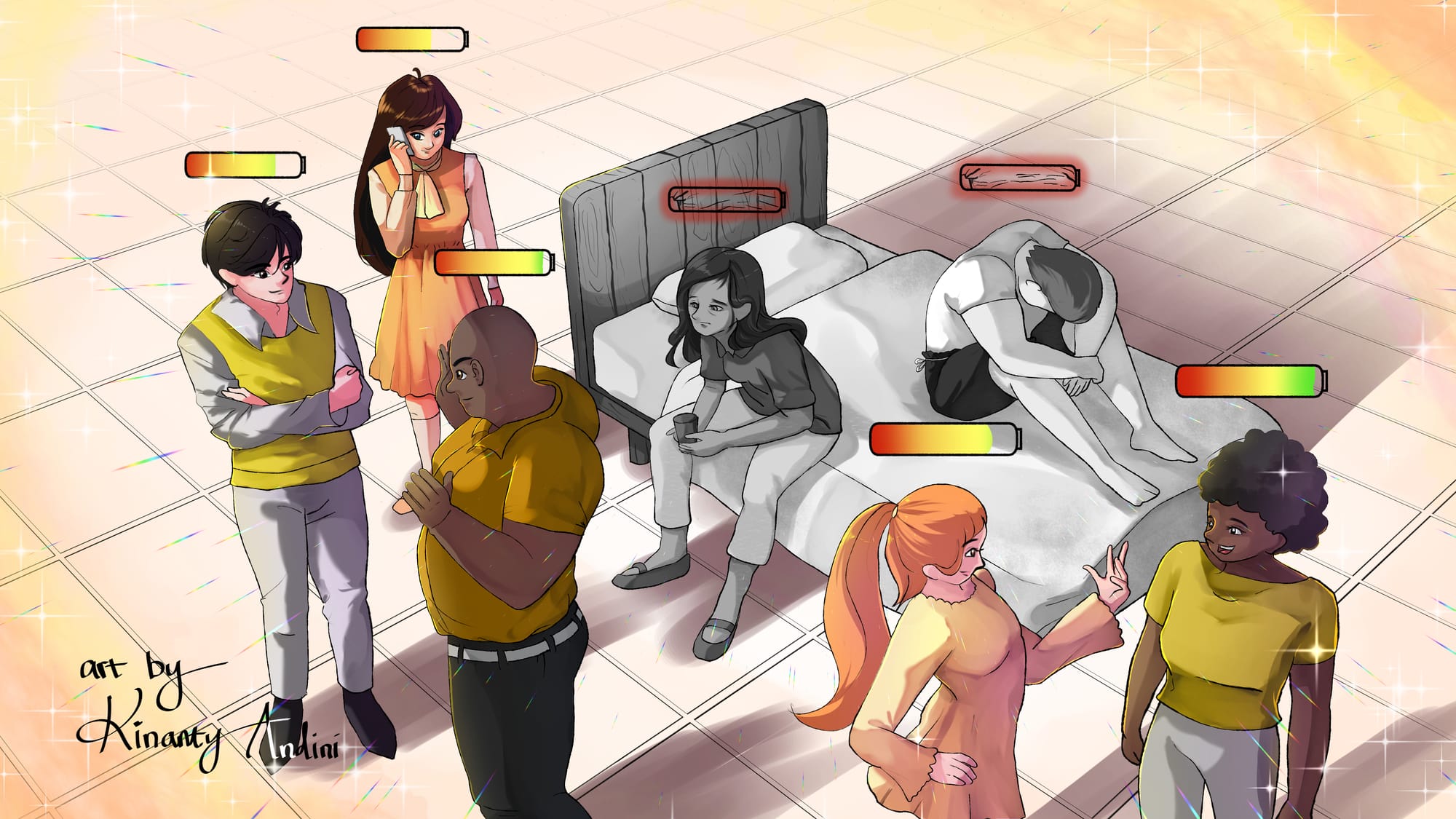
In the online world, mutual support for and by people living with energy limiting conditions is thriving. We are resting radically, campaigning furiously, often from our beds. We are connected.
But we find less solidarity in the global disability establishment of policymakers, international NGOs, and UN bodies. It’s striking that the policy priorities of the disability establishment have yet to catch up with the consequences of a mass disabling pandemic.
You don’t hear from us in international spaces like the Global Disability Summit because we are not invited to speak about our experience. And you will not find us in programme log-frames, in advocacy campaigns, or even in discussions of health equity for people with disabilities.
Access to this world is limited and gatekept. There are some impairment-specific groups with well-established positions. But even so, some global institutions claim that the specific nature of an impairment shouldn’t matter in the pursuit of rights for all people with disabilities. As a result, people with marginalised impairments are denied access to the advocacy spaces where change takes place.
And effective advocacy demands sustained energy that, by definition, people with energy limiting conditions lack. It’s hard to attract attention when fluctuating energy levels mean you can’t continuously call and email until people respond. It’s hard to be heard when you’re not well enough to shout.
We remain largely invisible within global disability movements, just as we are in the wider world they are trying to change.
An awkward bunch
People with energy limiting conditions rarely occupy senior decision-making roles in the disability establishment (or any other establishment for that matter). Energy impairment and full-time employment are rarely compatible, particularly in ableist workplaces. We don’t have champions in positions of power.
Plus, in the disability establishment there’s a longstanding ambivalence about including people with chronic illness. We trouble a prevailing social model of disability that squirms when faced with a sick body that needs medicine.
We’re an awkward bunch. We expose the reluctance of organisations to confront their ableist ways of working and the harms committed in the name of speed and productivity. And we are inconvenient: we require workplace adjustments that go beyond infrastructure and technology and demand new ways of relating to time, to place, to space.
Giving voice to our struggle
All disabled people understand the necessity and the demands of self-advocacy. It’s draining, and often daunting, constantly having to claim space for oneself. But we are rarely only speaking for ourselves.
When I write pieces like this, I do so because I can, and many cannot. I do so to honour people in our community who are so ill that they are hidden behind walls, and under covers.
I write for friends we have lost.
I write with love towards people who encounter these concepts for the first time and who feel a pang of recognition. And with compassion, for the pain and loneliness that accompanies impairment experiences that are poorly understood.
Some people don’t talk about their struggle with energy because it’s not part of their official impairments or diagnoses and so they feel it doesn’t count. Some people fear, quite reasonably, that they won’t be taken seriously if they raise it with doctors or employers. Others are silenced by shame in a world where our value is determined by our productivity.
We will take part
The more we use these new concepts of energy impairment and energy limiting conditions among ourselves, the more likely it is that people in the disability establishment will pay attention too.
I’m hopeful that at the international disability events of the future, our impairment community will be represented as speakers. We will take part in discussions about disability justice and the legacy of the Covid pandemic.
I’m optimistic that we will expand conversations about health equity. We will talk about how, by dismissing the testimony of people (especially women) with energy impairment, health systems gate-keep access to diagnoses and the disability identity required for claiming our rights.
Resting in plain sight
As our impairment community receives greater recognition, we will become more visible. Just as step-free access at a disability conference is a given, so we will find areas with reclining furniture where people can lie down, participating without the painful price of over-exertion.
Some of the people resting will be part of the disability establishment themselves, employed by high-profile organisations pioneering bold new approaches to time, pace, and place. Some will be recognisable from the global advocacy campaigns for our community. And others will be individual attendees for whom these spaces are newly accessible, and who feel welcome, seen, and safe.
We will always need to retreat and rest after these efforts – but resting from the exertion of participation is preferable to resting from the stress of exclusion. I am confident that in the future, the box will have a lid and be a genuinely quiet room for recuperation.
In this vision of the future, we are equal members of the global disability community and we are resting in plain sight. Our seat at the table is a bed.
In solidarity,
Anna
Outro
Further reading about energy-limiting conditions:
- Introducing "Energy Limiting Conditions": The Emergence and Evolution of a New Impairment Concept
- Challenging Disbelief & Disregard in the lives of people with Energy Limiting Conditions
- Resting Up Collective
For more from Anna, find her on Linkedin or at Equitable Health Futures.
And for more from Kinanty, see her website.
Let your friends know. Sharing the newsletter is how people find it!
Help us do more. The Debrief is free thanks to reader support.
Acknowledgements
Thank you to Peter for the care-full conversations, excellent editing, and dedication that keeps the Debrief unique and vital.
Thank you to the readers and organisations that support the Debrief as an essential resource in difficult times.
Thank you to Kinanty Andini – what a treat to have my words illustrated!
Thank you to Catherine Hale for ongoing thought leadership and collaboration on all things ELC.
Thank you to Anna Gkiouleka for the discussion that helped me figure out what I wanted to say and how I wanted to say it.