
Where traditional perceptions meet global views
Dear Debriefers,
Accept my greetings from Rwanda, a country of a thousand hills in East Africa.
It is in this part of the world that I have had over thirty years of amazing experience as an educator. I was active in the initiatives and struggles that opened up Rwanda’s journey to disability inclusion in education.
In this article I reflect back on the histories of disability in Rwanda, from figures in our oral traditions, the genocide against the Tutsi of 1994, up to the latest advocacy today. As well as stigma and exclusion we can see a communal responsibility that provided an inclusive environment for some.
International efforts on disability inclusion in Rwanda have too often ignored our indigenous traditions. Like in other African countries, treatment of community members with disabilities is an intertwined outcome of inherent social beliefs, practices of the colonial era, and the right-based models championed by activists in disability movements that came out of our newly-inclusive schools.
About this edition
These features, exploring disability around the world, are made possible by support from readers. With thanks to Andrew for a new contribution.
Evariste Karangwa was the founding Dean of the School of Inclusive & Special Needs Education in the University of Rwanda (2014-2024).
Kinanty Andini is an illustrator and digital artist from Indonesia.
A little known life in colonial times
Rwanda was colonised first by Germany (from 1885 to 1916) and then by Belgium (1916-1962). Disability was not much on the colonialists’ agenda, and people with disabilities lived a little known life in their families and communities.
However, in 1962, Father Josephe Fraipont (1919-1982), a Belgian Catholic priest founded Home de la Vierge des Pauvres (HVP) in Gatagara in the Southern Province.
For over four decades, it was the only centre catering for primary school education, rehabilitation, and vocational training of children with physical and sensory disabilities.
Government support for education of persons with disabilities only came in the post-genocide emancipation of the late 1990s. This period ushered in renewed demands for equalisation of opportunities for all marginalised groups (women, minority groups, people with disabilities, children, and others).
“The only chance for the children”
Seven months after the 1994 genocide, I was posted to reopen a small rural secondary school. Groupe Scolaire (G.S) Gahini had been founded in 1960s by Anglican Missionaries.
I vividly remember the shocking picture of the school in my initial days. None of the doors had working handles, there was no electricity and running water, and books and other educational resources were nowhere to be seen. Half of the school furniture had served as firewood for refugees, and only three staff had reported back. The first 91 students were visibly shaken by the experiences.
I was already terrified by the amount of reconstruction work demanded, when a team sent by a Rwanda Patriotic Front (RPF) soldier paid a surprise visit to my office. The team was made of Rwandan educators with disabilities who could not be educated in Rwanda in their youth, and had been taken to Kenya by missionaries.
The team’s words sounded like a command toned down into a request: “Your school is the only chance for the children - all big schools have turned them away”.
I was about to politely reject their request, when Mary (my wife) checked why I was running late for lunch. She interrupted, telling me that “with appropriate support, they can learn”. Mary reminded me of the St. Helen school in Mbarara, Uganda, where she had taught blind children alongside their peers without disabilities.
I wrote to the Minister of Education and his affirmative response came on 11th February, 1997.
Eight pioneers and a community effort
My letter led to an unanticipatedly quick response.
A week later, four blind boys and four blind girls made their historic appearance in the school compound. There was awe from the students and teachers. Our school had just become the first to pioneer the country’s inclusion for children with visual disabilities.
Mary had to combine her library work with support to both the new students and their teachers. And then working with parents and other influential leaders, we fundraised to be able to offer a resource room for the blind students. This used the old tradition of “Umuganda”, a community-based mutual support culture, to secure the resources needed for a disability inclusion initiative.
The school would go on to increase its capacity to 33 pupils with disabilities. And from there, it was an uphill trail of these students through secondary and then onto tertiary education, including the opening of public universities for disabled students.
Looking back on thirty years of work for inclusion
Almost 30 years on now, I am retiring as the founding Dean of the School of Inclusive Education in at University of Rwanda, while Mary continues to work with the Ministry of Education’s Inclusive Education’s unit of Special Needs Education.
Both of us have seen hundreds of teachers trained in Special Needs & Inclusive Education, and numbers of students with varying disabilities rise in all levels of education and subsequently as accomplished professionals, and mostly as founding cadres in advocacy organisations for people with disabilities.
The country has adopted policies on inclusive education, national policy for persons with disabilities, as well as other guidelines. And on the teams that developed these policies were people with disabilities who had come through as students.
These youth with disabilities continue to provide a renewed orientation to disability inclusion developments in Rwanda. And I saw an example of that last year in an event commemorating the genocide of 1994.
Genocide against the Tutsi
Each year there are countrywide events to remember the 1994 genocide against the Tutsi.
At one of these events in the University of Rwanda, a student with disability said that of victims of genocide we share what happened to Tutsi men, women, children, and even Hutus who protected their neighbours. But could the presenter please let us know what happened to people with disabilities and how many of them were victims?
The presenter struggled to answer, visibly lacking a response. The audience was thrown into group discussions, which revealed different attitudes towards disability of the period. While many of us assumed that people with disabilities would have been the first victims, the experiences shared showed different stories.
One blind student shared:
“Government soldiers who were impaired by the war of 1990s were brought to the Brothers of Charity at our center, and they took off their frustration on us… they felt abandoned. However, not all Tutsi students and staff with disabilities were harmed - while those without disabilities were killed”.
Others in the audience echoed this experience. They shared some of the views held by Interahamwe militias as they searched for the Tutsi victims. The often superstitious views ended up saving some people with disabilities.
They included vile stigma:
“We don’t have to touch the old and the disabled - they are half dead - God will decide their fate”,
“We only kill the normal”, or
“If you harm a handicapped [person], your wife will produce one [and] your community will condemn you for ever.”
The discussions continued uncontrollably, when the presiding discussant put the attitudes towards persons with disabilities in the context of cultural perceptions of disability that have lived in our communities for centuries.
Historic personalities in oral traditions
When I thought back about cultural perceptions, I thought of three historic personalities whose stories are still retold in Rwandan oral traditions.
Runukamishyo rwa Muhiga wa Nyamurorwa, a wise blind man from the ancient Rwandan territory of Ndorwa, who was the advisor of King Mibambwe I Mutabazi, in the fifteenth century.
Yuhi III Mazimpaka, a king of Rwanda (1735 to 1766, although historians vary in dates), with mental health challenges. He was popular for his his poetry, prophecy, and wisdom that shaped regional relations and trade.
Rwugamo, also from the eighteenth century, who is known as having been “mad” in the oral traditions. He was eloquent and entertaining and it is from him an expression is still used today, “Umusazi arasara akagwa kw’ijambo”.
This means something like “Even a mad person may stumble upon the truth,” or “Madness ultimately leads to wisdom”, and can be used to counteract ridicule of people with mental health conditions or intellectual disabilities. It is still a popular expression today.
Perceptions passed through generations
Each of these cases show that in precolonial times there were stories of persons with disabilities that emphasised their valour and prowess.
I saw them as meaning our ancestors might have been more accommodating for their community members with disabilities. But when I shared their stories my wife Mary was quick to ask, “Your accommodating ancestors did not have capable women with disabilities, did they?”
It is hard to answer Mary’s question, because so little is known about disability in the precolonial African sub-region. But my hypothesis is that beliefs and perceptions passed on through generations continue to inherently influence Rwandans’ daily lives, decisions, and interactions with disabled family members.
Stigma and family support in precolonial Africa
There is still little research on disability in precolonial times in Rwanda, but I take some guesses at it from my observations in rural communities. Extended family support (from grandmothers, siblings, cousins, aunties) is of paramount importance. Yet at the same time there is an unwavering stigma within the wider community.
Summarising my understanding of studies from around Africa, precolonial perspectives on disability are highly contextual and often intertwined with a society’s spiritual beliefs, economic base and communal values. Stigma and exclusion existed, but the emphasis on communal responsibility often provided a more holistic and supportive environment. The colonial era later introduced institutionalised and segregationist models.
For example, studies from ancient Egypt show how, in the words of researcher Alexandra Morris:
“Disability was incorporated into the very fabric of the community, religious, and social context at all levels - from the divine and incredibly powerful to those who were part of everyday life”.
And, on the other hand, the way that religion and culture can be vehicles for stigma was shown by Edwin Etieyibo and Odirin Omiegbe in their article on discrimination against persons with disabilities in Nigeria. They show the ritual practices that lead to violence against people with disabilities as well as the religious and cultural factors in children with disabilities begging for alms.
Writing on African Indigenous Norms on Disability in Contemporary Times, Nelly Mwale, researching women with disabilities in the Zambian Chewa Society, comments on the “negative and positive connotations” of indigenous norms on disability:
“Negatively, the implications were centred on stigma and discrimination while positively, they were centred on aspects of care and support at the individual, family, and community levels, and depended upon the nature and level of disability.”
Language and stigma
Another way to understand the presence of cultural beliefs is through the language.
Since time immemorial, people with disabilities in Rwanda, like in all Bantu languages of the sub-region, were associated with demeaning labels. Activist organisations publish guidance to appropriate concepts “Bavuga-Ntibavuga” or “do say - don’t say” and continue to aggressively remind public speakers when inappropriate terms are used.
Kinyarwanda, as other Bantu languages, organises nouns into classes and these groupings are indicated by prefixes. Nouns for humans are grouped into one class, denoted by the prefix “um”, such as “umuntu” for person. Objects have another prefix, like “ik”, “ak”. Referring to a human using those prefixes is often insulting, such as referring to someone with “ikintu”, which means “thing”.
Persons with disabilities are often referred to with the prefixes for inanimate objects, across the region. “Ikimuga” means “defunct object” but also is the traditional term for a person with disability. “Akaragi” implies a “speechless small thing” and it is not uncommon to find Deaf youth with the name. In Swahili, a blind person is often called “Kipofu”, worthless thing. And in Luganda (spoken in Uganda), “akasilu”, small fool, is often used for someone with an intellectual disability.
It would seem that these give a clear indication of stigma.
I wouldn’t see it so simply, however. In a study of language used about people with albinism in Tanzania, Giorgio Brocco saw that some phrases with seemingly offensive meanings were not understood as such by all individuals with albinism. One respondent did not find the words denigrating in themselves, as for them that would depend on the person’s attitude towards him.
The way I contextualise these words is the common social practice in many African communities to address someone by some (often physical) characteristic, rather than their name. For example, based on their skin colour or height. These labels are generally acceptable among close community members, while the original names are restricted for official use.
Present day Rwanda
Coming back to the present day in Rwanda. On the day of the discussion about the genocide we were also dealing with a preoccupying issue of the present. We had heard that G.S. Gahini school was going to close down its initiatives for inclusion of students with disabilities.
As well as being seated with my wife Mary, I was sitting with Venny, one of the eight blind students who had been the pioneers of inclusive secondary education in Rwanda. (Venny is a pseudonym.) When I shared the stories of our disabled ancestors, Venny asked sarcastically whether, if I brought them back, would they object to the closure of disability inclusion at G.S. Gahini?
Venny’s education at G.S. Gahini culminated in giving the graduation speech of her year, on behalf of all graduates. She credits the education she got there with making possible her career, where she now works in a government department supporting inclusive education.
However, even though disability inclusion may be closing at G.S. Gahini, there is much to celebrate in hundreds of schools and centres which have opened their doors for services for youth with disabilities in the last decades. HVP Gatagara, previously the lone example of inclusion, has expanded its services to six inclusive centres.
And, having been involved in teacher training for the past 24 years, I am aware of improved awareness in schools, a few young teachers’ initiatives, growing disability organisations and advocacy groups, all of which seem to join hands in support for disability inclusion.
Traditional perceptions intertwined with global views
The discussion on the place of persons with disabilities in the 1994 genocide sparked reflections that seemed to traverse generations, civilisations, and social structures.
In the same way, my own experiences show me practices that intertwine the different approaches to disability: deep rooted traditional perceptions, the persistent charity or institutional services of the colonial period. And now, increasingly, the global view that an equal place for people with disabilities is a matter of rights and entitlement, as it is for anyone else.
It is my personal observation, however, that the new developments on disability inclusion seem to be aligned more to the expectations of international organisations. They are often oblivious to indigenous potentials, still alive in our rural families and communities who are silently there for their dear kin with disabilities.
There are some welcome exceptions to this trend. For example, support from international organisations for students’ inclusive clubs, and schools that worked with parents to develop educational materials. Or, like we did at G.S. Gahini, using the monthly “Umuganda” and community work to make the local school more disability-friendly.
A reflective journey
In this Debrief I shared part of my reflective journey through a wonderful thirty years of working on disability inclusion in Rwanda’s education. And beyond that it looked back hundreds of years into our traditions and stories with a disability theme.
Each of these perspectives gives a new angle to see disability, through history community developments, sociocultural perceptions, gender and other important perspectives.
It will be my most heartfelt pleasure to hear stories from Debriefers elsewhere on this great planet of social diversity that we gladly share and value as equal citizens and participants.
Respectfully, I look forward to your friendly comments and feedback.
Evariste Karangwa
Outro
Further reading. There is a back catalogue of Debrief newsletters online, as well as a library of disability news from 170+ countries.
See more about Evariste on Linkedin or in this recent profile of his career on the New Times.
For more from Kinanty, see her website.
Let your friends know. Sharing the newsletter is how people find it!
Help us do more. The Debrief is free thanks to reader support.
Acknowledgements
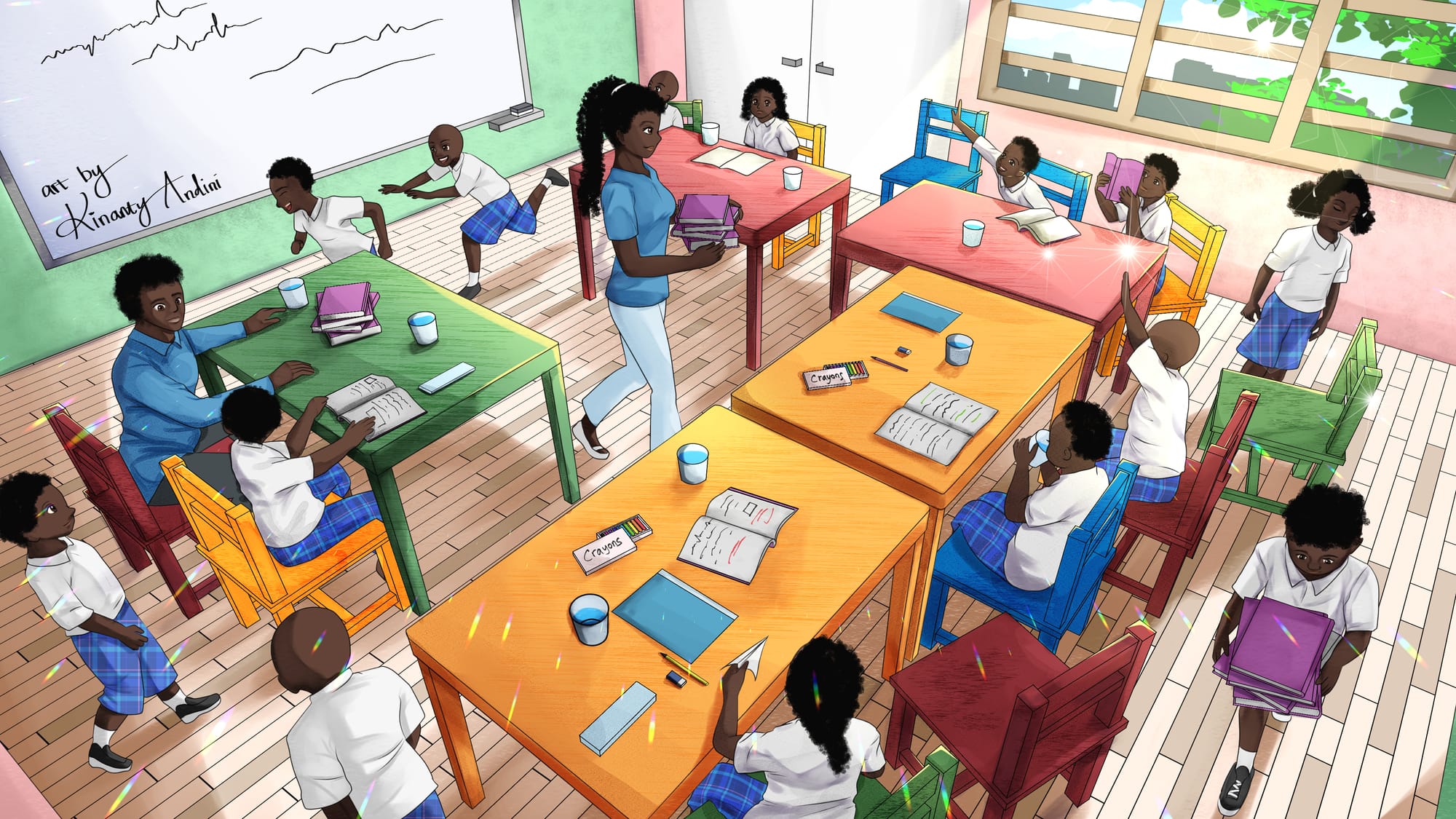
Thanks to Kinanty Andini for her illustration of a Rwandan classroom.
This article has been an opportunity to reconnect with friends and counterparts who have been part of the journey, whose views, tips, and reminders have been of great contributions, and I take this opportunity to extend my most profound gratitude to all those that have made the present story possible.
I feel indebted to all individuals and organisations that continue to promote and sustain the Debrief newsletter with financial support, the article contributors whose knowledge, views and ideas are always new and phenomenal. Debriefers will agree with me in sharing appreciation for this singular platform on which untold stories, preoccupying reflections, rare perspectives and voices on disability are regularly made available and freely shared.
With thanks to Peter Torres Fremlin for editing this piece. His guidance, encouragement, and wide knowledge on disability inclusion were invaluable.
The present article would not have been possible without the contribution of those that have been working with me, particularly my wife Mary, my students with disabilities, and I am deeply obligated to them all.