
Oh, it's happening to me
Dear Debriefers,
In the past five years I've faced a lot of physical change (by which I mean decline and loss).
I started using a wheelchair full-time and now need assistance breathing at night. These changes shut the door on much of the life I used to have before. That's getting older, right?
Not according to Ashton Applewhite, a writer and activist challenging ageism. She recognises the impact of these losses but sees that we need to separate ideas of ability from our ideas of age.
In this edition I'm happy to share a conversation with Ashton that brings together threads of discussions we've had over the past years. Her work changes the way I understand the connections between aging and disability and my own journey in a changing body and mind.
We explore how ageism and ableism are intertwined, the internal biases we need to confront, and what both the disability movement and “ageland” can learn from each other.
We talk through loss, failure, and how our different journeys through life can be a source of connection. I hope you'll get as much from this conversation as I did.
How did disability shape your day? Enter our open call for writing with your journal entry. Five favourite entries will be published on the Debrief and paid £100 each. Deadline 20th July.
About this edition
Disability Debrief is published through a pay-what-you-can model. Thanks to Lauren for a new contribution.
Peter Torres Fremlin is editor of Disability Debrief and is from the UK.
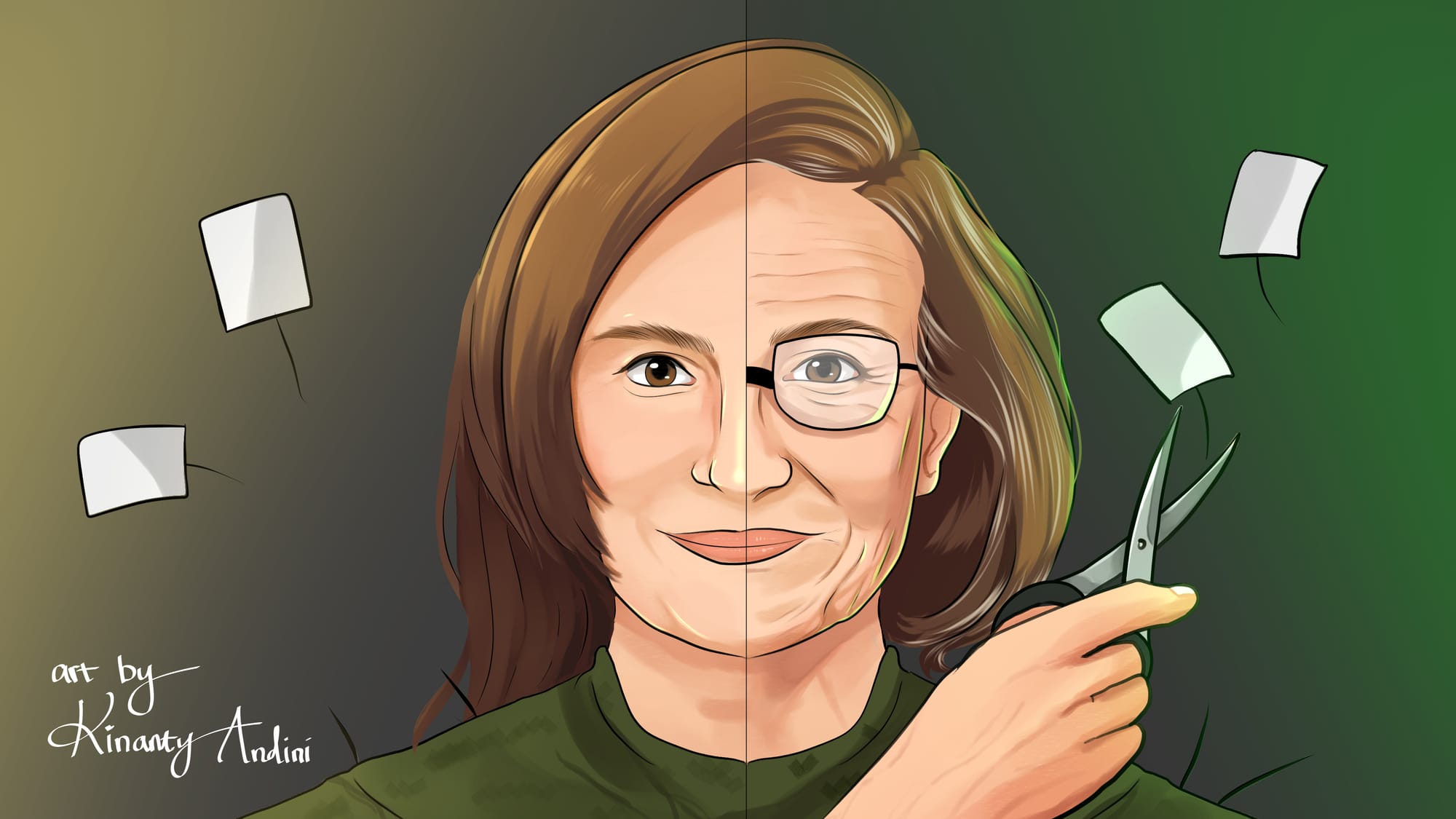
Kinanty Andini is an illustrator and digital artist from Indonesia.
A dual stigma
Ashton and I spoke on Zoom, and then edited our conversation for clarity.
Peter: What do ageism and ableism have in common?
Ashton: Most people's biggest apprehension about getting older, whether they are young or middle-aged or in fact old, is apprehension around how our minds and bodies might change.
We might think of that as ageism, but it’s actually ableism: stigma and unfair treatment around physical and cognitive function. Our minds and bodies can function very differently, right from birth. Or we can have a chronic illness, or be in a car accident, and on and on.
Of course aging with a disability is very different from aging into disability, in ways that are important to acknowledge. But when we ignore the ways ageism and ableism overlap, we miss the possibility for collective advocacy.
Peter: We know statistically that disability is more prevalent among older people. But people that identify in terms of disability are often younger, and older people might not use that word.
Ashton: It is a dual stigma. It's hard enough to get people to acknowledge that they’re older—not to mention old—even if they clearly have way more road behind them than ahead.
One of the many things I wish people knew about aging is that the longer we live, the more different from one another we become. Some 80-year-olds run marathons. Some 80-year-olds can't walk around the block. The same is true, of course, of 40-year-olds and 20-year-olds. It’s never actually about age.
A movement to end ageism is underway, but I think more people are aware of the disability justice movement. And I think that the age equity movement has so much to learn from how the disability justice movement has created this big tent of what disability can be.
Claiming disability identity
Peter: It’s interesting to see tackling ageism as a tool to help us navigate difference. That helps us see why it would be useful for us in the disability tent.
Ashton: I'm super reluctant to make any generalization on the basis of age because age says so much less about us than we think it does. But when we are born does help shape our worldviews.
Older people with disabilities tend to see themselves as who they are “despite” being blind or “despite” using a cane. The predominant narrative for most of their lives was about “overcoming“ disability and rejecting that aspect of their identity, or if claimed, claiming it reluctantly.
Thanks to disability activists, I think that narrative has changed. Disability is part of what defines us, not something to be hidden or ashamed of. I would love more older people to learn that fabulous lesson because there's such power in it.
Addressing our internalised bias
Peter: Looking at these disability lessons can help navigate life's changes. From “ageland,” as you call it, or your anti-ageism perspective, what are some things that you'd like the disability movement to consider?
Ashton: I think that it would be super useful for people in both movements to address their own internalized bias. People in the disability justice movement have come further in confronting their own internalized ableism than most older people.
For the vast majority of older people, “aging well” still means struggling to look and move like younger versions of themselves. That mindset is both ageist and ableist. People in the disability movement, on the other hand, are maybe less likely to have thought about ageism as a social justice issue.
I would love more younger people, and also younger people with disabilities to look at their own attitudes towards age and aging. Most bias is unconscious.
I know that younger people who use wheelchairs or canes might hear “You're too young for that.” Ironically this makes it harder for older people too, because they don’t want to “look old” either—let alone disabled.
But imagine if we could break away from those ways of thinking? To say, “What do you mean by that,” instead of, “F*** you, I'm not old.” To not let these ideas diminish our sense of wellbeing or our sense of ourselves in the world as powerful, sexy people.
If we were to think of aging and encountering impairment as a road we’re all traveling, and learn from to the way others adapt to (or fail to), and find shared power and beauty in it, think of how much better off we'd be.
A shared source of pain, difficulty, and power
Peter: When I speak with older people whose bodies are changing, I feel how tackling some of that ableism – being more positive about assistive technology, being more creative about finding new ways to do things – might be useful. But often it's hard to communicate that, or relate to my experience.
Ashton: Why is it hard to communicate?
Peter: I get the sense that people see me in a different category. They see, "Oh, Peter is doing X, Y, and Z, but that doesn't apply to my challenges." And I recognise that if you’re at a different phase of the body-mind-change journey, you might not have that capacity or energy to deal with changes, which then makes adaptation harder.
Ashton: I love that phrase, “a different phase of the body-mind journey”, because it is about every human in the universe. That’s what I'm always looking for: ways to see this as a shared issue, a shared source of pain and difficulty, a shared source of power and commonality. Where can we learn from and draw strength from each other?
Peter: Society does so much to differentiate us based on body, mind, age. But you're saying, “Look, this is actually something we have in common.”
Ashton: Absolutely! Adapting to these changes is necessary and powerful, once we shift out of shame and denial.
People think aging is sad because they equate it with loss. But we are aging from the minute we're born. It’s not something sad that old people do. There's all kinds of growth and power and liberation in aging past youth.
To live is to age, and to age is to live.
Oh, it’s happening to me too…
Peter: This discussion makes me think of my own change processes. One challenge is that one really does assume these problems will happen to other people. When I was in my 20s and walking about I saw older wheelchair users and part of me didn’t think that was going to happen to me. I couldn’t imagine it.
Ashton: I didn't realize this till I heard what just came out of your mouth: the same is true of getting older. When you’re a kid, you cannot imagine preferring sitting down and talking to playing games and making noise. …
Like most people when it comes to aging, I thought, gee, I was magically going to get a pass. But then I looked in the mirror and realized, "Oh shit, it's happening to me too."
I think that's human. We age slowly, and in a world that teaches us to dread aging past youth.
If you had told me 20 years ago I'd be interested in aging, I would've said, “Why do I want to think about something sad and depressing?” And it's anything but. It's how we move through life, and it touches on every aspect of being human.
Loss and narrowing horizons
Peter: Aging with a physical disability has put me in a situation that, approaching 40, my body is in a very different place from where it was when I was 20, whereas most of my peer group, there's a smaller difference. “Aging” doesn’t feel neutral to me, it feels like a way to describe the physical loss and narrowing horizons.
Ashton: You haven’t aged faster, but your physical capacity has changed in ways that theirs has not. And it makes you feel older.
The task is to separate the idea of ability and the idea of age, and to understand how they differ and overlap.
Peter: Part of it was my state of mind as well. The feeling of loss for the way I used to be able to travel independently, for example.
Ashton: That's real. And you’re human. I just wrote a post about learning to use a cane. Even after all the work I've done it still took me several weeks to walk out the door holding it because of my internalized ableism. I thought of those awful road signs that show ancient people hunched over a cane, and was still thinking, “I'm different from them.”
If you’re thinking of using a mobility aid…
Peter: There’s a thought “I'm not going to do this because other people will look at me differently,” but I think it comes from our own fear. I really felt that when I shifted from a mobility scooter to a motorized wheelchair.
Ashton: Have you noticed a difference?
Peter: I know the difference between those two devices. Most other people, they don’t. They're not calculating my mobility trajectory based on that.
Ashton: Yeah. When they see the cane, people ask, “What happened?” which is a completely reasonable response. I say, “nothing,” which I hope gives them ground for thought.
I did not have a precipitating event other than a hard-to-arrive-at change in attitude. I can easily walk without it, but my balance has deteriorated, I’ve fallen quite a few times, and I want to prevent future falls.
Recently I learned a phrase via Blossom – the Debrief agony Aunt: “If you’re thinking of using a mobility aid, that’s the sign that you need one!” I had to come to terms with the fact that that meant me.
“Bluntly put, to age is to fail.”
Peter: How does shame play into this?
Ashton: We live in a world that celebrates youth and speed, and where their loss is perceived as a personal failing. “If we ate enough kale, did enough sit-ups, had a better skincare regime, we could stop the clock.” Bluntly put, to age is to fail. When we cannot maintain this standard, even though it’s impossible, it can feel shameful.
I'm curious about how that resonates from your side of the non-existent fence.
Peter: In the disability space, we're so busy resisting negative external views of our situations that it's hard to engage with our own negative feelings about them.
Ashton: Dylan Thomas has a famous line: “Rage, rage against the dying of the light.” There are times to rage! But it's not a great long-term mindset, because the light is inevitably going to die out. If we are stuck in rage, if we feel our bodies are betraying us simply because they are changing, it’s harder to adapt. And adaptation is key to aging well.
A thought on the negative thoughts. A lot of people, as they inch past midlife, realize, “You know what? There's lots of things about growing older that I really like.” And the pendulum can swing to this hyper-positive position: “It's all going to be great if I eat well, stay active, etc.”
And maybe it will? But so much luck is involved. The only thing we can actually control about how we age is our attitudes.
Peter: That reminds me of the incredible strength in Alice Wong’s work. She could name that: disgust with her body changing, and how that made it important to claim joy, desire, sexiness…
Ashton: Yes! Joy, desire, pleasure are almost completely missing from the age discourse.
Life in the back mirror…
Peter: Another difficult thing I find about my current situation is that it’s hard to believe in the future when I have a daily fear about further loss, and how that might limit my life. There's a feeling of life in the back mirror…
Ashton: People who encounter age-related impairments could learn so much from what you are going through. When you’re older, it's very easy to assume processes like these are a function of chronological age. In fact they’re related to moving through life in a human body. At any age or stage, each person’s experience is unique, and each of us brings different strengths and vulnerabilities to the challenges at hand.
Peter: What are the things in my experience that would be relevant?
Ashton: Time thresholds. Loss. Rearview mirror. The necessity of mourning the loss and appreciating everything that remains. How disabled people hack the world.
The experience, the perspective, the self-knowledge that aging confers, is also conferred in variable ways through adapting to disability. Young people have created joyous, ingenious, creative communities, many of whose members celebrate inter-dependence and identify proudly as disabled.
Think what we olders could learn from them about asking for help, adapting to impairment, and age pride! Think what they could learn from us. Let’s get interdependent!
Changing the way we feel and behave
Peter. I think one thing worth reiterating from our conversation, is that, look, ageism and ableism are within us. They're not bad things only done by the enemy.
Ashton: Of course external forces make aging and having a disability harder than they ought to be: capitalism, and patriarchy, and misogyny, and racism, and all the rest. They're all out there.
But all change begins within us: by examining our own attitudes towards moving through life in beautiful, imperfect bodies. By confronting shame and denying it a further foothold.
When we change our attitude, we change the way we feel and behave. And when we take that awareness and energy out into the world, we change it.
Peter: Adaptation is a fundamental lesson of disability. And individually there’s a lot of adaptation, but part of the view we take of disability is that society needs to adapt.
Ashton: Yes, there is the necessary and somewhat radical idea that it is the environment that disables us. If we say adaptation is key, are we in fact undercutting that and shifting the burden from society to the individual?
Universal human experiences
Peter: I think the reason your work resonates is because you're looking at these internal questions. But if there’s someone who's in a difficult situation and facing social and environmental barriers, dealing with grief or dealing with real loss, it’s very hard to say to them “Feel better.”
Ashton: Yeah. Or “try harder”. How can you say, “Joining this community will be great for you,” when the fact that you’re joining that community that is one of the things that you are demoralized and upset about?
And you're entitled to your feelings. The paradox here is that joining a community is a source of strength and learning from each other. So much of what you’ve said about your experience resonated. It echoed with conversations that I've had with people of all ages. And I think there's such power in that.
Aging and disability have unique intersectional and advocacy potential because they are tents that contain us all. Everyone is aging, and everyone lucky enough to live long will experience some loss of capacity. Because these are universal human experiences, there is enormous potential for collective liberation.
Outro
For more from Ashton: see her website, her manifesto against ageism (or TedTalk on ending ageism). Ashton is co-founder of Old School Hub and she is about to launch her own newsletter on Substack, Things I Used to Say.
More on the Debrief See further interviews on the Debrief. For more on ageism and ableism see the role that ableism played in the 2024 US presidential election: No way to run a country. And I've shared changes in my own bodymind journey in Breathing In and my long break-up with walking.
For more from Kinanty, see her website.
Connect. Get in touch. You can find me on Linkedin and Bluesky.
Let your friends know. Sharing the newsletter is how people find it!
Help us do more. The Debrief is free thanks to reader support.
Acknowledgements
Thanks to Ashton for such a generous interview and our conversations through the years.
Thanks to Kinanty Andini for a beautiful portrait of Ashtons through the years.
To Celestine Fraser for support editing the interview. And to all the readers and organisations who support our work.