
Returning the gaze
Moloweni Debriefers,
From a very early age, my sense of identity, as a person with albinism, has been shaped by damaging representations.
The realities of people with albinism in South Africa and beyond have for the longest time been influenced by irrational damaging imagery. From a very early age, my sense of identity has been shaped by medical representation centred in tragedy, how our bodies are made exotic spectacles, and the constant exclusion we encounter.
These representations have influenced how society view people with albinism, and how I have learnt to understand myself. In this article I trace how these existing representations impacted my formative years, my sense of self and belonging. Visual narratives are powerful: they can restrict, empower or wound.
But while I grew up with little to no constructive representation of people with albinism, now that I am older, I am able to challenge that. Through a journey into arts and activism, I use images to challenge damaging portrayals, reclaim agency, and offer humanising depictions of people with albinism.
About this edition
Original writing like this is made possible by support from readers. Thanks to Eirin for a renewed contribution.
Athenkosi Kwinana is a visual artist and activist with albinism, from South Africa.
“You are blocking my view”
I grew up in Mthatha a small town in the Eastern Cape province. I lived with my maternal grandparents, my mother, two younger siblings, aunts and ground staff. And because it was post-apartheid South Africa, this meant segregation based on the colour of one's skin had officially ended.
After our school days, once we completed our homework, my siblings and I would gather in front of the television to watch our beloved cartoons, the likes of Pokémon or Dragon Ballz. Or as a family we watched South African soapies.
We had two small-screen Panasonic televisions. They were bulky, boxy, heavy, and black, with temperamental aerials. On the side they had little knobs, which, when pressed, would make a sharp static sound.
Owing to my low vision, I often struggled to see what was on the screens. I would go and stand or sit right next to the television screen in an effort to recognise what I was watching. Unintentionally, I would than block the television screen with my head.
“Athi uyandisitha maan!”, my younger sister would explain, “Athi, you are blocking my view, man!”. For a moment, I would lean back. But I would not be able to see, so unconsciously I would again move back, blocking the TV. My sister, or other family members would shout again.
It was a daily occurrence, one that led to frustration, arguments, or tears.
Bringing characters to life
One day, however, my mother couldn’t take the bickering and I think in an attempt to stop it, she gave me a piece of typek paper and a 4-in-1 pen and told me to draw. And so, I did.
When I couldn’t watch television, I drew to bring those characters to life. I draw Ash and Pikachu, Bratz dolls, and portraits of my mother. My drawings would fill her dresser, workbag, and office desktop. I would hang them on her bedroom walls with a chappie, bubble gum.
It saddened me not to be part of the audience, to be unable to share these experiences with them. I valued those special moments of laughter and bonding.
But gradually drawing became my way of escaping my painful moments of unintentional exclusion. And I’ve been drawing ever since.
A person like me
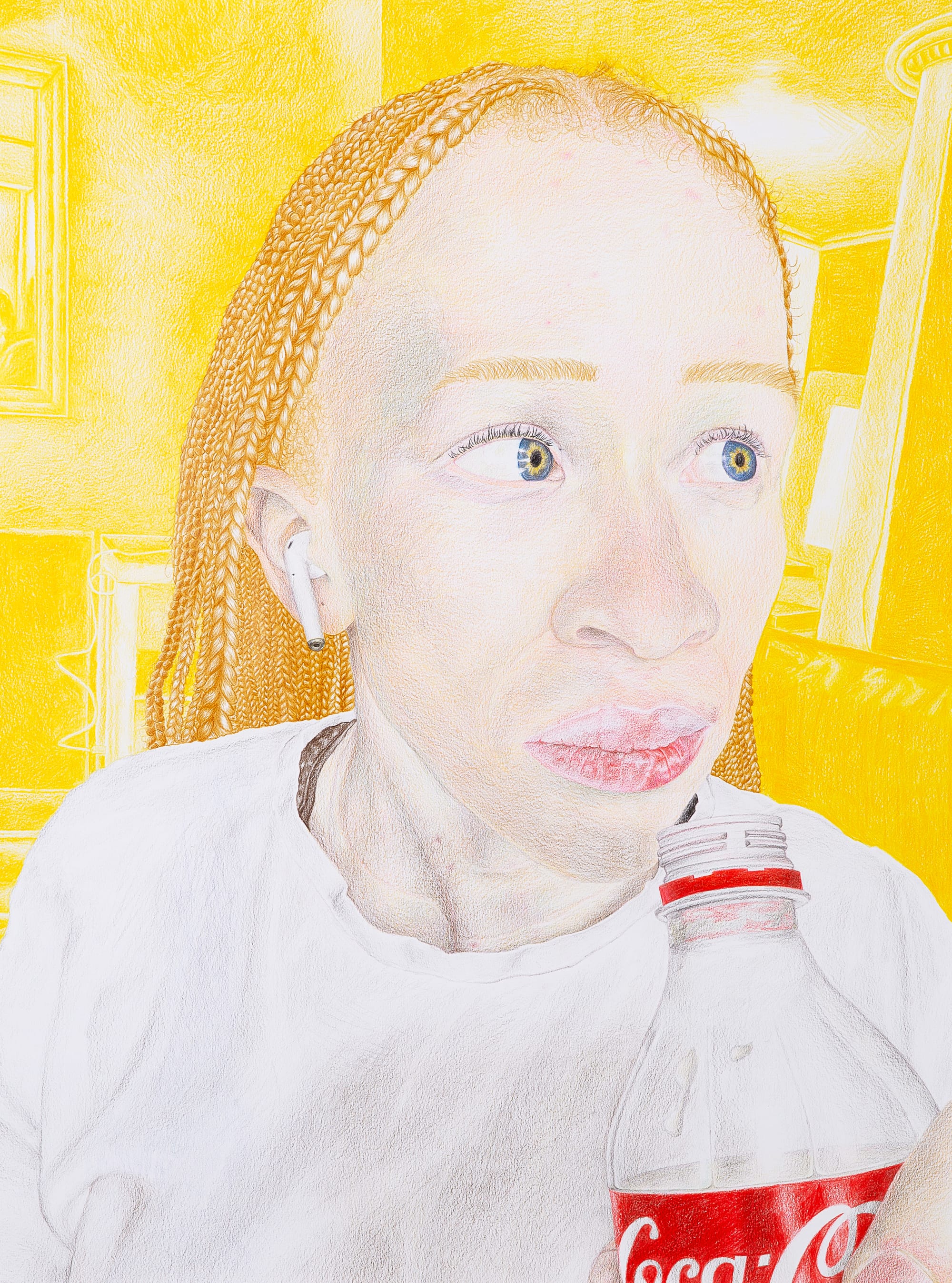
I rarely did self-portraits. I struggled with drawing myself owing to the less visible tonalities of my light-toned face. Photographs and my own mirror reflections were not helpful.
I came across a family health encyclopaedia that belonged to my late grandmother. It had two keywords: “Albinism” and (the problematic term) “Albino”. I would flip through the encyclopaedia, in attempts to find a picture of someone who looked just like me, but it had none. It just had pictures of different herbs and pills.
My first exposure to the image of a person with albinism was from a newspaper article, raising awareness about skin cancer affecting people with albinism on the African continent. But the images were not easy to look at.
They showed black people with albinism with extreme sun damage on their faces, shoulders, and sometimes chest. The patients were captured in a way that showed hardship and them as undignified and ungainly.
I felt uncomfortable looking at them. These portrayals made me dislike how I looked. Sad to say, I felt embarrassed to have albinism. I could not fathom my lived realities outside the lens of pain and suffering.
“Your kind does not belong in the sun.”
These images remind me now of the stereotypical marketing of Western charities. Advertisements showing black African mothers with their children starving, stripped of their dignity, and presented as helpless, with a renowned individual to speak on their behalf, as if they could not speak for themselves.
Unfortunately, only having access to only such images really wrecked my self-esteem. I struggled with ideas of self-worth and of beauty. These images made me feel inadequate and miserable.
I could not look at myself in the mirror and appreciate my own gaze – my golden coils, the textures of my skin and blue eyes. Instead, the act of looking at myself in the mirror felt like a humiliation ritual.
Over time it became evident to me that these were the only sort of portrayals South Africans knew of people with albinism. When I wanted to play with other children outside I would be told by them, or their elders, “hai hai buyela endlini, nina kaluku anivani nelanga”. “No, no, go back in the house, your kind does not belong under the sun”.
Different images of people with albinism
As years went by, I started seeing different images of people with albinism in magazines and newspaper articles.
There was an increase in media attention to killings of people with albinism and cases of mutilation owing to cultural myths and societal perceptions.
All these available images seemingly reduced our experiences to tragedy. Don't get me wrong, while the realities must be acknowledged, they often have become the only form of knowledge about the realities of people with albinism.
A second prevalent theme of images was seeing our bodies through an aesthetic lens. Bodies of people with albinism were portrayed as exotic spectacles. There was an emphasis on difference. I would see it in how fashion models with albinism were used to create an ethereal aesthetic rather than being celebrated and portrayed as humans with their own autonomy.
And another persisting frame was where our bodies are presented as rare beings rather than human beings. With documentaries and imagery presenting our bodies under an almost ethnographical gaze – as though the viewer is being introduced to something unfamiliar – something outside the common African identity.
To me, seeing such imagery was a massive blow to my stomach. It is worrisome, especially for black people with albinism, whose bodies have put us at the centre of heavy discrimination, exclusion, and violence. It exacerbates the already existing ideologies about our lived experiences.
Portrayals of people with albinism created an extreme paradox: if we are not marginalised, we are lusted over; if we are not hunted for our body parts, we are being othered.
“Stare back”
When I was younger, I was stared at in school, churches, supermarkets, everywhere. I have Oculocutaneous Albinism (OCA), the most visible of the known types of albinism. It’s characterised by the presence of little to no melanin in the skin, eyes, and hair.
One day I was visiting the local supermarket with my mother and siblings. As usual shoppers stared for a while and looked away. But to my dismay, the person packing shelves had frozen, his arms stuck holding the products, unblinking.
Hurt, with my head bowed, I whispered to my mother that he was staring at me. She paused, and told me, “Mjamele nawe, ungamuvmeli akudelele”. “Stare back, do not let him disrespect you”.
Challenging questionable representations
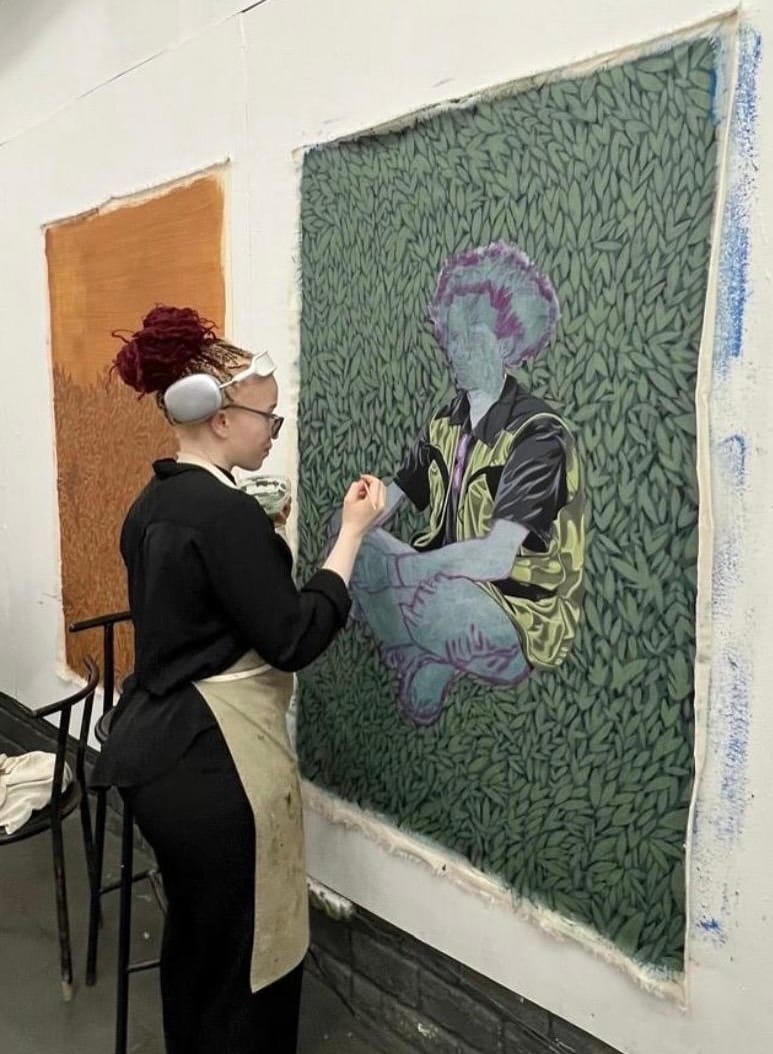
I took up art as a subject in primary school, high school, and as a degree at university. It was not my primary choice of study: I had initially wanted to study something related to social work or community development; little did I know that I could explore the same social and political issues through this field.
From a lecturer I learned how art can be used as an instrument of change in the world. This led me to conduct a small case-study on the representation of people with albinism in the Eastern Cape, and over the years these questions have turned into a full-time dedication.
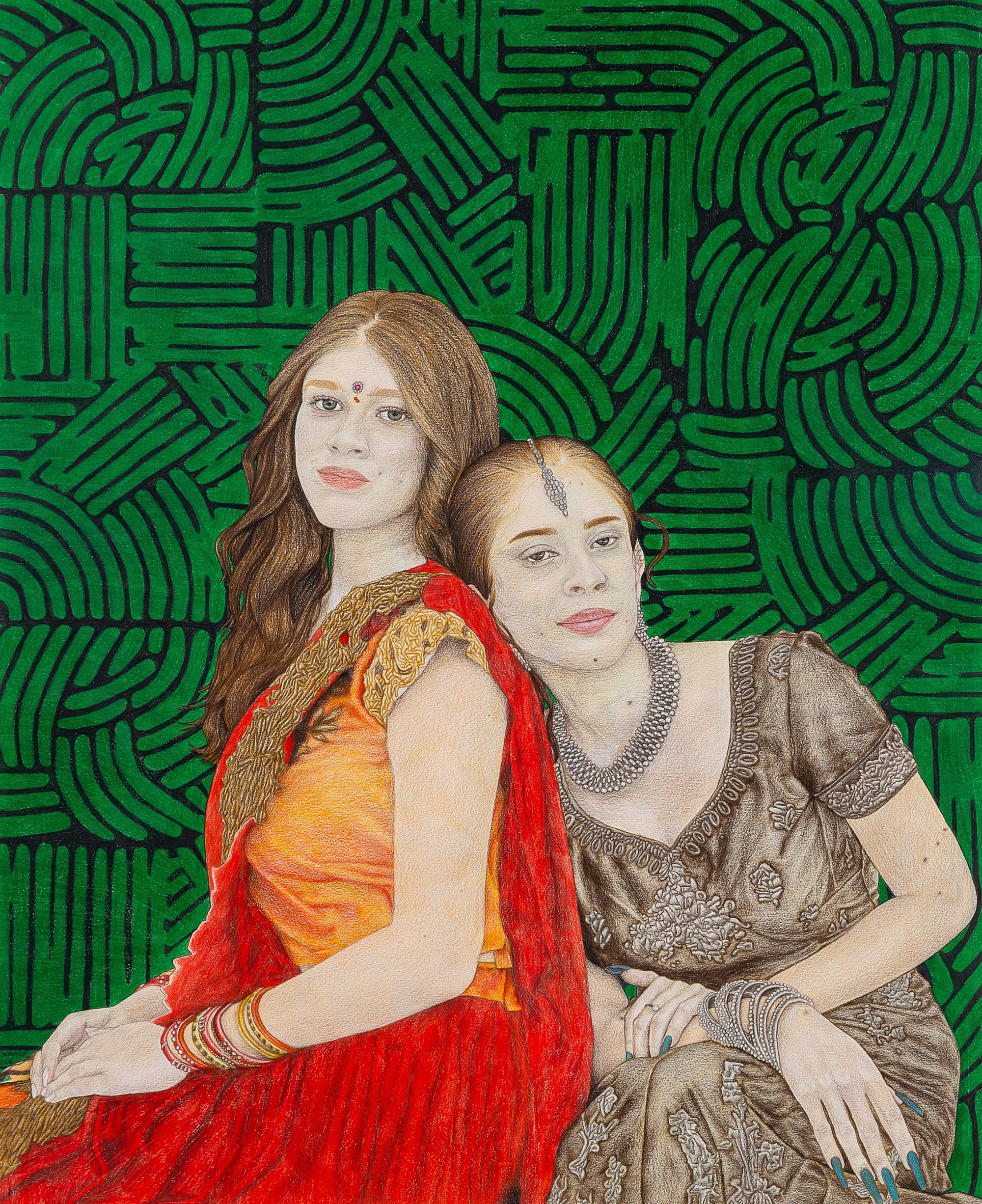
And now, as a visual artist and visual activist, my work seeks to challenge the questionable representation of people with albinism and foster dialogues on albinism. I use different mediums – drawings, paintings and drypoint – to create factual reflections of our realities.
My work comes as a corrective tool. It is a visual argument that insists on the portrayal of people with albinism in a humanistic manner. I base it on my own lived experiences and those of other individuals with albinism. And it documents the hyper-visibility, exclusion and misrepresentation we encounter daily.
Rather than showing subjects through tragedy or a spectacle, I focus on intimacy, belonging and everyday human connection. I use relaxed poses and domestic space to portray people with albinism in ordinary moments of comfort and familiarity.
Individuals like everybody else
As I’ve shared this work through exhibitions, art fairs, residencies and campaigns, it leads to conversations inside and outside of the albinism community. I hear from people with albinism that my images make them feel seen and valued.
Guardians/partners/friends also express how the portrayals warm their hearts. These constructive representations still rarely exist in the public sphere, and validate their child’s/partner’s/friend’s lived realities, acknowledging them as individuals like everybody else.
The reception from exhibition viewers and social media commentary affirms the need for rational and empowering visibility. A new kind of representation helps people with albinism navigate self-worth, belonging, and ideas of beauty.
From victimhood to connection and agency
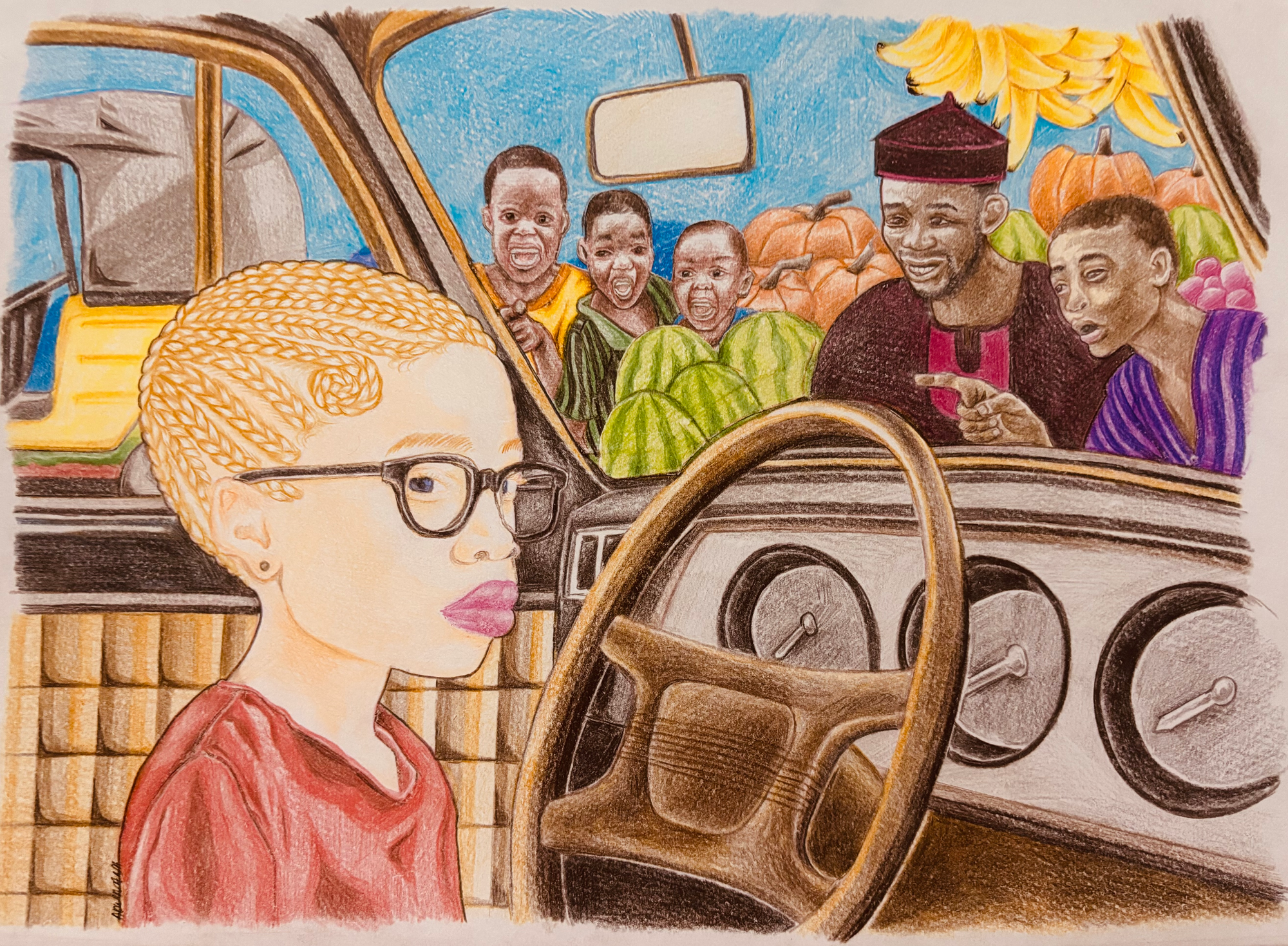
In the illustrations I have done for Disability Debrief, I was illustrating I.K. Ero’s articles that addressed themes of advocacy, power, motivation and identity. (And it was I.K. herself who linked me with the Debrief.)
The incidents she described included painful episodes – like being left alone in a car on a market day and being stared at – and the challenge was to illustrate these in a nuanced and empowered manner.
I emphasised showing the psychological reality as well as an emotional resilience. And in the episode of a meeting through a bus window, it was a chance show a moment of solidarity.
I hope these images show the viewer that we too are human with human experiences.
Questions of visibility
The experience of struggling to capture my face while drawing trained me to work with heightened attention to tonal variation and detail. And I adopted a slow and intentional mark making approach rather than abstract impressions.
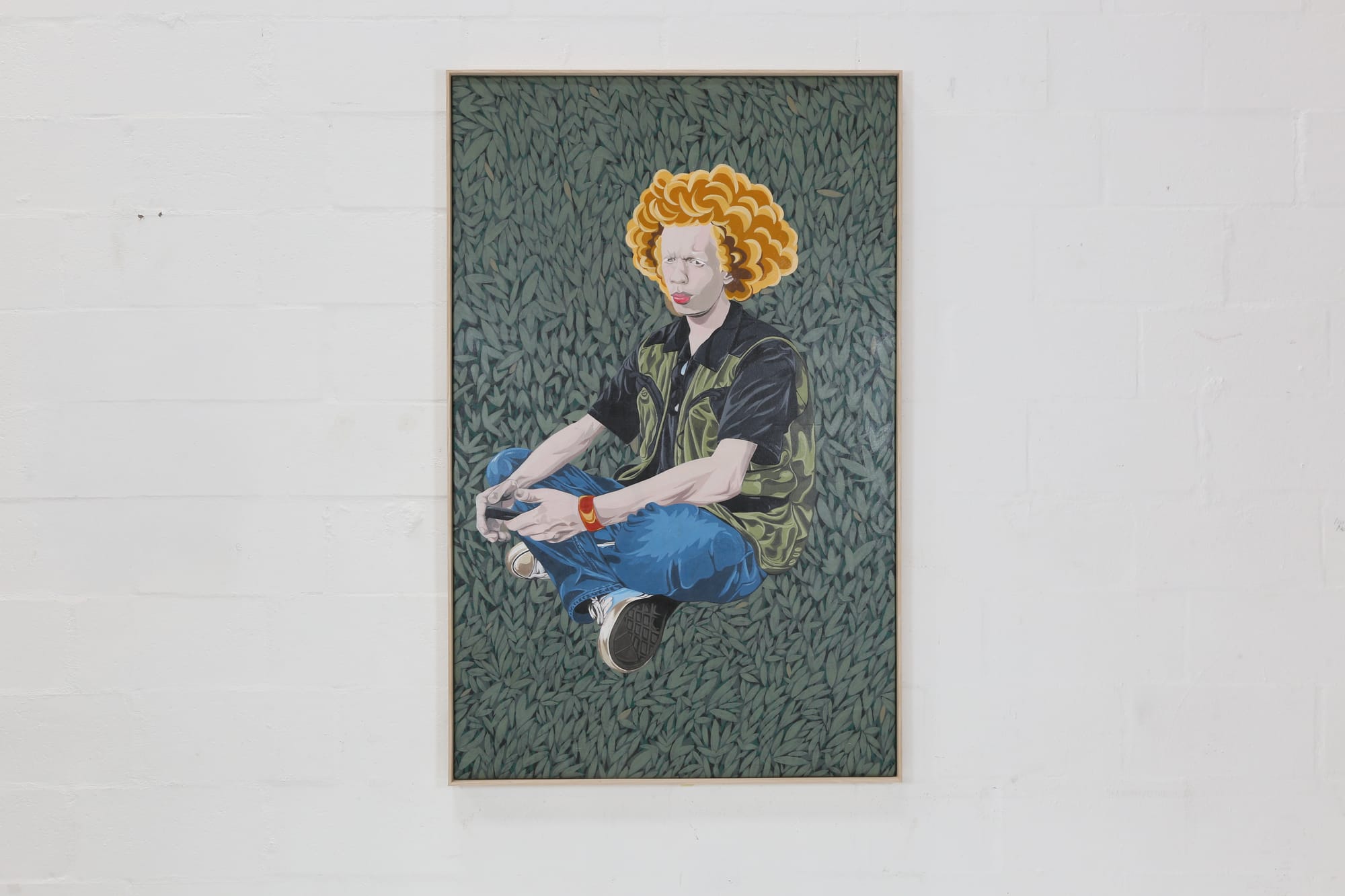
In this image I used a very layered painting process, from dark to light tones. In its creation of contrast and visibility I wanted to create questions of visibility and individuality. I blended the figure into the botanical background to question both the visibility of plants as well as the social invisibility experienced by people with albinism.
And as for the subjects of my artworks, I don't disclose further details about them, as I believe their privacy and agency are important. I prefer the focus to remain on the artwork itself and the questions it raises, rather than on the identities of the individuals depicted.
Returning the gaze
As a child in the supermarket, my mother taught me to stare back.
Now, in making images, I also want to reverse the way we have been looked at. I create portraits to stare back at the viewer, confrontational compositions that refuse to present people with albinism as passive observed objects. We are active participants in the act of looking.
Growing up, I used to unintentionally block the view of the television screens. I am still that child, but the lifetime of drawing that started then has led me to create new views. And with the images I create, I hope to help people with albinism finally see themselves clearly too.
Ngothando, with love,
Kwinana
Outro
For more from Athenkosi, see her Linktree or follow on Instagram.
See also IK Ero's pieces on albinism and advocacy, This is War and You Have to Do Something. Or for more artwork presenting lived experiences in new ways, see My Octopus takes me to the Neem Tree, by Fulltime Hedgehog.
Let your friends know. Sharing the newsletter is how people find it!
Help us do more. The Debrief is free thanks to reader support.
Acknowledgements
My artwork shared in this article was provided by me. The Market Days piece was commissioned by Disability Debrief.
With thanks to Peter Torres Fremlin for editing this piece. And it would not be possible without the support of my dearest family.
To the readers and organisations that support Disability Debrief, and acknowledge the need for our stories, thank you for ensuring the existence of such spaces and for helping these conversations reach wider audiences.