I have so many rights but I still want more
Disability Debrief explores the world through a disability lens. The articles are open and available to all thanks to a pay-what-you-can model.
Dear Debriefers,
To mark the twentieth anniversary of the United Nations Convention on the Rights of Persons with Disabilities (CRPD), we wanted to understand what disability rights look like on a day-to-day level in people's lives.
Our open call for writing, Writing Disability Rights, got an incredible 178 submissions from over 40 different countries.
Thanks to the hard work of Celestine Fraser, who also helped design the call, we shortlisted and selected our five favourites. We were struck by how far afield disability rights have travelled and the many ways they've changed lives.
Here is our selection, taking us from Mexico to Nepal. They show the opportunities opened up, the confidence rights can bring, and some of what's still missing.
All best for the next twenty years,
Peter
Kinanty Andini is an illustrator and digital artist from Indonesia.
Contents
- Nobody ever told us, by Leul Tesfameskel Mekelle, from Ethiopia.
- “I must have hit a nerve”, by Coastal Cat, from the USA.
- The world in the documents, by Luis Fernando Padrón, from Mexico.
- The one training on the Convention, by Taranath Sigdel, from Nepal.
- I have so many rights but still I want more, by Alexandra Kilgore, from the USA.
Nobody ever told us
By Leul Tesfameskel Mekelle, Tigray, Ethiopia
Dear Debriefers,
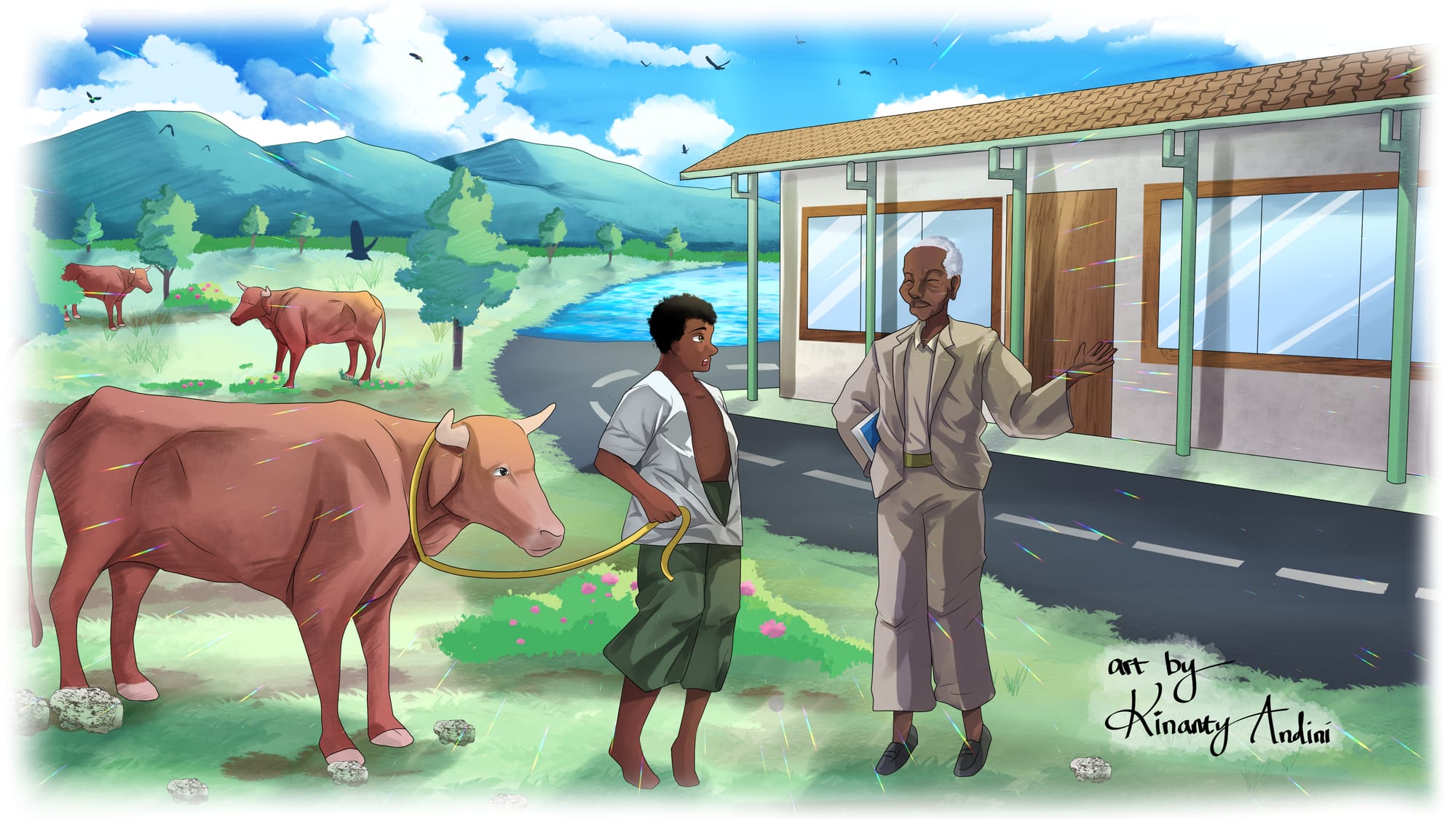
Until I was nineteen, I herded cattle. I was born deaf in Zalambessa, in northern Ethiopia. Neither my family nor I knew that I had a right to education. Nobody ever told us.
I only started school when I was 19 years old. Before then, I watched boys my age walk past with their exercise books, talking together. Sometimes they laughed with each other and passed without greeting me. When I went near the school and saw them playing sports, I felt sorry for my own luck. Sometimes I cried. I still remember it.
Then I met an educated man who told me that being deaf was not a reason to stay out of school, and that learning was my right. I told my family. My father took me to Adigrat, where a new school for deaf students had just opened. The teachers told him I had the right to learn.
When I started school most of my classmates were grown like me, because there was no school for deaf people near us. I felt deep regret for the twelve years that had been wasted, and I still do.
Before school, I communicated through lip-reading and using traditional signs. Now the students signed in a modern sign language based on American Sign Language (ASL). I didn’t understand anything. But after three months, I got used to it.
The students from town were better dressed than me, a boy from the countryside. Seeing them gave me strength: being deaf was no obstacle. In 2011, I graduated from Mekelle University with a BA in History and Cultural Studies. I chose history because I like to understand things from their roots.
I am now close to finishing my MA in History and Heritage Management, and I teach deaf students. I am also the founder and chief executive of Yes We Can Relief Organization (YWCRO), a local civil society organisation that trains people on the principles of the UN Convention on the Rights of Persons with Disabilities.
In the villages and small towns around me, the Convention is still unknown. Most people with disabilities have never heard of it. They hold rights they do not know exist.
But I have seen what happens when that knowledge reaches them. In one of my trainings, a deaf ninth-grade student signed all the articles to me. The smile never left his face. He signed with the spirit of a winner.
I do not measure the Convention by how many countries have signed it. I measure it by how many children with disabilities are told, in time, that they belong in school. I was lucky. I hope the next twenty years make that luck unnecessary.
With respect and hope,
Leul Tesfameskel
Note on AI use: This article was translated from the original Amharic using Claude and Google Translate. Then Leul and Peter edited it together.
“I must have hit a nerve”
Coastal Cat, writing from San Francisco, USA
Dear Debriefers,
Tum-san-kannis, thank you, in the language of the Costanoan people from the coast of the San Francisco Bay.
I had never told any medical personnel, outside of the Indian Health Center, that I was Costanoan.
Like many indigenous people who are recovering from a colonial system, I had only recently returned to the tribal community, and received from the tribal historian our family documentation. I had recovered my ancestors paper identity.
That night in the emergency room, for the first time, I answered as I always did, mixed race, but this time proudly added that I was Costanoan.
I had been in pain since the morning, and by the evening, things had not improved. We went to the ER.
My Dad had been a doctor and I felt safe going to the hospital.
From the waiting room, I was given a cup for a urine specimen. Few people were there and no one seemed to pay much attention to the evening news describing the start of the 2008 financial crash.
Fifteen minutes later, a receptionist called me up front, I had a urinary tract infection, they'd prescribe penicillin and send us home. Perfect. It was a school night.
Suddenly, a nurse walks out and calls me to the back “for more testing.’ I wondered why since the issue had been identified.
I had always modeled for my son that blood draws and needles are nothing to be afraid. So we were both surprised when I shouted out in pain.
“I must have hit a nerve,” the nurse said as he continued drawing the vial of blood full.
By the middle of the night, I experienced increasing and more horrific pain. By the next day, the nerve damage impacted my spine and legs.
My subsequent attempts to get additional medical attention were met with defensive medicine. The City financially responsible for that hospital denied a wheelchair, made periodic discontinuances of food benefits and denied home aid.
I was told my 10-year-old child would have to fill that role.
As our lives crumbled, I was no longer able to work, and I could not walk my child to school as I had every day. The pain was so intense, I often could not stay awake when he arrived back from school, or to make dinner.
A few years later were both thrilled for his acceptance into the Model U.N. with the Center for Talented Youth.
My son returned home excited to share that he had learned about the Convention on the Rights of People with Disabilities.
Even though our country would never fully ratify the CRPD, he told me about legal protections for disabled people. I could see in his eyes that he no longer felt alone. There was a framework for him to understand what happened and what challenges disabled people everywhere faced.
That night, I cried in gratitude.
Since then, my 10-year-old child has grown into a compassionate, empathetic, kind adult who works in the legal field with plans to attend law school.
I will never forget how learning about the Convention on the Rights of People with Disabilities changed us both forever. We were seen. And, he didn’t have to save his Mom on his own.
Tum-san-kannis,
Catherine Herrera
The world in the documents
By Luis Fernando Padrón, Mexico City, Mexico.
Very good day, Debriefers!
In 2001 at UN, Mexico proposed the creation of the “Convention on the Rights of Persons with Disabilities” and presented the first working document. In May 2008, the Convention came into force.
And on Tuesday October 13th, 2026, I am riding the newest subway line with the objective of getting my Tarjeta Incluyente, Inclusive Card. The card is issued by the Mexico City government and will allow me to get access to an assortment of benefits. The first step is to get my “permanent disability certificate”, that must be signed by a government sanctioned specialist.
After some stops, I must transfer to another subway line. The interchange station is relatively new, with signs for people with visual disability and elevators for pregnant women and people with reduced mobility. However, there is a long queue of people waiting for the one elevator that skips three flights of stairs.
I get to the platform of the other subway line; this one was built in 1970, so it has zero accessibility features.
The clinic is in an old building located in an old neighbourhood. The streets are narrow, the sidewalks are even narrower, full of cracks, potholes, trees, street lighting poles; there is a small auto repair shop that has its dismembered cars in the sidewalk.
They begin to give fichas, tickets, at 1.30pm. I go to the waiting room, open my book and start reading. I am called at 5pm, the general doctor is very professional, kind, and performs a very thorough interview.
By 6pm, I am finally in the street, walking towards the subway and with a reference to the psychiatric clinic (I am on the autism spectrum). I must go and request an appointment, but before that, I must sign in in a government web page to set up my official medical records.
Back in the subway the trains are getting crowded. In a few minutes they will be overcrowded and not all passengers will be able to get in. In the interchange station there is a very large queue waiting for the one and only slow and small elevator. One mature woman with crutches and an older man with walking stick say some words that I cannot dare to write down and start walking in the corridor. Apparently, the effort to ascend the long staircases is less than the cost of the waiting time for the elevator.
I arrive home about 7pm, thirsty, hungry, and tired. I cross my fingers my appointment with the psychiatrist to get the certificate needed for my Tarjeta Incluyente does not take that much time.
At night I reflect: The world in the documents is almost perfect. The real world is not made by documents.
Good night Debriefers!
Luis Fernando
The one training on the Convention
By Taranath Sigdel, writing from Kathmandu in Nepal.
Dear Debriefers,
I am Mr. Taranath Sigdel from Nepal. I am 43 years old. When I was 11 years old, I contracted leprosy. The fingers on my right hand became like a claw and it had some other permanent impact on my limbs.
My family members, neighbours and some relatives visited me at the leprosy hospital and they had bad impact to see other leprosy patients. They had huge fear of transmission of the disease and they did not believe that leprosy is curable or that I will be totally released from treatment.
There is very little awareness about leprosy in the village area where I was born. I faced much discrimination and stigma after return from six months stay at leprosy hospital.
That time I used to study in grade six in a local public school. My school friend stopped talking with me, coming near me, or touching and playing with me. I felt totally isolated from my friends and teachers. Then I decided to leave my study and change the school, to go to one faraway, where nobody knew about my problems.
I completed my bachelor level of study. My family did not have any income source for me to be able to do further study. My parents were very poor, they have six children, do not own land and they must work as a labour to run daily life.
I tried to find a job. One organization selected me for writing exam as a program officer. I succeeded the writing exam and they invited me for interview. During the interview, one interviewer saw my deformed hand and asked me what happened? I answered that “My right hand is deformed due to leprosy disease but now I am totally cured”. They immediately quit my interview.
There are other so many examples and bitter experiences in my life because of having a leprosy-affected disability.
While I was working at the The Leprosy Mission Nepal I got an opportunity to participate in a training on the United Nations CRPD, provided by the International Disability Alliance (IDA).
I was able to understand about human rights for persons with disability. I actively involved myself in the training and shared my bitter experiences due to having leprosy-affected disability.
After I acquired the knowledge on disability rights, I started to advocate the rights for persons with disability, provide training on disability rights, and raise awareness on understanding of disability to public, government officials and private sector.
I got the opportunity to work in a project working for livelihood, job, training and counselling support to persons with disability. I am able to self-advocate for my rights and advocate for other persons with disability through various organizations as a resource person or consultant.
At the moment, my income is good, I have better family and respectful and dignified life. I feel secure, protective and always dedicating myself for disability rights.
The one training on the UN CRPD brought drastic change in my life.
With gratitude and solidarity,
Taranath
I have so many rights but still I want more
By Alexandra Kilgore, writing from Milwaukee, in the United States.
Dear Debriefers,
I live in a country where my legal rights are barely older than I am. I still think I’m young, but in the years I taught elementary school, my third graders didn’t think I was, and now the college sophomores who I teach don’t think so, either.
On this university campus, I have so many rights. I had an Individualised Educational Plan (IEP) and a 504 plan to get me here. On the days any of them work, I have elevators and automatically opening doors.
I’m a disabled woman getting a PhD, part of an even smaller subset of the 14% of doctoral students with disabilities nationally. We don’t collect statistics on people like me, but I’m used to that: there are less than 100 confirmed cases in the medical literature of Escobar syndrome worldwide, even though I know there’s many more out there.
I have so many rights but still I want more. I never knew when to quit and I still don’t.
I have ramps, but I want to marry my boyfriend without losing the opportunity to receive Supplemental Security Income (SSI). I have a big bathroom stall, but I want to go out and dance with my friends or even just go to the grocery store without being stared at. I have curb cuts, but I want my professors to take me seriously before, not after, I turn in my first assignment.
The church on campus has a cut-out in the pew for a disabled congregant but no way for a disabled priest to get on the altar and say the Mass. The lecture hall has an accessible entrance around the back, up a rickety elevator, and through a labyrinthine series of hallways.
When I get there, the auditorium has a spot to park a wheelchair up in the back row of seats. There is absolutely no way for a disabled professor to get all the way to the floor to lecture by the podium. I have the right to participate, but not to lead. And I have more people than I could ever want to remind me that I should be grateful even to have this.
I’m happy that I have the legal right to a closer parking space. But it didn’t stop a federal court from ruling that the government could abandon its enforcement of the right of people with disabilities to live in our own communities instead of institutions.
Disabled people marched and organized and protested and died for these rights and I am so grateful and still they are not enough.
In hope,
Ally
Outro
See also the other pieces that come out of these open calls for writing.
Let your friends know. Sharing the newsletter is how people find it!
For more from Kinanty, see her website.
Help us do more. The Debrief is free thanks to reader support.
Acknowledgements
Many thanks to all those who shared their pieces on disability rights. It was a challenging prompt and we appreciated the creativity and range of responses. And it is always an honour to read about your lives.
Thanks and congratulations to those we published here: Alexandra, Catherine, Leul, Luis Fernando and Taranath.
Thanks to Kinanty Andini for the illustration of cow herder finding school.
Thanks to Celestine Fraser who designed the call for writing, and worked to shortlist and select the favourite pieces.
And thanks to the readers and organisations whose support of the Debrief makes this work possible.