The Weight of the House We Built
Dear Debriefers,
For decades, the disability movement has largely organised around the idea that representative Organisations of Persons with Disabilities (OPDs) should be the primary vehicle for change.
I’ve spent much of my career defending and strengthening that model. I’ve advocated for consultation mandates in the law, helped draft guidance to operationalise it, and worked to ensure that states and international actors recognise and engage with representative OPDs.
I believed – and still believe – that Mad and disabled people must shape decisions that affect our lives. But I’m no longer convinced that the architecture we built around that principle is working.
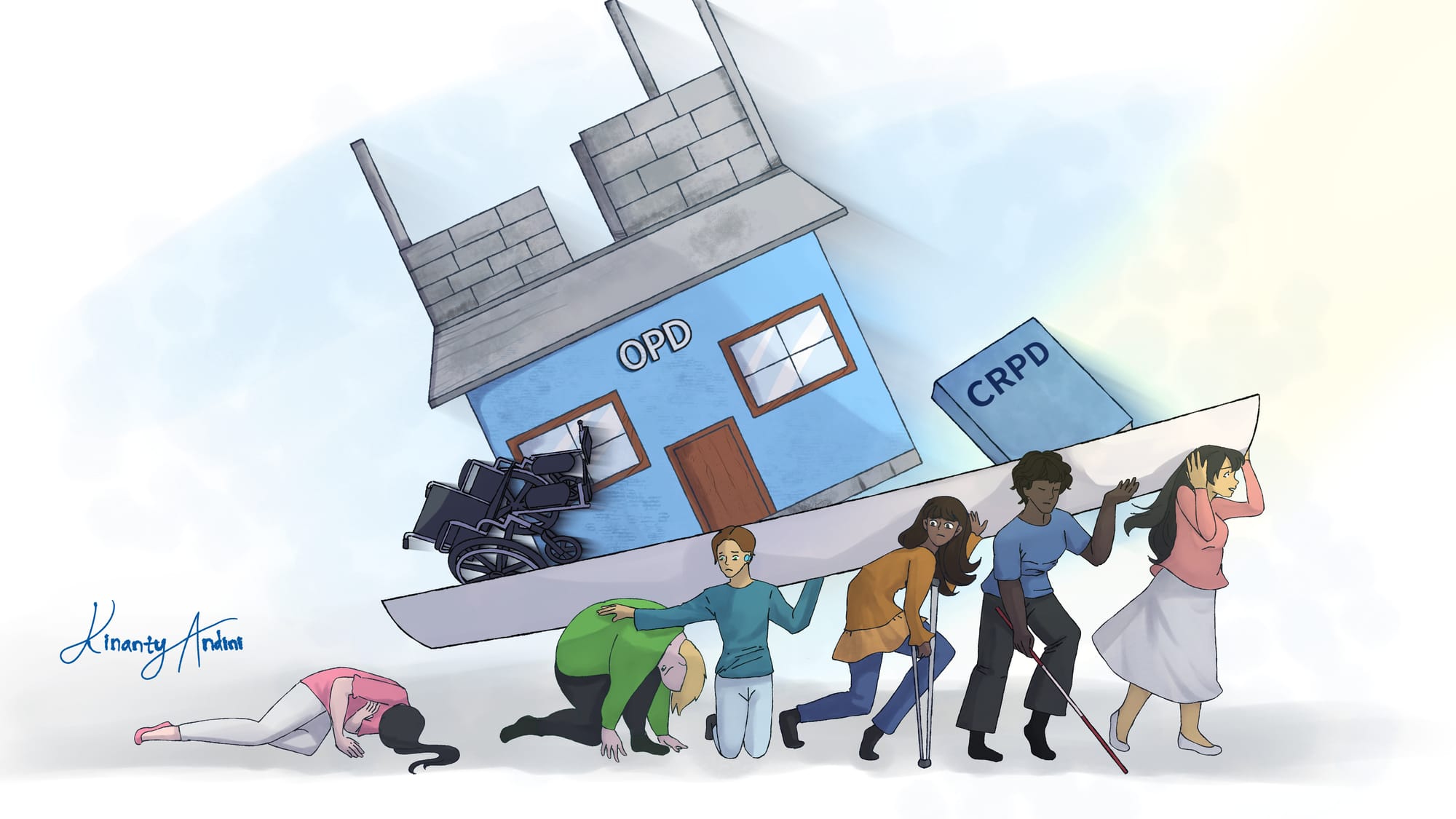
I wonder if we have mistaken the structure for the movement, the house for the home. OPDs are the house meant to hold our politics. The people make up the home: the relationships, the urgency, the anger, the imagination.
The house exists to serve the home, never the other way around. When preserving the house becomes the priority, we risk losing the life inside. People grow restless, or quietly move elsewhere.
This is not an argument against OPDs. It is an attempt to ask whether the way we center them still serves the movement they were meant to strengthen.
About this edition
Alberto Vásquez Encalada is a Mad/disability activist based in Switzerland.
Kinanty Andini is an illustrator and digital artist from Indonesia.
The Debrief needs help to weather the storm faced by independent media and disability rights initiatives. Thanks for new contributions to Annie, Alison, Amy, Bernd, C., Christine, Claire, E, Freddy, Katherine, Michael, Mostafa, Philippa, Shirin and Wendy,
The need to come together
One of the most meaningful experiences of my activist life has been being part of RedEsfera, a network of Mad and neurodivergent activists across Latin America. It gave me space to belong, think, and build with peers. At the core, this is why organisations of persons with disabilities exist.
OPDs emerged from a long history of being spoken about by others – families, institutions, professionals, and decision-makers – and from disabled people’s need to come together, support one another, and act collectively.
Around the world, OPDs have been essential to advancing rights, shaping policy, and responding to moments of crisis. They helped assert disability as an identity rather than an individual tragedy and gave form to a demand that has long powered our movement: nothing about us without us.
With the adoption of the UN Convention on the Rights of Persons with Disabilities (CRPD), the role of “representative organisations” was formalised, embedding OPDs at the centre of national and international consultation frameworks.
What counts as an OPD is less clear than it seems
Saying what OPDs do is easier than defining what they are.
OPDs are commonly understood as organisations led, directed, and run by persons with disabilities. This distinction reflects a political demand: that those excluded from decision-making should shape the decisions that affect their lives.
But leadership and governance structures take many forms. Formal arrangements say little about how decisions are made, how priorities are set, or how accountability is practised.
I co-founded Mad Thinking with another Mad activist, but initiatives like ours might not be classified as an OPD. Yet some organisations recognised as OPDs may be run by non-disabled staff or operate with minimal engagement from a broader base.
Even the question of who counts as “disabled” is not straightforward. These boundaries shift, making it less clear which organisations are considered “of persons with disabilities.” For example, organisations of people living with cancer or other health conditions might not be recognised, or see themselves, as OPDs.
Representation through membership
An additional, sometimes implicit, part of the definition of OPDs is that they are membership organisations. Having members makes them representative, which in turn confers the authority to speak.
A broader membership is meant to bring a wider range of experiences, making it more likely that organisational positions resonate beyond those directly involved. In that sense, membership could better reflect the diversity of the disability community. It should also help keep priorities and decisions accountable to lived experience.
The legitimacy of OPDs comes from these assumptions. But a problem arises when membership is treated simply as a metric, where legitimacy comes from member numbers and from how well organisations can tick the boxes of representation.
A widening distance from the people represented
In most contexts, OPDs are organised into layers, built on top of one another.
Local organisations are part of national federations, which are themselves part of regional bodies and, in turn, members of global organisations. These layers are meant to connect different parts of the movement, bringing together diverse groups and experiences into a broader collective voice.
But as layers accumulate, the distance between decision-making spaces and the people supposedly represented widens. Power concentrates at the top, while the broad base is rarely consulted, leaving a small group of leaders to speak for many. Leadership turnover is minimal, with the same individuals in their roles for years, sometimes decades.
As ties to a social base weaken, accountability increasingly flows upwards, towards donors, states, and international organisations. Organising adapts to their timelines and priorities. As I’ve written before, professionalisation and gatekeeping progressively replace grassroots politics. Stability becomes an end in itself, and dissent is managed in the name of unity.
This isn’t unique to disability. Across movements, organising tends to narrow as it moves upwards, driven by the demands of institutions, funding structures, and access to power. In the disability field, it just feels more entrenched.
Sometimes our organisations end up speaking more about those they represent than with them.
The pressure to appear representative
OPDs compete for recognition, access, and resources in a system that rewards those who can claim to speak for the broadest possible constituency.
Donors, partners, and institutions begin to ask whether they include people from rural areas, specific impairment groups, or those at the intersection of different constituencies. The pressure to fill these gaps incentivises shortcuts, as organisations seek to demonstrate representativeness.
In some cases, local or smaller OPDs are brought in to fill these gaps without meaningful engagement. They may be invited to join coalitions or processes in a superficial way, echoing the tokenistic inclusion that OPDs often criticise in other actors.
In recent years, this has been evident in efforts to include young people with disabilities. Youth sections in OPDs remain tightly controlled and have limited decision-making power or resources.
In other cases, external expectations can lead to the artificial formation of new organisations aimed at filling constituency gaps. This can happen alongside, or even in competition with, existing groups already doing the same work. The resulting organisation may be formed largely on paper, with little social base or political life beyond that.
Rather than building power from below, some OPDs are more preoccupied with appearing representative to those looking down from above.
When people opt out
This kind of hierarchical, hollowed-out participation drains time, energy, and political imagination. And it puts many of us off.
More and more, disabled people, particularly younger activists, opt out. They do not recognise themselves in these structures and do not see them as effective means of bringing about change.
In the space that opens up, other forms of organising emerge: informal networks, small collectives, mutual aid groups, start-ups, and individual activists whose reach is amplified by social media. Much of the more innovative and transformative work today comes from these actors at the edges of traditional OPD structures. While the OPD architecture remains in place, the politics it was meant to enable are shifting elsewhere.
Layered organising itself is not the problem. Most political movements rely on it to coordinate action and share resources. The problem is that, in much of the disability sector, layering has hardened into a means of aggregating numbers, managing access, and presenting a single, stable voice to states, donors, and international institutions.
Claiming to represent people with disabilities as a whole
Across contexts, from national to international levels, federated and umbrella bodies tend to present themselves as representing the entire disability population. The scale implied by this claim far exceeds the size of organised participation.
Even where organisations play an important advocacy role, many are sustained by a small number of overextended leaders working across multiple organisations. It is difficult to think of many other movements in which a single organisation claims to represent an entire population in this way.
The reach of OPDs was tested by Morgon Banks and others in a population-based study across several low- and middle-income countries. They found that membership among people with disabilities ranged from 3.5% to 14% across settings. And, given the variation in how “organisations for persons with disabilities” are understood, these figures likely overestimate the number who participate in member-led, representative organisations.
Does representation have to work this way?
Disability organising inherited forms designed for a different political moment: trade unions, veterans’ associations, and welfare-era mass organisations. These models were built for negotiation with states and employers through formal systems of representation – for a politics structured around recognition, redistribution, and institutional bargaining.
Other movements emerged from similar roots but followed different trajectories. Women’s movements, for example, have built power through a wide range of strategies: grassroots organising, cultural production, protest, and informal networks, often alongside more institutional, representative structures. Their influence has commonly stemmed from shaping the broader social base rather than speaking through a single organisational voice.
The disability movement has largely remained within federated, representative architectures.
Some worry that if we loosen the hold of representation, then space is created for non-disabled people to speak on behalf, through large NGOs or other professionalised actors. But these actors already hold considerable power within the system as it stands today, sometimes through their relationships with OPDs. The formal structures of representation did not keep them out.
Pressure for a unified voice
Disability is a very diverse constituency, shaped by intersecting forms of oppression. Yet our dominant organisational model pulls in the opposite direction, seeking to reduce this diversity to a single, coherent voice.
Perhaps the problem is that the broader political and institutional context demands an unrealistic form of representation. The disability movement often seeks to have an impact in institutional contexts where “unity”, formal structure, and simplified representation are rewarded.
These dynamics are particularly visible within international systems, including the UN and other multilateral spaces. Consultation frameworks privilege identifiable counterparts, and donor systems favour entities that can demonstrate scale, hierarchy, and stability. These incentives shape how organising is imagined.
There is an old Soviet joke about work culture: “They pretend to pay us, and we pretend to work.” At times, a similar dynamic can be seen here: states and international actors pretend to consult OPDs, and OPDs pretend to represent all people with disabilities.
Who belongs to the disability movement?
While working on this piece, I recalled times when I’ve heard someone or an organisation described as “not part of the movement.”
I’ve heard versions of this said about grassroots groups, loose networks, informal collectives, or individuals who advocate on their own – those who don’t fit neatly into established structures of the “disability movement”.
If I’m honest, I’ve said it too. Not long ago, in a strategic discussion with activists, funders, and allies, I told someone from a donor intermediary organisation exactly that: I wasn’t sure they were really part of “the movement.”
I tell myself that I’m trying to protect space or signal where power should sit. Maybe I was. But I can’t ignore the possibility that my comment stems from the same instinct – the urge to define the movement by how well people fit the OPD mould.
Overlapping struggles and many movements
The large house we have built – with many floors, formal entrances, and carefully maintained facades – cannot substitute for the life that animates it. A structure may endure even when some of its rooms sit empty. A movement cannot.
In fact, there isn’t a single movement at all, but many. What we commonly describe as a unified front may be better understood as overlapping struggles, organising in different ways and different conditions. Some operate within institutions and under formal mandates. Others move across networks, communities, and digital spaces, less visible yet often more agile.
The spaces that feel most alive to me – grassroots collectives, disability justice groups, Mad and neurodivergent networks, and transnational feminist organising spaces – are rarely the ones that speak for “the movement” in official settings.
However, those spaces are often where new language takes shape, solidarity is built in practice, and different futures are imagined. They move faster, take risks, and experiment. Their work can be uneven and sometimes fragile, as they operate with fewer resources and without guaranteed recognition. But they are alive.
Moving from a pyramid to an ecosystem
What if the focus was less on representing everyone and more on connection?
The dominant model imagines movements as pyramids. An ecosystem works differently. It has no single centre and no final summit. Different forms of organising play distinct roles: providing continuity, convening, enabling others, engaging with institutions, or generating disruption. Some are visible and recognised, while others operate quietly. No single actor can carry this alone.
A networked approach would loosen the grip of single structures or voices. OPDs, collectives, NGOs, peer groups, and informal initiatives can coexist without being ranked in a hierarchy of authenticity. It would also create more space for flexible and localised forms of organising.
In truth, disability movements already contain this plurality. Federations, collectives, networks, informal groups, and individual organisers interact in complex ways. The problem is not diversity, it is imbalance – the tendency of one organisational form to stand in for the whole, and the exclusion of forms that don’t align neatly with those claiming authority.
In a healthier ecosystem, solidarity would replace representation as the organising principle: people act with and for one another, rather than speaking on others’ behalf. Accountability comes from trust, shared risk, and responsiveness to one another, instead of membership lists or formal mandates.
This is not a quick fix. Ecosystems are not designed overnight; they are cultivated over years with care and attention.
A claim about power
“Nothing about us without us” has always been a claim about power, not about a particular organisational structure. It is a demand that Mad and disabled people shape the decisions that affect our lives. That no policy, programme, or decision about us be made without our direct engagement. And that we refuse to be spoken for.
The CRPD provided a framework for realising “nothing about us without us”, but in doing so it also shifted the emphasis towards identifying representative organisations. In practice, this shift has reduced the broader political principle to the technical question of “what counts as an OPD?”
Of course I believe that OPDs are still vitally important. We need spaces where disabled people can come together and organise. But I don’t think the future of disability politics can rest on our current structures alone. At least not without fundamentally reimagining them.
Rebuilding through everyday choices
It might be rare to share doubts about OPDs so publicly, but many have been grappling with these concerns for a while.
I don’t think the answers are simple, but perhaps we can begin to shape our organising through everyday choices:
- Who am I accountable to?
- Do I question where power lies in my own spaces and how it is used?
- Do I use my position to create space for those often left out?
- Do I build relationships across groups, or do I ask them to come together under a single banner or to support a pre-set agenda?
- Who do I offer solidarity to?
We built our movements with the tools available to us, on foundations laid long before us. They gave us shelter and enabled us to be recognised, to build power, and to gain rights. But movements are not monuments. They are living things.
If our structures have grown rigid, we need to take down a few walls. Rebuilding is not decline. It is how movements endure.
In solidarity,
Alberto
Outro
See Alberto's previous pieces on the Debrief: exploring the risks posed to the disability movement by gatekeeping and by professionalisation.
And find Alberto at Mad Thinking or find on Linkedin.
For more from Kinanty, see her website.
Have your say. Share your view with Peter or in the comments below.
Help us do more. The Debrief is free thanks to reader support.
Acknowledgements
Many thanks to Victoria, Akriti, and Akwe for reviewing different iterations of this piece and for their thoughtful suggestions. Thanks also to Kinanty Andini for the illustration that accompanies this piece, and to the readers and organisations that support the Debrief and make this work possible. Finally, to Peter Torres Fremlin, for thoroughly editing this piece, shaping it, and trimming it with care.