
A new kind of clock
Dear Debriefers,
What time is it? Our disabilities change the question and its answer.
This edition looks at crip time, and some of the other stand-out pieces I've come across in my recent reading.
It covers extra time in exams, parenting disabled children, what hearing aids really do, and the concept of “accessibility hindering”.
Our open call for writing is about to close: Dear Disability Diary, which asks for up to 500 words on how disability shaped your day, is taking submissions until 20th July.
About this edition
Disability Debrief is published through a pay-what-you-can model. Thanks to Ina, Jackie, Laura and Wang for new contributions.
Peter Torres Fremlin is editor of Disability Debrief and is from the UK.
Kinanty Andini is an illustrator and digital artist from Indonesia.
A new kind of clock
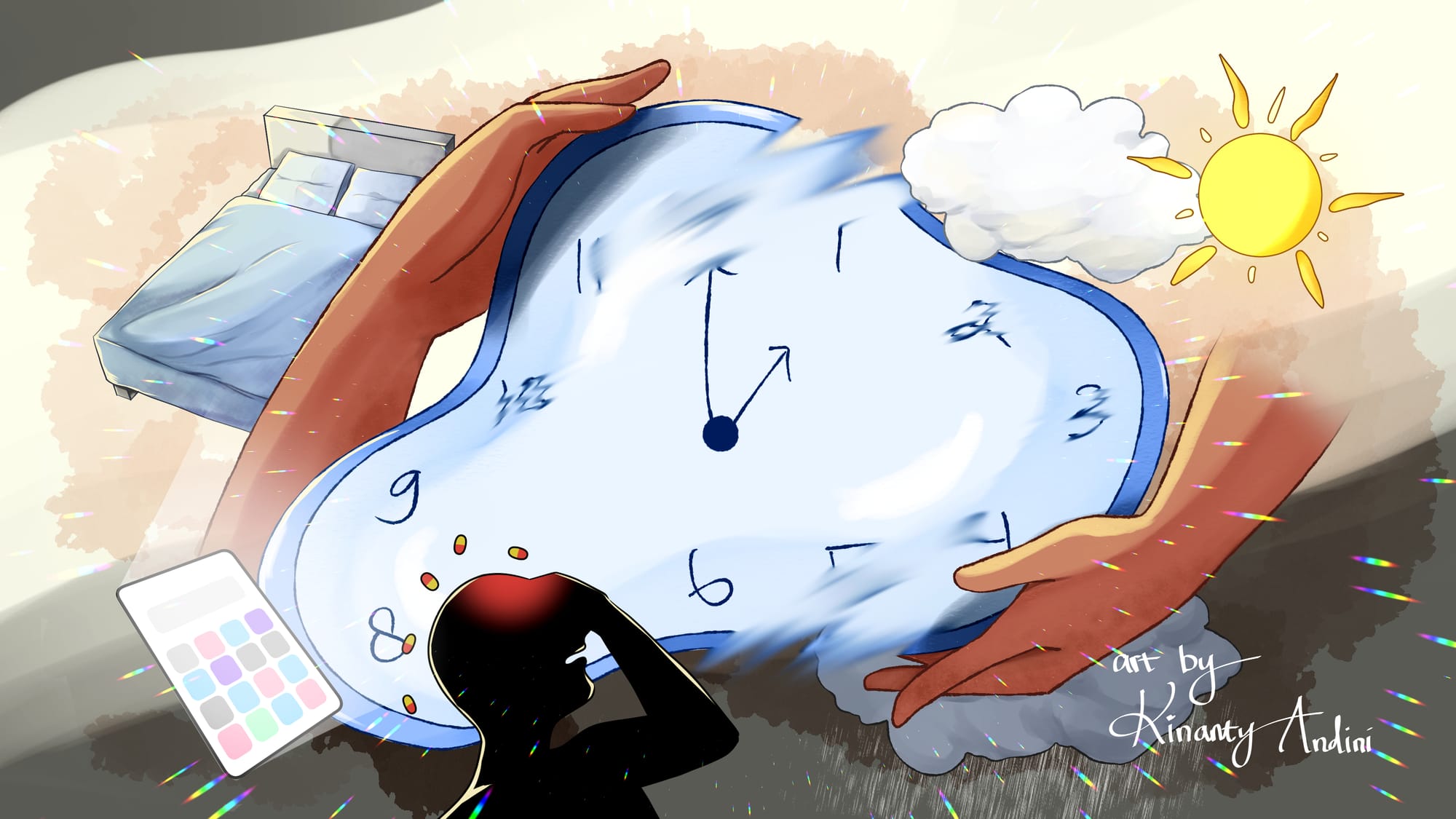
“Crip time” refers to the ways that experiences of disability change our experiences of time, and expectations around it. In the UK, creative artist Jamie Hale writes about how it gives us a “new kind of clock”.
As Jamie writes, crip time doesn't just shift the perception of days or weeks, “but also the life course that stirs the whole body”:
“Disability routinely disrupts and forecloses the normative development timeline. We experience our education interrupted, our careers fragmented, and our relationships strained by the unpredictability of our bodies and minds. The questions of milestones, such as marriage and children, also become complicated or closed. Those milestones arrive late, in the wrong order, or are replaced by others entirely.
“We can have a complicated relationship to ageing - perhaps having been seen as having an early wisdom that comes from the life management skills acquired through illness, or perhaps ageing faster physically or psychologically than we could have been expected to. For some of us, we may also live with the knowledge that our timelines could be genuinely shorter than those around us.
Crip time isn’t just about the movement through an individual day, but also about the ways a life accrues meaning outside the standard shapes that life is given to us.”
This is just one of a series of pieces that I've been loving from Jamie's substack, which I strongly recommend. Back-to-back brilliant pieces include:
- On Anger: “Until the moment where your narrative arc ends in triumph, you are that bitter, disabled person”.
- On Rest: “There is a tension between what our bodies need now and what we feel we need to have done before we can’t.”
- And on creating in a disabled timeline: “I write these blogs in bed, dictating to a computer screen, often with my eyes closed.”
Racing against the clock
Over in the US, there is an increase in Harvard undergraduates who need disability accommodations. J. Sellers Hill, writing in the Harvard Crimson, sees this as progress.
At the same time, the increase has led to “legitimate concerns about whether parts of the system could be vulnerable to misuse.” In particular, the question of “When should assessments depend on time?”. Hill answers:
“Grades should reflect mastery of course material. As such, timed assessments are only one tool — sometimes a good one, sometimes a poor one — to measure that mastery. In some contexts, time pressure is meaningful. If it takes a student four hours to translate a sentence in French, their fluency is certainly in question. In other contexts, speed is incidental. In many advanced problem-solving settings, arriving at the correct method and justification matters more than racing against the clock.”
Meanwhile, in Turkey, the Eskişehir Disability Solidarity Network led a May 1st demonstration with the slogan “Speed belongs to capitalism, life belongs to us”.
“How deaf are you?”
In the US, Sara Nović's new memoir Mother Tongue explores deafness. An extract in Bomb Magazine provides useful correctives in an extract from the book.
First on strangers asking “how deaf are you?”:
‘“How deaf are you?” hearing people often ask me. They crave a number, a specific percentage—twenty, fifty, eighty percent? I’m not even sure where the idea that deafness is measured in percentiles came from; it’s not, though my best guess is that it stems from a misunderstanding of the audiogram, the standard graph used to depict hearing sensitivity. Perhaps more confounding is why otherwise socially adept adults feel it’s okay to ask a stranger this question at all. To me, it feels both as prying and useless as asking someone, “How male are you?” or “What percent straight?” That people inquire as often as they do speaks to how foreign the notion of deafness is to most hearing people. Maybe, if they could just wrangle it with a nice round number, it would make more sense.’
And, vitally, on how to understand hearing aids:
‘People who haven’t used hearing aids or cochlear implants often assume these devices are corrective, working in the same way putting on glasses can restore many types of blurred vision back to 20/20. But hearing technology is not equivalent to prescription glasses. Hearing aids can amplify sounds, and CIs can convert and pass them to the auditory nerve, but neither can clarify or interpret them. Listening through hearing technology can be a bit like turning up the volume on an out-of-range radio station; the music gets louder, but so does the static. Though today’s devices offer directional microphones and options for different listening atmospheres, technology still pales in comparison to the cochlea and brain’s natural filtering capacities. Rather than glasses, a more apt comparison of medical technology might be a pair of crutches—they will help with mobility, but they won’t make the user walk “normally.” Most of the time, this distinction is not explained by audiologists or doctors to the technology users or, in the case of deaf children, their parents, setting in motion a mismatch of expectations that can have permanent consequences.”
Ready for the real world
Nović's memoir is also about parenting, and in the same extract in Bomb magazine, she writes:
“But to be born deaf today is, for most people, to begin life estranged from one’s parents.”
Expanding on this theme in conversation with Rachel Kolb, Nović contrasts today's parenting culture that emphasises the validation of children's feelings. But, “when it comes to disabled children”:
‘The experts immediately change their tune. Instead of respecting and validating kids, we should turn our homes and schools into training grounds that teach them how to look “normal” and get ready for the “real world.” The concept of the real world has always been very silly to me, as if childhood and school and home life are somehow not reality. But more importantly, how do we expect a child to succeed when they have no safe harbor, no relationship with the people who are supposed to guide them, no chance to just play and be a kid?’
On her newsletter Switchbacks, Rachel Kolb also spoke with Will Fertman, author of the Deaf Baby Instruction Manual. Fertman shared how he and his wife made decisions on discovering their son Oscar was deaf:
“We spent a lot of nights discussing it, and came to an agreement that the experts in this situation were going to be d/Deaf adults, folks who’d actually lived deaf childhoods. When we found them, their message was consistent: whatever you do with speech and hearing devices, also learn ASL [American Sign Language]. This fit with the actual scientific research we were finding.”
“I have to prove how mental I am”
Back in the UK, the Graeae theatre company shares experiences of people facing the assessments and cuts in the government's Access to Work support. From one anonymous testimony:
“During the call. I have to prove how mental I am. But not seem too mental because I know that is alienating and risks being thought of as being seen as ‘dramatic’ and ‘difficult’ and that you Kate with the nice Leeds accent are the one who makes the decisions so I can’t make you angry.. And that, that makes other people angry. And that if I’m too mental then the woman on the end of the phone with the northern voice will think that I need to be sectioned or something. And that I’m not doing enough for myself. Because I’m not enough.
“She wants to ‘understand a bit more about my illness’.
“It’s difficult, when you feel like you are on fire, in a situation that is directly threatening to your existence to discuss ‘in a reasonable tone so you don’t seem too mental’ why and how you are mental and how your mentalness impacts your ability to work. Especially when you haven’t largely experienced these things too much for the past three years because things have been going rather well so you feel supported and connected and the work is going really rather well and you are tired of course but the work is going in the direction you want it to be going in. So you have to cast your mind back to ‘the good old days’.”
The Duty of the State
Staying in the UK, our former Primer Minister Tony Blair warned that by the end of the decade the government might spend more on incapacity and disability benefits than our defence budget.
However, this is already the case: working age health and disability spending is slightly higher than defence spending. Frances Ryan sums up the dilemma:
“That these choices are not easy betrays the truth few are willing to admit: protecting its people from poverty, prejudice and ill health is as much the duty of the state as keeping them safe from war.”
And, speaking of those that are supported by the UK state, Tom Shakespeare points out that dependence can be a sign of high status:
“For example, if you describe a family who live in segregated accommodation, are looked after and have their meals cooked for them, go to special schools, do not look after their own money, have people to drive them around, and are likely to be stared at wherever they go, it might be imagined you were talking about a very dependent type of person. Yet you could be describing the British Royal Family.”
Shakespeare's quote is from his book Help, published in 2000. Thanks to Malick Reinhard for pulling it out in his post asking if disability is a rich person's issue?
“Label them an activist”
I recently wrote about the Met Gala in the US and how Aariana Rose Philip, was the first wheelchair user to star on its red carpet. Rose Philip described to Vogue the spotlight disabled people are put in:
“I think that for a long time, it’s been easy to see a disabled person in the public eye and label them an activist because we have no other choice but to speak up for ourselves in the spaces that we inhabit. Other people are not familiar with our bodies or how to accommodate us. We’re given the title of activist because we are challenging a social system. I think that people realise that there’s no choice but to do that if you have a disability in a major public space, because we have been so historically marginalised and pushed aside.”
“Lived experience is intellectual property”
Earlier in the year at the Zero Project in Vienna, one of the quotes going around the conference was from Sinéad Burke's keynote:
“Lived experience is intellectual property, and it is a set of skills. And that lived experience and intellectual property translates into a skill set not in spite of barriers, but because of them. And if we in this room are not creating the pathways for Disabled people to be leaders, systems will never change.”
Badge never worked for me
Meanwhile, still in the UK, Celestine Fraser (who also writes on the Debrief and is instrumental behind the scenes) did a great feature on the politics of sitting down. She wears the “Please offer me a seat” badge while on London transport, but:
‘The badge has never worked for me in the way it promised: I’m not often offered a seat. And yet I continue to wear it because it helps me in other ways. Once a seat does become available, it emboldens me to make a beeline for it, to unashamedly claim it, to not spend my journey sweating that I’ll be forced to get up for every person older than me. It gives me what Ysé [one of the people interviewed in the article] describes as a “safety net.”’
Accessibility Hindering
I'm grateful to accessibility consultant Christiane Link for coining a new phrase:
‘The growing demand for accessibility services has attracted a category of suppliers that I’d describe as “accessibility hindering.” They know the vocabulary. They can spell WCAG [Web Content Accessibility Guidelines]. They will tell you they’re “inclusive” in the first thirty seconds of the call, but if you ask them about the social model, they go blank or tell you something about social care.
They often can’t explain what it’s like to board a train in a wheelchair, how wheelchair boarding works at airports, or what happens when screen readers encounter poorly structured tables. Nor can they show how a good website functions or why requiring complaints for “reasonable adjustments” is unreasonable.’
Link's is another newsletter I regularly appreciate, about accessibility in transport. She recently wrote about the hidden labour when travelling and put in words something I feel too, after her recent stay at a Holiday Inn Express:
“That uniformity of hotel chains that some travellers find boring is genuinely useful when you’re disabled. Predictability is a form of accessibility. When you know what you’re getting, you conserve energy for the journey itself.”
Phantom model of disability
Going now to Latin America, Argentinian academic Gustavo Fulco told Yo También about how policy and legal frameworks just “stay as pretty words”, failing to change the lives of disabled people. Fulco calls this the modelo fantasma, “phantom model” of disability:
‘Unlike other, more obvious forms of discrimination, the “phantom model” operates subtly. It is present in policies that are not implemented, in spaces that are labeled inclusive but are not accessible, and in decisions that consider disability only symbolically.’ [Translation form Spanish]
“We need to talk less”
And, closing out in Mexico, where artist and activist Guz Guevara was given a medal of merit for defence of the rights of persons with disabilities, by the Congress of the City of Mexico.
In his acceptance speech, he recognised the medal as warming to his soul and ego, but also saw it as a reminder to the Congress of the “historic debt” they owe disabled people for surviving through centuries in a “system that continues to reject our existence”:
“I am tired of living in a world that constantly tells you ‘no.’ We need to talk less, give fewer speeches, and take more action.”
And, he closed, Hasta que el anticapacitismo se haga costumbre, “onwards to anti-ableism becoming a habit”.
Here's to that habit,
Peter
Outro
Further reading. There is a back catalogue of Debrief newsletters online, as well as a library of disability news from 170+ countries.
Let your friends know. Sharing the newsletter is how people find it!
For more from Kinanty, see her website.
Connect. Get in touch. You can find me on Linkedin and Bluesky.
Help us do more. The Debrief is free thanks to reader support.
Acknowledgements
With thanks to all the brilliant writers who help us see the world afresh through their words. To Kinanty Andini for her creative illustration of Crip Time. And to the readers and organisations whose support makes the Debrief possible.