
“An industry we cannot escape”
Dear Debriefers,
Today we're on another tour of the world with a disability lens.
We start at the Met Gala in New York. From there we go back to school and see the incentives that schools have not to be inclusive in their mainstream provision.
And, trying not to break our wheelchair on a US airline, we travel as far as Papua New Guinea. Plus, we see disability-gain in both journalism and for jousting parrots.
Explore the full guide of 108 hand-picked links: curated across 31 countries or 40 subjects. This edition continues from the update in April.
About this edition
The Debrief is published through a pay-what-you-can model. Thanks to Áine, M., and Mark for new contributions.
Peter Torres Fremlin is editor of Disability Debrief and is from the UK.
“An industry we cannot escape”
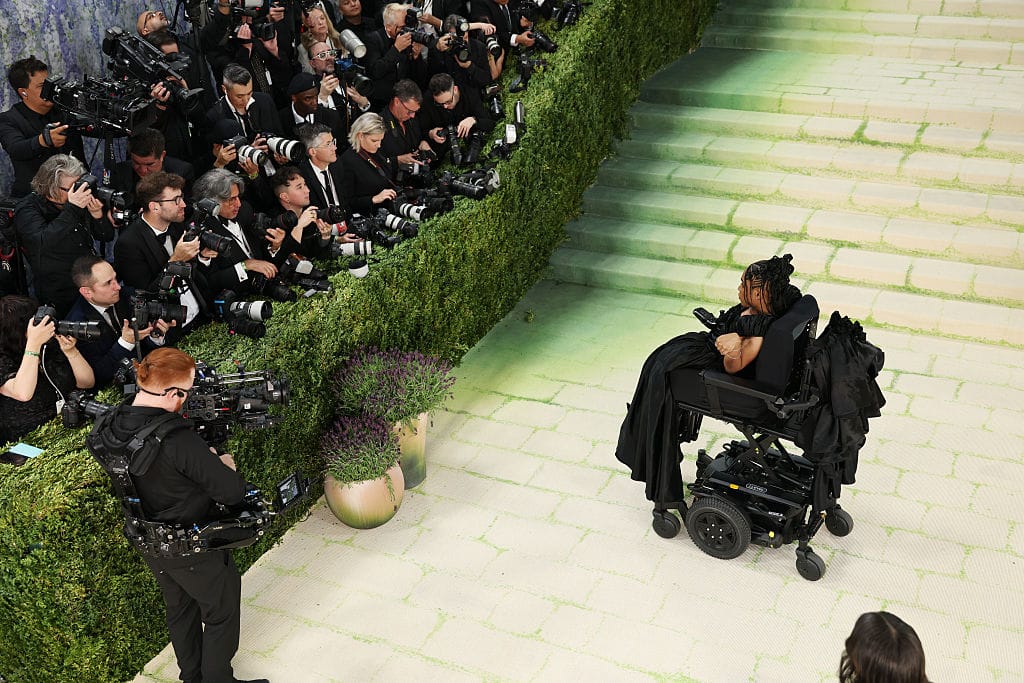
This year's Met Gala, sponsored by Jeff and Lauren Sánchez Bezos, included Aariana Rose Philip, a trans model and the first wheelchair user to star on its red carpet.
Philip was one of several disabled people at the Gala. Alongside their participation, the Met's 2026 exhibition “Costume Art” includes a section on Disabled Body featuring artistic representations from the ancient to the contemporary, and custom-designed mannequins of disabled bodies.
Inclusion of disabled people at the Gala and in the exhibition was supported by Tilting the Lens (friends of the Debrief). In Sinéad Burke's write-up of that work she shares how they found an accessible entrance to the Gala. The Gala is normally inside a tent stretching over two city blocks; extending it a further block allowed use of the Met's accessible entrance on the next street.
Burke also explains why she works on fashion, and the tensions in it:
“I know that for some, fashion is frivolous, expensive, and harmful. It can be all of those things, and it is also an institution that shapes culture, society, and is an extraordinary art form. It has an urgent responsibility to do better for people and the planet, but it is also an industry that we cannot escape from. We all wear clothes.”
And beyond these tensions, the visible and deliberate participation of disabled people in elite spaces naturally brings up tricky questions of who is co-opting who, and what message is sent by being at the “Bezos Ball”.
What does “inclusion” mean in such an exclusive setting? Do disabled people benefit from the stage it gives, or does their presence serve as a virtuous cover for the interests of the rich and powerful?
You tell me! Personally the impression I have is that the Gala's pop culture resonance gets far beyond the circumstances of the event itself (which, lest we forget, is fundraising for a public institution). It produced unforgettable images of people with physical disabilities turned out in the utmost glamour.
Schools have an incentive not to meet disabled student's needs
In Australia, data now shows that now 27% of Australian students are receiving an adjustment for disability at school. This is up from 18% in 2015, and the reasons for increase are explored by Linda J. Graham and Callula Killingly.
One of the reasons is that schools get more funding if more intense needs are identified in a student. This ranges from from $4,000 USD for those with “supplementary” adjustments to $32,000 USD for those with “extensive” adjustments. As Graham and Killingly write:
“There is no incentive for schools to meet children’s needs through accessible quality universal teaching – in fact, there’s a perverse incentive not to.
Meeting children’s needs at level 1 [where no additional financing is provided] currently means forgoing the additional funds that could be gained by providing adjustments later.”
Meanwhile, in Bangladesh, money also speaks in inclusive education. S M Toibir Prosshod writes about exclusion from education:
‘In Dhaka’s elite English-medium schools, disabled children access resource rooms, therapists and trained teachers. These schools charge 20,000-50,000 taka monthly [$163 to 407 USD], ten times what most families earn. For the poor, “inclusion” exists only in United Nations documents.’
Bridging policy and reality
“Bridging policy and reality”. In Papua New Guinea an overview of challenges and opportunities on disability rights is given by the activist Jerry Hensen. The article was published last month, after he passed away in January: “Disability support in PNG today stands at a critical juncture.”
Young leaders. In India, Young Leaders for Active Citizenship (YLAC) works with young people to become mobility champions:
“Last year, 40 Mobility Champions conducted 88 accessibility audits, surveyed 370 individuals, organised 8 empathy-building workshops with people with disabilities and mixed groups, reached 1,300 individuals through workshops and audits, and reached [160,000] cumulative online impressions and interactions.”
Lessons learned. The Inclusive Futures development programme shares its lessons learned from work in six countries over eight years. Among them are the importance of working on stigma-reduction. And, as Mark Carew, Narayan Das and Stephen Thompson write, on transport access:
“Even within holistic, multi-level interventions that aim to both support individuals and address structural barriers to inclusion (e.g. inaccessible workplaces, negative attitudes), access to transport is often treated as peripheral or left unaddressed entirely.”
“The biggest innovators and impact-makers”
New list. Forbes has released its Accessibility 200 list, which “highlights the biggest innovators and impact-makers in accessibility”. See previously for more about the business model of Forbes lists.
Ranking US airlines. Wheelchair Travel looks at the data on airlines handling assistive devices on domestic flights. In the rate of mishandled wheelchairs and scooters per 100, Delta airlines was the best performer at 0.43% and JetBlue Airways last place at 1.44%.
New leadership. In Europe, the European Disability Forum (EDF) has elected its new governing bodies for the period 2026-2030. Along with wider renewal in the board, Gunta Anča was elected President. It was high time for new leadership, and before this election Yannis Vardakastanis had been President since EDF's founding in 1999.
Inherent skillsets
In the United States, Andrew Leland has written on why (and how) blind people produce audio. Independent journalist Jason Strother told Leland how his disability adds to his work:
“There are inherent skillsets that a visually impaired person has that can make them a better radio journalist. [...] When I’ve been out in the field covering a demonstration, for example, I can’t see what’s written on the signs, so I’ll ask a protester, ‘Hey, what’s written on your banner?’ [...] They don’t realize I’ve deputized them as my in-field guide,”
Meanwhile, in terms of audio accessibility, check out Accessible Lines, a project that makes illustrations accessible through audio descriptions read by the artists, and enhanced with atmospheric sound production. Hatiye Garip introduces the project over on Illustration Research. I liked Circumcision Wedding by Uğur Altun.
And in terms of accessible media, Laura Wissiak shares the history of sign language at the Eurovision Song Contest.
“Bruce can't bite”: but finds disability-gain for fighting
In New Zealand, Bruce is a kea with a broken beak (a kea is a type of parrot). Some years ago he became famous for how he used pebbles as an assistive technology to clean himself.
Since then researchers have seen how his disability led him to a new way of fighting, and to the top of the pecking order. As described by the New York Times:
“Male keas typically bite one another around the neck. Bruce can’t bite; instead, he has learned to joust. He rushes his opponents and slams his lower beak into their bodies.
Jousting proved a clever strategy. Bruce consistently won his fights, and the other males deferred to him. One perk of becoming the alpha male: Bruce got to visit the bird feeders first.
[...] After enjoying a meal, Bruce permits lower-ranked males to preen his feathers and clean his bottom beak.”
What if disabled people designed the world?
In case you missed last month's Debriefs, check-out:
- The Weight of the House We Built, Alberto Vásquez Encalada rethinking questions of representation in the disability movement.
- Weathering the Storm: my piece on how the Debrief is sailing against strong winds impacting diversity and independent media.
- Finding my armour in threads, Tanzila Khan's on fashion and identity as a wheelchair user in Pakistan.
And for more from me, I recently joined a Tilting the Lens webinar asking What if Disabled People Designed the World?
All best for your own adventures in disability news, and for the world you design. With my best beak forward,
Peter
Recent News
This update has 108 curated links from 31 countries and regions, organized across 40 subjects.
You can explore it organized by subject or by country.
Subjects
- Accessibility and Design
- Assistive Technology
- Civil Society and Community
- Climate Crisis and Environment
- Communication and Language
- Conflict and Peace
- Culture, Entertainment and Media
- Data and Research
- Digital Accessibility and Technology
- Economics and Social Protection
- Education and Childhood
- Employment, Business and Work
- Gender Equality and Women with Disabilities
- Health
- History and Memorial
- Humanitarian, Migrants and Refugees
- Independent Living and Deinstitutionalization
- Indigenous People and Minority Communities
- International Cooperation
- Justice Systems and Legal Capacity
- Lived Experience and Opinion
- Mental Health
- Mobility, Travel, Transport and Tourism
- Policy and Rights
- Politics and Elections
- Relationships, Sex and Reproductive Rights
- Space Exploration
- Sport and Paralympics
- Violence and Harassment
Countries
Outro
Explore Further. All the links from these curated editions go into the Debrief library, which now has over 7,500 links from over 170 countries.
Let your friends know. Sharing the newsletter is how people find it!
Connect. Get in touch. You can find me on Linkedin and Bluesky.
Help us do more. The Debrief is free thanks to reader support.
Acknowledgements
Photo by Dia Dipasupil/MG26/Getty Images for The Met Museum/Vogue. Thanks to Celestine Fraser for help with its selection, and revision of an earlier draft.
Many thanks to everyone who shares links, news and reports, and the readers and organisations whose support makes this work possible.