I am not from here
Disability Debrief explores the world through a disability lens. The articles are open and available to all thanks to a pay-what-you-can model.
And please join me in welcoming Meritt Buyer to the Debrief! – Peter
Dear Debriefers,
How do you do it? How are people with disabilities being included in your country, your community, your workplace?
As someone who works in international development and disability rights, this is a question I have been asked dozens of times. From parents in Uzbekistan to non-profit workers in the US, people are looking for solutions.
Truthfully, I don’t think anyone is really doing it particularly well. But who am I to even try to answer such a question? Even though I am called on to offer advice, I'm sure that I’m the one who is doing the most learning.
I do not myself have a disability. But I work in this area, and I have a younger brother with intellectual disability. Being his sister is one of the most important parts of my life.
Yet I often feel that my work can go against several principles of disability inclusion. Ideally, international organizations should be shifting power to local communities. It would make development initiatives more responsive and sustainable, as well as following the principle of “nothing about us without us”.
There are deep failings within the development and humanitarian aid sector that make realising true disability inclusion fraught. Yet, ever an idealist, I hold on to the belief that there are ways to do it better, and I hope I can be part of that.
Would you like to write for the Debrief? Our open call for writing closes on Monday 2nd November. Thanks for so many submissions so far!
About this edition
Connected to community. Thanks to Chase who made a paid subscription to the Debrief and said: “Your newsletter has helped me feel connected to the wider community and been incredibly informative”.
Thanks also for new support from: Casey, Jamie, Maria, Melissa, and Sonia.
Meritt Buyer is a consultant in disability-inclusive development from the United States.
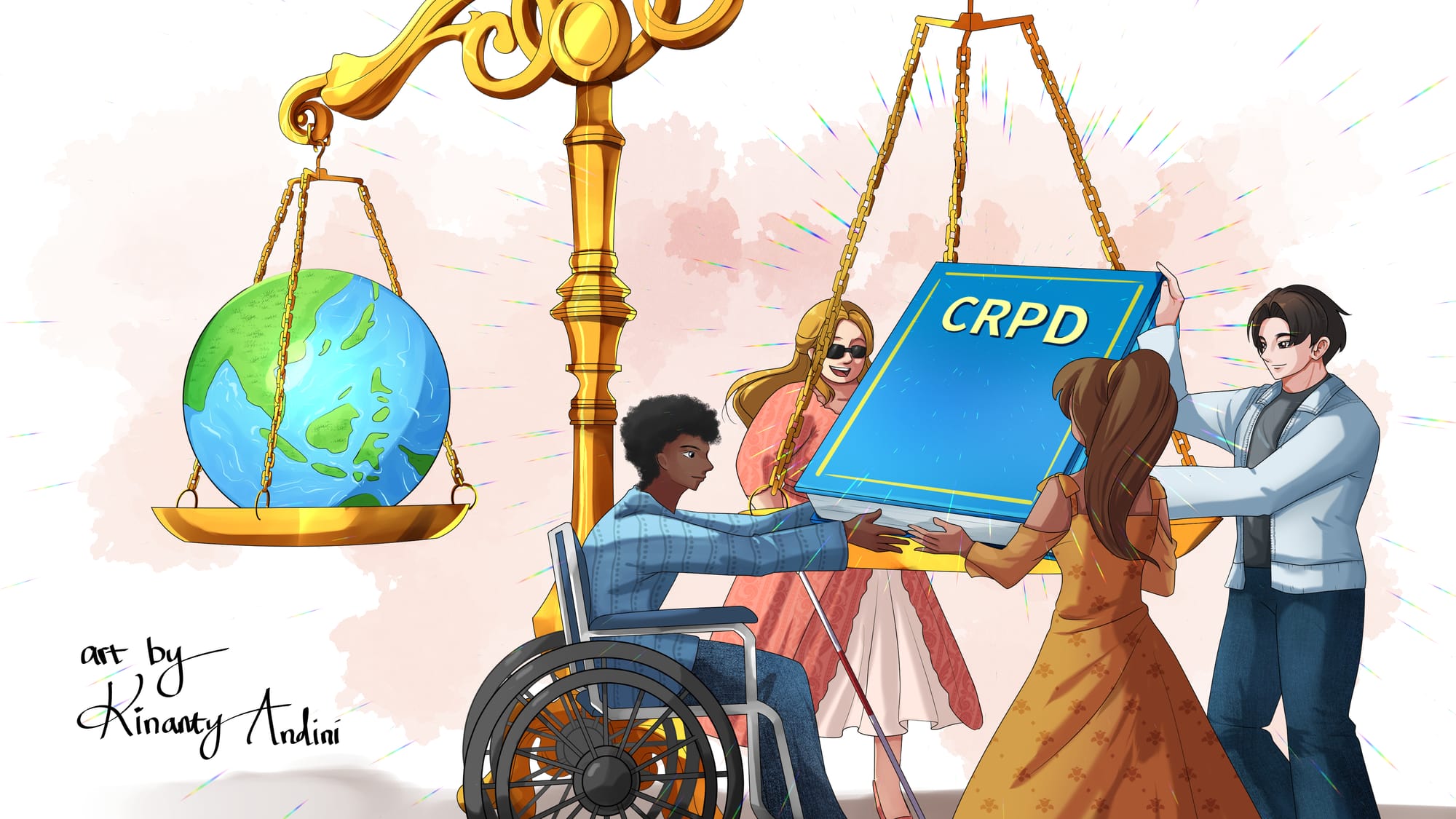
Kinanty Andini is an illustrator and digital artist from Indonesia.
I am not from here
The dry flat landscape stretches out into the hazy distance, nothing but sand as far as I can see. At 3 in the afternoon, the Kenyan sun is beating down. I can feel the sweat running down my back and behind my knees. My feet are covered in dust.
I duck through the door way into a small shop. A petite blind woman with a deeply lined face and a bright smile grips my hand as she proudly shows me around. She sells enough washing powder, snacks, oil, rice, and other basic necessities to feed her family.
The shop owner has my co-workers laughing along with stories about her neighbours. I nod and smile along. From my time living in Tanzania, I speak enough Swahili to understand about half of what she is saying. I could listen to her for hours.
I am a tall, white woman from the other side of the world. I do not have a disability. In this shop, I am the outlier in every way. But I am relaxed, laughing along with the group, grateful to be welcome here and for this small insight into these lives.
A career that comes out of personal experience
For my entire life I have been steeped in conversations around barriers, fights for access to services and efforts for inclusion. I have a younger brother with intellectual disabilities, my mom is a special education teacher and my dad a child psychologist.
From the time my brother was a toddler, my sister and I spent time in waiting rooms at physical, occupational, and speech therapists’ offices. I was not bored or impatient: these rooms were bright and colorful and the things my brother was getting to do looked like fun!
We proudly cheered his first hesitant steps around age two and when he started to say simple words shortly afterwards – we had no idea that this was not typical.
I marched in local parades with United Cerebral Palsy and hung out at the rehab hospital where my dad worked, making friends with patients who were my age. Even then I was aware how extremely stressful it is for my parents to navigate the system to get the support my brother needed then or needs now.
This upbringing led me to a career of work on disability rights and inclusion, some in the US, but largely doing international development work. I believe that these personal experiences make me better at my job, and have given me a different lens to see the world as well as the ability to relate to families like mine no matter where they come from.
But at the same time I am aware that I capitalize on some privileges to do this kind of work. I have never had to contend with an employers’ lack of understanding about access, or imagined medical concerns. Not to mention all the other barriers that many people with disabilities face when looking for work in international development.
Removed from reality
I am sitting in a windowless meeting room in a generic looking office building in Washington, DC. The air-conditioner hums quietly overhead, the recycled air raising goosebumps on my arms. My shirt feels stiff around my arms and I fight the urge to slip off my shoes under the table.
Everything about this room feels so far removed from that hot dusty yard in Kenya and the reality of inclusive development work. In doing this work, I am deeply aware of moving through stark social divides. It is rarely comfortable, and not usually when and where I would expect it to be.
A low murmur of small talk fills the room, everyone networking, gauging the value of other attendees. I spot a familiar face on the other side of the room and give a quick wave, grateful for the small connection.
And as I settle into a padded office chair to listen to the panelists, I wonder for the millionth time why, in this climate controlled room, twenty minutes from my apartment, in a language in which I am fluent, this always feels so hard.
We do this work outside of our walls
Over the last fifteen years, I have worked for US service providers, international NGOs and smaller community-based organizations.
I cannot overstate the respect and admiration I have for many of my colleagues who approach disability inclusive development work with passion, perseverance, and humility.
I would, however, like to share some of my experiences in this sector and patterns I have noticed. Primarily, that the charity model persists, not overtly, not by name, but it continually creeps in and undermines organizations whose stated objective is a more inclusive world.
Employers still sometimes see inclusive employment as optional or act as if they are doing people with disabilities a favor to hire them. They don't see everyone as equals who contribute to the work. We strive for real inclusion outside of our walls, but not necessarily within.
And ableism still exists everywhere, perhaps more so in the places that claim to have moved beyond it. Here are some examples of things that occurred while I was working in what was meant to be disability-inclusive development:
- As far as I know, I never had a boss who identified as having a disability. Or, for that matter, any senior leadership in any organisation I've worked for.
- In preparing for a strategy refresh, one organization sent out an internal survey that asked employees if hiring people with disabilities should be a priority for the strategic plan. As if it was a valid option not to.
- Upon learning that one of my co-workers had a disability, our manager acted like it was a big confession and a secret, shut the door and began to apologize.
- At one point, on a team of seven, I was the only one that had any prior experience personally or professionally in disability rights and inclusion.
- I have given trainings on inclusive practices for other organizations when my own organization was not following them itself. It was incredibly uncomfortable to answer that question – how do you do it?
A danger of reducing identity
I realize that navigating this space is not simply a question of reducing everyone's identity to whether they have a disability or not.
When someone takes the podium - how am I to know if they have a disability or not? Maybe they also have some other connections to disability, like being a parent or a sibling. And for those like me, who don't have disabilities, what place, if any, can or should we take to speak?
And even when the speaker does identify as someone with a disability, that doesn't mean they speak for the entire disability community. Or, indeed, that what they say is in-line with the principles of disability inclusion and rights.
The social divisions around this issue are complicated and deep. There are ongoing hierarchies in the disability community, and the divides sometimes leave out persons with intellectual disabilities, for example.
And lastly, if we are constantly counting the people involved who have a disability, we are in a very real danger of tokenizing them. I vividly remember cringing every time I watched a director pat themselves on the back whenever they engaged someone who “ticked the disability box.”
Showing up for each other
Humanity is an innumerable combination of identities, opinions, and experiences. And real sustainable change requires global participation.
Very few people would argue that advancing women's rights and empowerment can be done without participation of men. And the goals of the disability rights movement will not be achieved without work by both people with and without disabilities.
I think it comes down to how people engage. To make an inclusive world, we need to internalize the principles of human rights, and we are required to show up for each other. We are required to listen and learn as much and as deeply as we can. And be honest about what we don’t know or understand.
What I am describing is basic empathy and humility. We are still in a place where the disability experience seems so foreign to so many that they don’t stop to think that the same principles of social and emotional intelligence apply as they would to any other identity.
There are many valuable skills that can be contributed to the movement, whether you do or don't have a disability: in logistics, facilitation, writing, policy, and evaluation, etcetera. And they should be applied with empathy and equity.
I believe it is possible to do this work as a person without disabilities if you take the time to listen and if you don't pretend or assume you understand everything.
Systems falling apart
It is hard for me to imagine that there is anyone in the United States who has not felt the impact of the government lay-offs and budget cuts last year.
Whether you believe in the importance of diversity and equality, or benefit from health insurance, most of us have lost something and/or are living with a lot of anxiety about systems that we have come to depend on falling apart.
The closure of USAID, the US development agency, is estimated to have led to hundreds of thousands of deaths per year and catastrophic closure of programmes supporting disabled people. The full effects won't be understood for many years to come.
And it also had a deep impact on those of us who work, or worked, in humanitarian aid or development. So many of us lost our jobs in the past year. I count myself very lucky to have found a couple of consulting projects.
But among the people I know, it is those with disabilities who have been hit the hardest, and who seem to be having the most difficult time finding new positions. We have a very long way to go as a sector and as a society if we still cannot see the talent and potential that is being lost here.
One last scene
July last year, in DC under Trump. I am walking up the middle of Constitution Ave toward the Capital building. The sky is as blue as can be and the heat is shimmering off the pavement. A welcome breeze provides a hint of relief every once in a while.
A column of a few hundred people in blue t-shirts streams up the empty road – all braving the mid-day heat and humidity to protest the recent cuts to Medicaid and call attention to their impact on people with disabilities. The crowd is about as diverse as it gets, and the energy is palpable, both joy and indignation.
I am with a few friends who I have worked with for years. Two of us have a family connection to disability, others came to movement in different ways but with dedication and drive. I respect them all immensely.
Most of us are in some stage of job seeking, trying to stay connected to the work we love. It feels incredibly comforting to be here with them. Among this crowd of friends and strangers, this is the first time in a long time that I have felt truly hopeful.
A sign on the back of a woman's wheelchair captures the anger, pride, determination, and solidarity that we feel: “Judy Would be Pissed”. I feel like I am with a familiar community – I might actually be from here.
With love, hope, and deep appreciation,
Meritt
Outro
For more from Meritt, find her on Linkedin.
For more from Kinanty, see her website.
Further reading. There is a back catalogue of Debrief newsletters online, as well as a library of disability news from 170+ countries.
Let your friends know. Sharing the newsletter is how people find it!
Help us do more. The Debrief is free thanks to reader support.
Acknowledgements
A huge thank you to Peter for giving me the chance to explore these ideas and for so much support and patience along the way. And to Kinanty Andini for illustrating this piece.
To all the amazing colleagues, friends, and advocates who get up every day and continue to do the real work of trying to make this a better world. Thank you to all the readers and organizations supporting the Debrief and making these kinds of exchanges possible. And to my sister and brother, through everything.