
“Let's block more streets”
Disability Debrief explores the world through a disability lens. The articles are open and available to all thanks to a pay-what-you-can model.
Dear Debriefers,
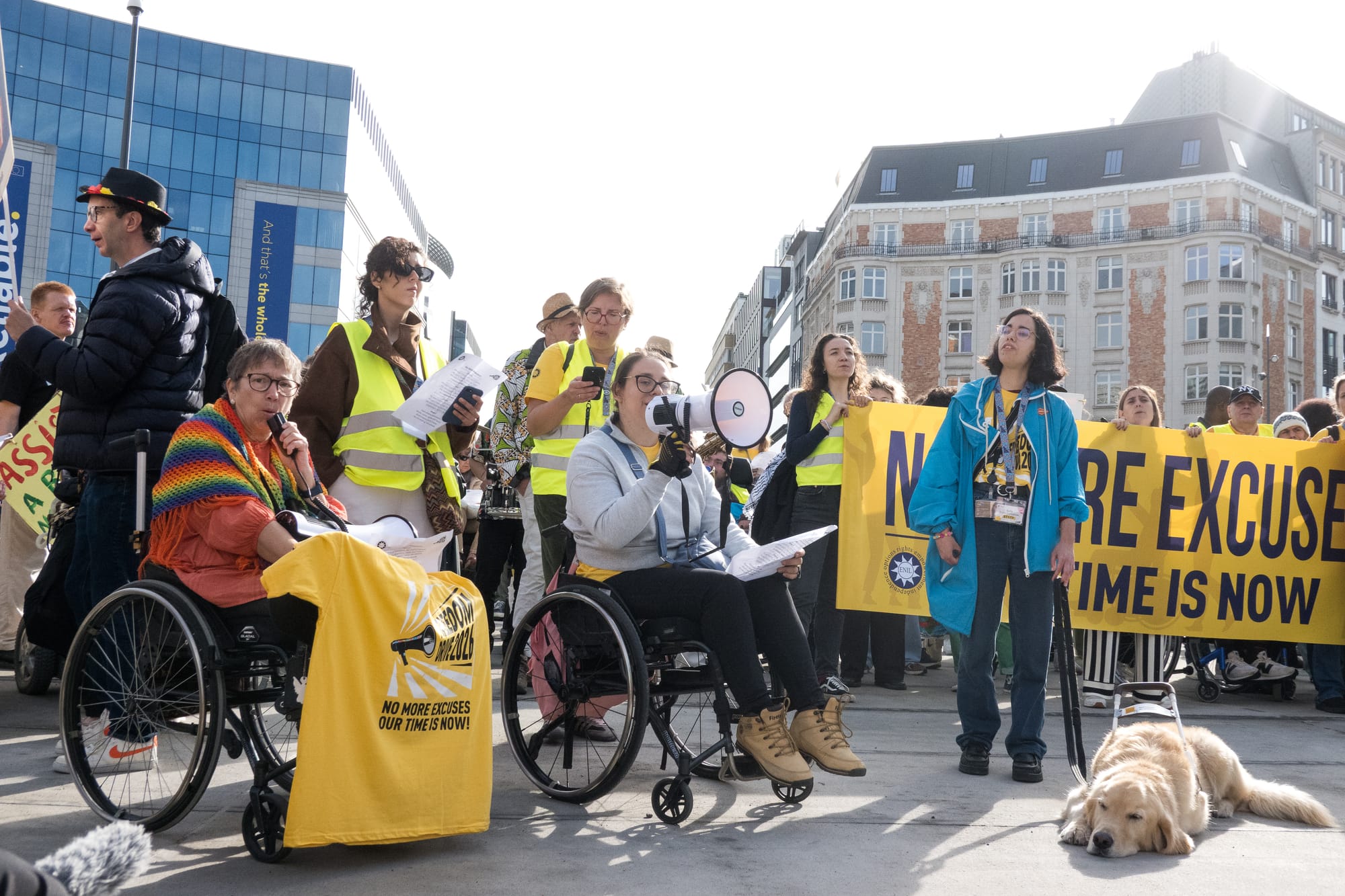
A few weeks back I was in Brussels, marching with hundreds of other disabled (and non-disabled) people on the European Parliament.
We were there for the European Network on Independent Living's (ENIL) Freedom Drive, which is part-conference, part-campaign, for disabled people in Europe to get the supports they need to live their lives as they choose.
It was my first time on Brussels' cobblestones, and I have the dents in my chair to prove it. The Drive took me further inside the independent living movement and its demands for radical change. And, in its heart-warming and heart-breaking moments, it showed how precious and fragile these connections are.
About this edition
Peter Torres Fremlin is editor of Disability Debrief and is from the UK.
Going onto the road
The Eurostar train from London is usually a pleasant experience (and you get access seats at a discount). But this time we were at the last minute bumped to the evening train because of a fault with the hydraulic lift needed for getting on the train with a wheelchair.
I travelled with Pete, my trusty physio/assistant/friend. We arrived in Brussels just after 9pm, and met its first access challenge on the sidewalks out the station: step inclines that pass for curb cuts. Crossing the road needs a small detour.
We meet further challenges as we roll up the hill to our hotel. I'd been warned about the cobblestones, but as well as these are the gutters running on the side of the roads. The steep curb cuts plunge even further, into the gutter, before rising sharply onto the road surface.
At one junction where I didn't think I could get onto the pavement on the other side, I realise it's time to drive a stretch on the road. I look up and down the street, quiet at night, just parked cars. I turn up the speed on my wheelchair and, as I go onto the road, declare “let's f*** about and find out”.
Europe is increasing segregation of disabled people
The campaign for independent living is much-needed in Europe. Even though European governments are supposedly committed to supporting disabled people living in communities, the number of adults with disabilities living in institutions increases. And confinement is funded even by the European Union itself.
A Eurofound report from 2024 found that in EU countries, over the past decade, the number of adults with disabilities (aged 18-64) in residential institutions increased by 29%, to over 900,000. Leading the pack in increase was France, which doubled their number of disabled people in institutions to 290,000.
At the conference I heard how there is even a pride in France over this approach of supposedly looking after disabled people. As CLE Autistes put it in 2020:
“French society seems to consider institutionalisation as an obvious and satisfactory response for disabled people, in terms of inclusion.”
I was further shocked to learn that the French desire for institutionalising disabled people is so great that they ran out of space themselves and send around 8,000 more to Belgium to be institutionalised there.
And, even though European Union spending currently has some rules being aligned with the UN Convention on disability rights, and shifting away from institutional settings for disabled people, these can be disregarded or manipulated. ENIL's research shows EU funds being used for large institutions in several countries in Eastern and Central Europe, as well as a new institution even in Brussels itself.
A conference led by people living the issues
Getting to the conference obviously involved more detours past expensive shops, and further complaints about cobblestones and curb-cuts. But arriving at the fancy Royal Library venue we see some accessible portable toilets outside and start to feel more comfortable.
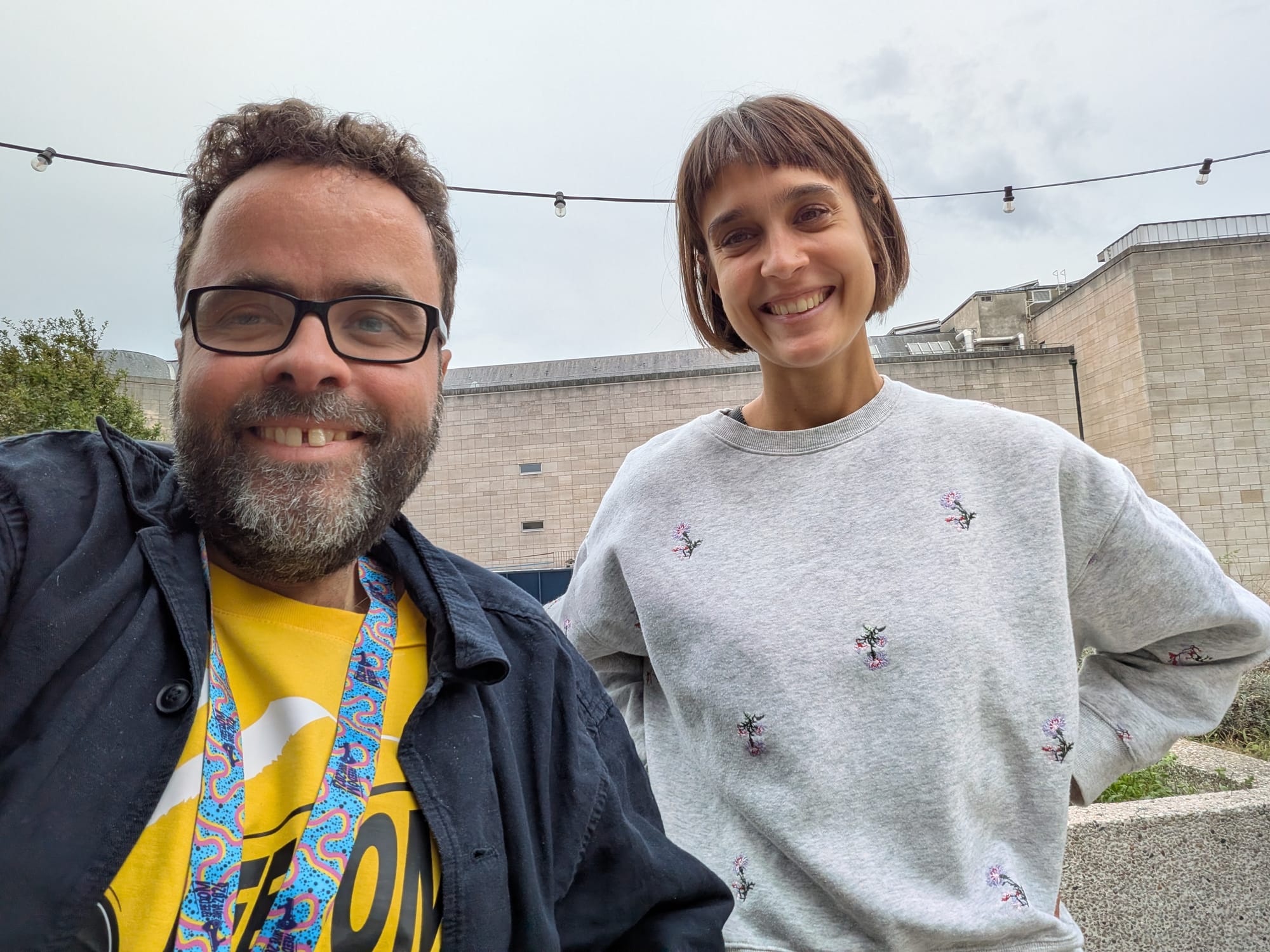
My main approach at these things is to mill about chatting. At the conference were several people I knew virtually but had never met, including several Debriefers. And one person I met in-person for the first time was Lea Labaki, whose article on the loneliness of life in community is a reader-favourite.
The Freedom Drive has a more down-to-earth feeling than some of the other international conferences I go to. While the attendees include policy folk and quite a few academics, it is more visibly led and run by people who are living the issues we're discussing.
Directing our own lives
Living independently has, after all, a very concrete manifestation in people's lives. It is the practicalities of support, or its absence, that determine the conditions disabled people live in, whether we can wake up when we like, and whether we can do the things we enjoy or go where we choose. (See more on the history of the movement in Teodor Mladenov's recent piece on the Debrief).
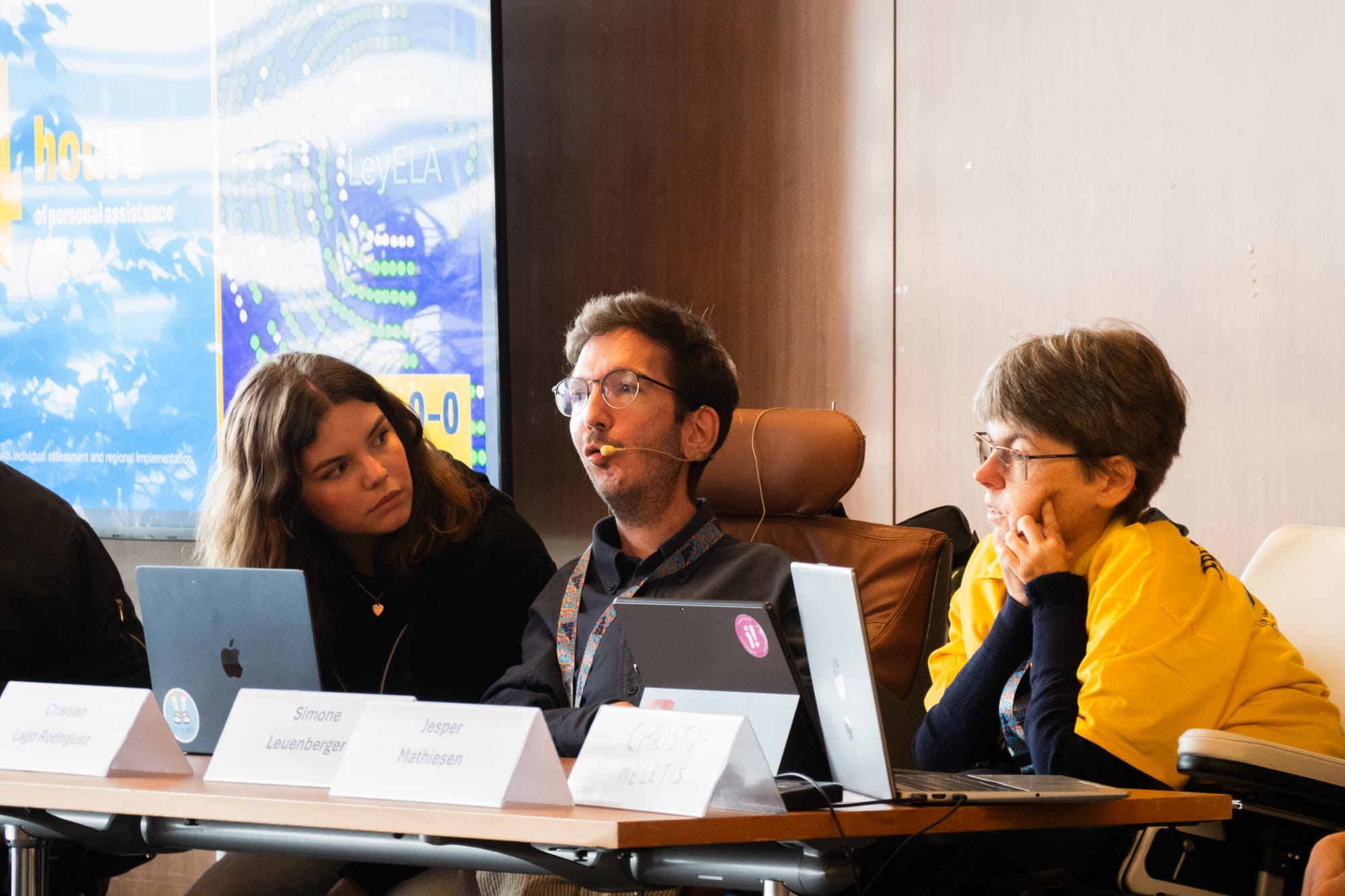
One speaker, who gave an example of these provisions was Cristian Lago Rodriguez, a Spanish advocate. He shared how, thanks to organised campaigning, personal assistance is gaining ground in Spain. In some cases disabled people can get 24-hours of personal assistance a day, and direct that support themselves.
As Cristian carefully traced out in his presentation, these gains come from successive changes through the years, and are based on the results of previous advocacy. While I, sadly, missed his talk, the last slide of his presentation made the acknowledgement to that history, and those who made it:
“To those no longer with us, whose work lives on in every right we have won.”
“We don't really like to adopt a defensive position.”
My days in Brussels also helped me resolve some of the questions I've had about the independent living movement.
The movement often takes absolute positions, like rejecting the word “care” or in the wide range of settings it sees as institutional. And in an era of increasing belt-tightening in government budgets, I wondered what it it means to be asking governments for more support.
I found among the conference attendees a diversity in opinion and approach, including those who took more gradualist or pragmatic approaches to deinstitutionalisation. And the radical positions that ENIL takes were explained to me by their Policy Coordinator, Florian Sanden:
“We don't really like to adopt a defensive position. We prefer to attack, you know? It avoids that you get backed into a corner and start justifying, which always puts you in a weak position. Not just to say ‘no more cuts’, but to ask to fully fund personal assistance. Then you have a chance that the opposite side has to justify things.”
And, thanks to the presentation of work from Teodor Mladenov and Miro Griffiths, I saw how the movement's demands for a very different world are combined with creating practical examples of what that world can be.
“Our time is now”
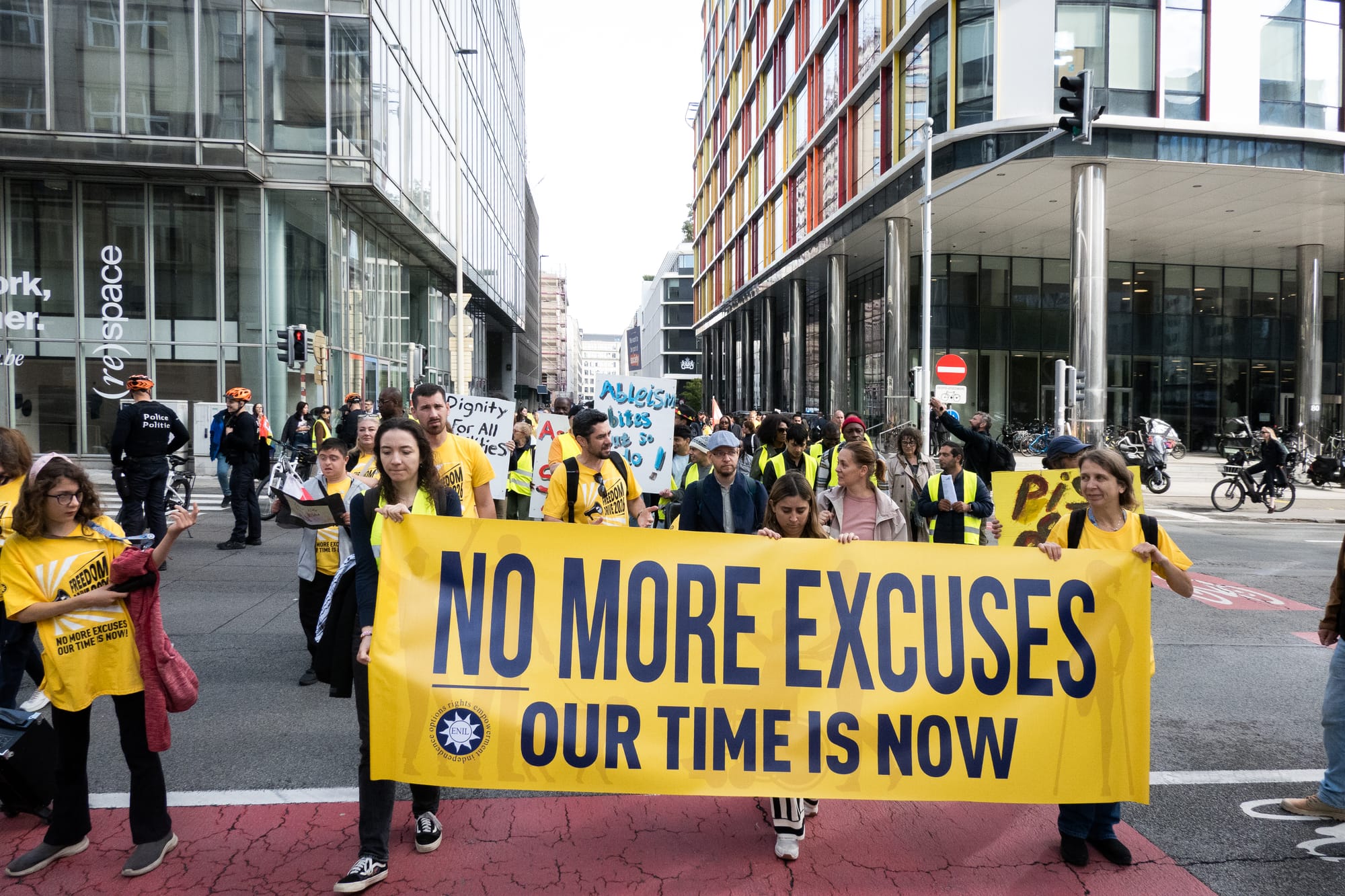
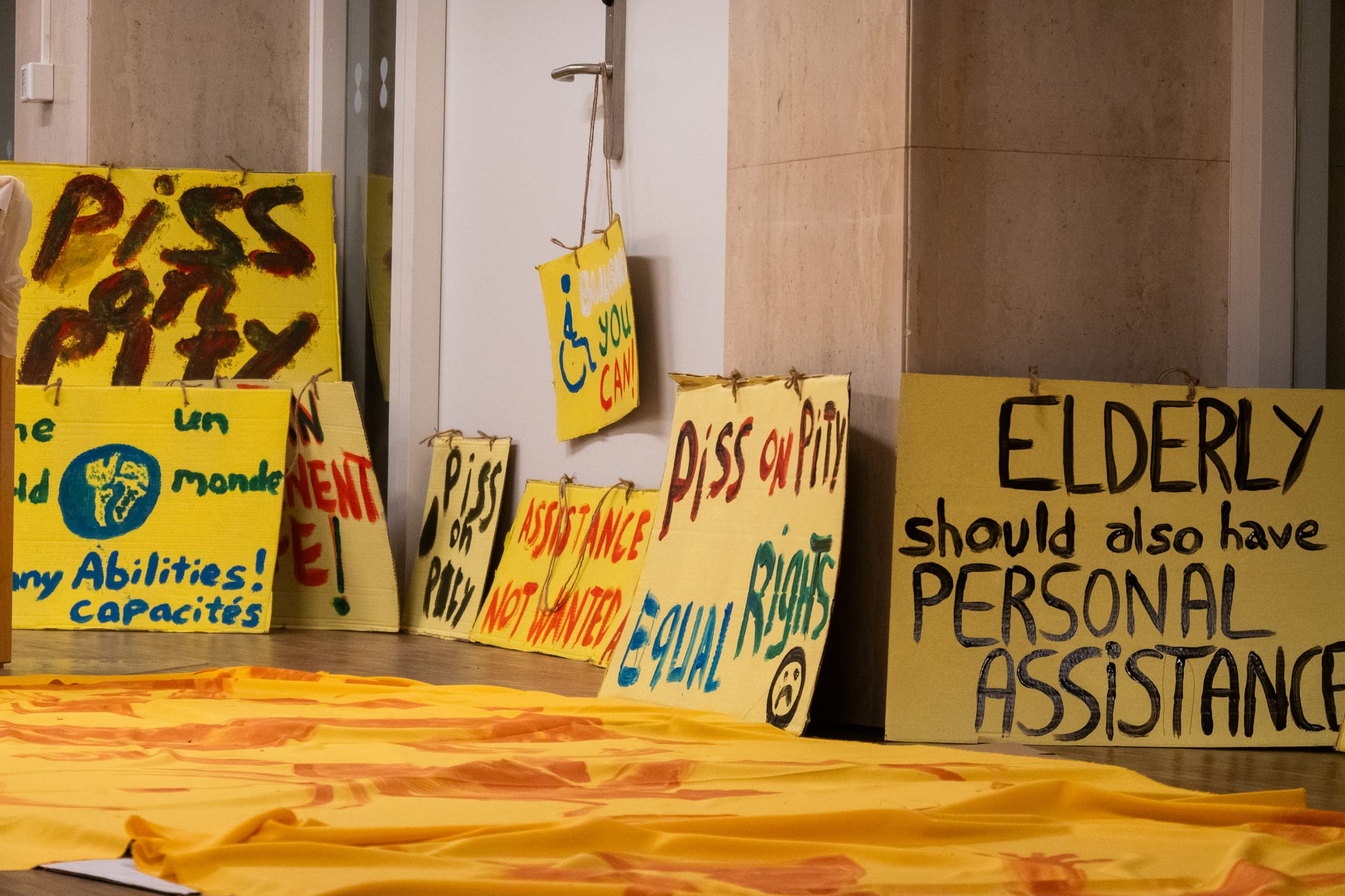
On the third day of the Freedom Drive we marched on the European Parliament.
The tram route to get to the start of the march from our hotel was not accessible (not all tram stops are next to the sidewalk). So back to scooting Brussels roads, where on one of the curb-cut challenges my chair is brought to an abrupt halt. Going onto the road I whacked into my footplate.
A few hundred of us are gathered, and there are speeches and even a protest song. As we roll onwards I hang about near the back chatting with people. Many carry flags, and I ask someone with a red and green-crossed flag on the back of their wheelchair which one it is. “Basque” I am told, in a tone of “now you know and you'll never ask again”.
My favourite moment is going down a central avenue with police blocking the roads so we could pass. There's a thrill to hear several lanes of traffic stopped and blaring their horns at you.
“Let's block more streets”
Entering into the European Parliament for the hearing, protest signs need to be put to one side, along with the Brexit feelings rising up in my throat. I show my Portuguese identity card.
I'm quite blasé and perhaps cynical about panels as a form of advocacy, but I recognise there can be an important symbolism in them. We saw people like us on stage, using wheelchairs, with visible disabilities, a speech impairment or using a ventilator. And Roberta Metsola, the Maltese President of the European Parliament came in with her entourage, made warm remarks, and, as she left, put on the yellow Freedom Drive t-shirt.
There was also a technical discussion of the European Union's multi-annual financial framework. Even though the EU funds can already be misused to support institutions under the current rules, the new budget framework is proposing that those social requirements be made more flexible, and countries given more latitude over how they spend their money.
These changes could mean even more investment of the two trillion euro budget in efforts that further segregate disabled people.
Katrin Langensiepen, a disabled Member of the European Parliament from Germany gave us a rallying cry – “let's block more streets”. She spoke about the governments we face, and need to fight against:
“They smile. They laugh. They spit, especially for parents of children with disabilities. They cut the money for personal assistance. They cut the money for our rights. And here we must be loud and clear and block more streets, again and again”.
A precious and fragile collective
After so much of our lives that need to be lived on the margins and in their detours, it's moving to be recognised in a place with status and power. And we came together despite the many barriers we face to do so. (ENIL told me they coordinated hundreds of individual access requirements to make the event happen.)
Perhaps because of the stress of my own logistics I didn't really feel a collective emotion in the moment. But looking back I do feel the magic of coming together with people like me, and sharing our aspirations for a world that supports us. It's something fragile, that we can't take for granted.
The conference itself ended on a heartbreaking note, although most of us only found it out later. On the last day, Cristian, who shared the situation in Spain, became unwell and went to hospital. He was stabilised and put in intensive care before passing away on the 10th of October.
Cristian is one of the advocates whose work and example made personal assistance possible. I regret not getting to meet him. Although, as he named in his own presentation, his work lives on in the rights he helped to win.
Finding freedom
I got back fed-up and exhausted with Brussels streets and with duct-tape holding together a footplate in need of repair. In my five days there I did more driving on the road than I'd done in the previous five years of using an electric wheelchair.
But I'm proud of myself for making the journey and grateful to the people (especially physio Pete) and the wider circumstances that made my trip possible. Making that kind of journey is something in the spirit of an aptly-named “Freedom Drive”.
Freedom is, after all, the point of all our efforts on disability inclusion, rights, or justice, whichever slice of that you sign up to. We are striving to live our days as we choose, take a train somewhere we haven't been before, to join with our friends, and to roll up for something we believe on.
It's the freedom to dream of a better world, and in the time we have together, however short or long that is, the freedom to cross some roads, and to block some others.
Peter
Outro
See also ENIL's round-up post after the event.
And for more on the international disability movement, see the Debrief's further reporting.
Let your friends know. Sharing the newsletter is how people find it!
Connect. Get in touch. You can find me on Linkedin and Bluesky.
Help us do more. The Debrief is free thanks to reader support.
Acknowledgements
Thanks to Nicolas Wissler and ENIL for the photographs (except for the one of Lea and I, which was a selfie).
Thanks to Peter Vaughan for the assistance through the trip, being such a positive travel companion, and for doing great work with the duct tape. Pete's time was funded by the UK government's Access to Work programme.
Thanks to ENIL for what must be quite a fearsome organisational task! Especial thanks to Christos, Florian, Kamil and Melike for answering all my questions in preparation for the article. And to everyone I had the pleasure of speaking with at the conference itself.
Thanks also to Celestine Fraser for the alternate text for the photos.
And, as always, to all the readers and organisations whose support makes the Debrief possible.