
Rise and fall
Dear Debriefers,
Hope you're all doing well. I'm back from my August publishing break, and getting back into the swing of disability news.
We start off with the far wrongs of the far right in Europe, and then see new research on the impacts on disabled people of Trump stopping international aid.
There's also a great case study on the rise and fall of an advocacy organisation in Kenya, updates on disability media and how you can garden with an energy-limiting illness.
Welcome back to another world-tour of disability news...
Explore the full guide of 119 hand-picked links: browse across 40 countries or 39 subjects. This edition continues from the update in July.
About this edition
The Debrief curates disability news from around the world with support from readers. Thanks to Cara, Stephane and Zara for renewed support.
Peter Torres Fremlin is editor of Disability Debrief and is from the UK.
Far right rising
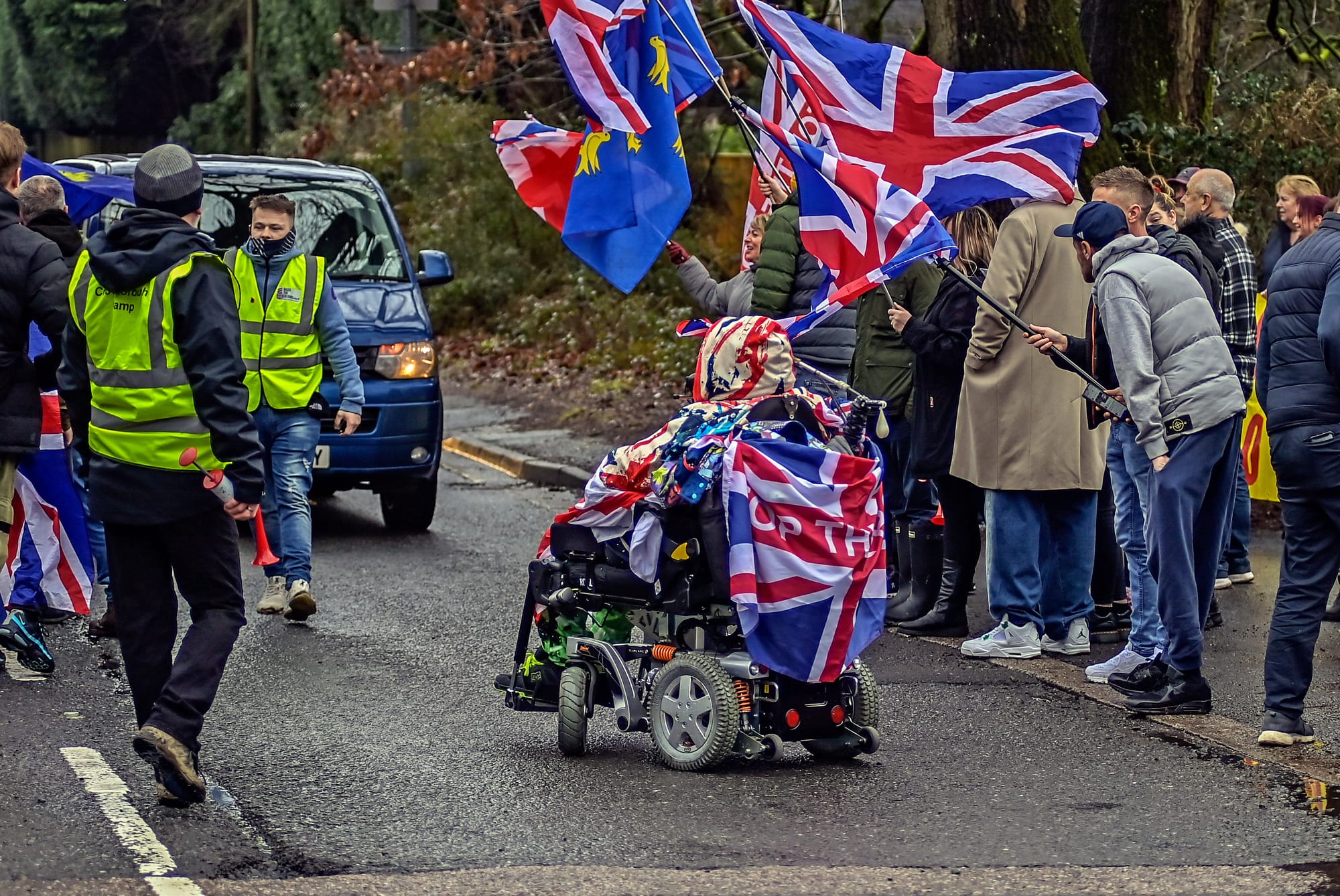
Across European countries, the politics of the far right continue to surge. And as the photograph from the UK shows, the relationship with disability is not a straightforward one. One (not necessarily consistent or true) suggestion of the new politics is cutting supports to migrants to allow more support for citizens.
I'm just back from a couple of weeks in Germany, where the Alternative für Deutschland (AfD) are top of the national polls and just secured a historic win in the state of Saxony-Anhalt.
The AfD declared that, in education, the “inclusion experiment has failed and must be ended”, proposing instead to expand segregated schools for children with disabilities. They have also suggested some increased benefits for disabled people.
However, as with other countries, the rise of the far right is also accompanied by denigration of disabled people, and attacks on rights, and, in Germany, positive references to the Nazi past.
Ulrich Siegmund, the charismatic leader of the AfD in Saxony-Anhalt, was declared by Der Spiegel the “most dangerous man in Germany”. A couple of months before he swept to victory he picked up his shirts from a workshop for disabled people, commenting: “Was für eine Motivation!”
Meanwhile, in France, the threat of the National Rally coming to power include: making eligibility for disability benefits more dependent on administrative status or nationality; departure from rights-based approaches; and possible attacks on public-funded associations supporting disabled people.
“We have lost our voices in the community”
Last year's sudden closure and dismantling of USAID, the United States' agency for international aid, is one of the most damaging things this Trump administration has done. It is estimated as leading to hundreds of thousands of deaths per year.
When I reported on it last year, the devastation was clear but it was hard to understand exactly how much USAID had been working on disability.
But new research from Inclusive Development Partners, which used to implement USAID grants, shows us the extent of the impact. They provide the best estimate we have of disability-related USAID support:
“Survey respondents estimated that the projects collectively aimed to help approximately 349,000 beneficiaries with disabilities at the time of closure, with approximately 137,000 in Africa and 65,000 in Asia.”
This is just across 82 projects surveyed – and even if they might have disproportionately focussed on disability, this number is a “documented minimum” rather than the total, which might be much higher.
The cessation of these programmes was catastrophic, and especially so in their abruptness. One mother in Nigeria said “Our children are out on the streets” because of the closure of USAID-supported schools. In several countries, parents began to feel “cut off from the future they had begun to imagine for their children.”
A disabled person who worked for a USAID program in Kenya lost his job said “my life crashed”. And organisations of persons with disabilities which had been the visible face of USAID-funded programmes faced the anger when it closed: “they said we lied to them”, said one in Liberia. And in Nigeria: “We have lost our voices in the community”.
Rise and fall of and advocacy organisation
What happens when advocacy organisations develop and then fade away? Over on Mad Thinking, there's valuable case study of Users and Survivors of Psychiatry Kenya (USP-Kenya) researched by Debriefer-favourite Alberto Vásquez Encalada.
Some of the general trends will be familiar to many: what started as voluntary initiative based on peer-support then grew quickly with support, largely from a single donor. Then, with loss of funding and leadership transitions, it faded away.
Alberto presents the lessons in terms of managing rapid growth:
“Growth can be exciting, but it needs to be intentional and supported by investment in people, shared leadership, organisational systems, and a broader funding base. Structures that distribute power, clarify responsibility, and enable accountability are essential to sustaining movement work. Administrative and governance systems also matter because they help an organisation care for its people and protect what they have built. Boards need the capacity to provide direction and oversight, while knowledge, relationships, and responsibility need to be shared so that the work can continue through funding losses, leadership changes, illness, or periods of distress.”
Many of these issues echo what we've seen at the international level.
The case of USP-Kenya has a poignancy to it in an “ending without closure”:
“In the absence of a clear final moment or shared account of what followed, a sense of unresolved loss ran across the interviews, and some people remained without clear information about what had happened.”
The platform for collective advocacy may be gone without saying goodbye, but the research shows how USP-Kenya left an important legacy. Networks persist, some local groups continued independently, and former staff and participants who continue important work.
Do advocacy organisations need to be built to last for longer?
Shift the power
For more on disability in international development, see:
- a brief from Center for Inclusive Policy on Official Development Assistance,
- recent United Nations guidance on mainstreaming disability inclusion,
And an example of doing development differently comes from ADD International (who also support the Debrief). The outgoing co-CEO Mary Ann Clements reflects on “shift the power” as a call to action, and how the organisation worked to find funding “to support approaches which served the needs of disability activists rather than funders”.
Making disability media
In the US,
- Julia Métraux spoke with Andrew Pulrang about covering the disability beat under the Trump administration.
- Grant Stoner writes about the vanishing art of disability reporting in the gaming industry.
- All in Frame is a new “free stock photography collection led by disabled creatives”.
In India, Priti Salian assessed disability representation in the coverage of anti-government protests.
And for more disability newsletters:
- Disability Rights International has a new newsletter on deinstitutionalisation, The Meeting Place.
- There's a growing community of folk writing on disability and chronic illness on Substack these days. An extensive directory of them has been curated by Illness and Insight. (The Debrief isn't published on Substack but I have a personal profile there).
“Raging for 500 years”
Today's arguments about benefits have been “raging for 500 years”. David Turner's research in the UK shows how suspicions about fraud and bureaucratic battles go back to the first formalisation of welfare systems, five hundred years ago.
In Nepal, Disability Justice Project has gathered unique testimonies of Deaf women after the floods, filmed by Bishwamitra Bhitrakoti. And this article on Kathmandu Post shares how a disabled couple offered shelter to more than 200 people.
In Pakistan, a nice feature on what accessibility means for disabled women, by Mahvish Nazar.
Standing up to stigma: an academic paper on stigma resistance by adult self-advocates with intellectual disabilities and a personal reflection from Madi Snow-Gould on how to get proud. In both cases, advocacy is part of it.
“Because everyone deserves the joy of gardening”
“Because everyone deserves the joy of gardening”. Tips on gardening with an energy limiting illness by Chronically Seeking Joy.
And before you go out into your gardens, do catch-up on last week's Debrief: a piece from Rwanda where traditional perceptions meet global views. It's by Evariste Karangwa and he shared his decades of experience in inclusive education there.
Let me know what you plant,
Peter
Recent News
This update has 118 curated links from 40 countries and regions, organized across 39 subjects.
You can explore it organized by subject or by country.
Subjects
- Accessibility and Design
- Ageing
- Assistive Technology
- Civil Society and Community
- Climate Crisis and Environment
- Communication and Language
- Conflict and Peace
- Culture, Entertainment and Media
- Data and Research
- Digital Accessibility and Technology
- Disaster Risk Reduction and Crisis Response
- Economics and Social Protection
- Education and Childhood
- Employment, Business and Work
- Gender Equality and Women with Disabilities
- History and Memorial
- Humanitarian, Migrants and Refugees
- Independent Living and Deinstitutionalization
- International Cooperation
- Justice Systems and Legal Capacity
- Lived Experience and Opinion
- Mental Health
- Mobility, Travel, Transport and Tourism
- Policy and Rights
- Politics and Elections
- Space Exploration
- Sport and Paralympics
- War in Ukraine
Countries
Outro
Further reading. All the links from these curated editions go into the Debrief library, which now has over 7,900 links from over 170 countries.
Let your friends know. Sharing the newsletter is how people find it!
Connect. Get in touch. You can find me on Linkedin and Bluesky.
Help us do more. The Debrief is free thanks to reader support.
Acknowledgements
The photograph is by Stuart Brock/Anadolu via Getty Images. Thanks to Celestine Fraser for help with its selection,.
And many thanks to everyone who shares links, news and reports, and the readers and organisations whose support makes this work possible.