
Reimagining and Rebuilding
Dear Debriefers,
I'm pressing send on this one from Vienna, where I'm attending the Zero Project Conference. Do say hello if you're here in person! And plenty of sessions are live-streamed if you'd like to follow proceedings from afar.
This edition is a tour of world news and how disability fits into it. We see how disabled people are playing a role in Syria's reconstruction, and how disabled people are caught in the chaos in the US.
There are some policy and legislation updates, reflections on disability journalism, a Barbie doll and a trip into space. But we start with some thanks to new supporters and a question coming out of the Debrief reader survey.
Browse highlights below, or explore the full guide of 116 hand-picked links: curated across 40 countries or 36 subjects. This edition picks up from the update in January.
With thanks to new supporters
Disability Debrief is published through a pay-what-you-can model. Thanks to Robert Bosch Stiftung who have given a three-year grant to help us in connecting the disability community. Thanks also to ADD International who renewed their previous support for causing good trouble for a good cause. And to Anna for a new contribution.
Peter Torres Fremlin is editor of Disability Debrief and is from the UK.
Does the Debrief leave you hopeful or discouraged?
Thanks to those who have been filling out the Debrief survey. I'm closing it next week, and more respondents before then will help shape how we go forward.
Here's one example of the kind of question I need your guidance on. On the one hand, Brittney appreciates the coverage for being uplifting:
“I am thrilled to get disability-related news in my inbox. It helps me find the glimmers of hope in the world and it shines a light on the people who light them.”
But on the other hand, another reader finds the Debrief too negative:
“Overly heavy on current events news in a way that seems very negative. I get everything is on fire, not saying we pretend it isn't, but it's discouraging.”
Last year global politics changed quite substantially, and in ways that profoundly affected the community the Debrief writes for.
As the world changes, how I write about it needs to evolve: I appreciate your feedback on what is and isn't working for you.
Let me know! Fill out the reader survey.
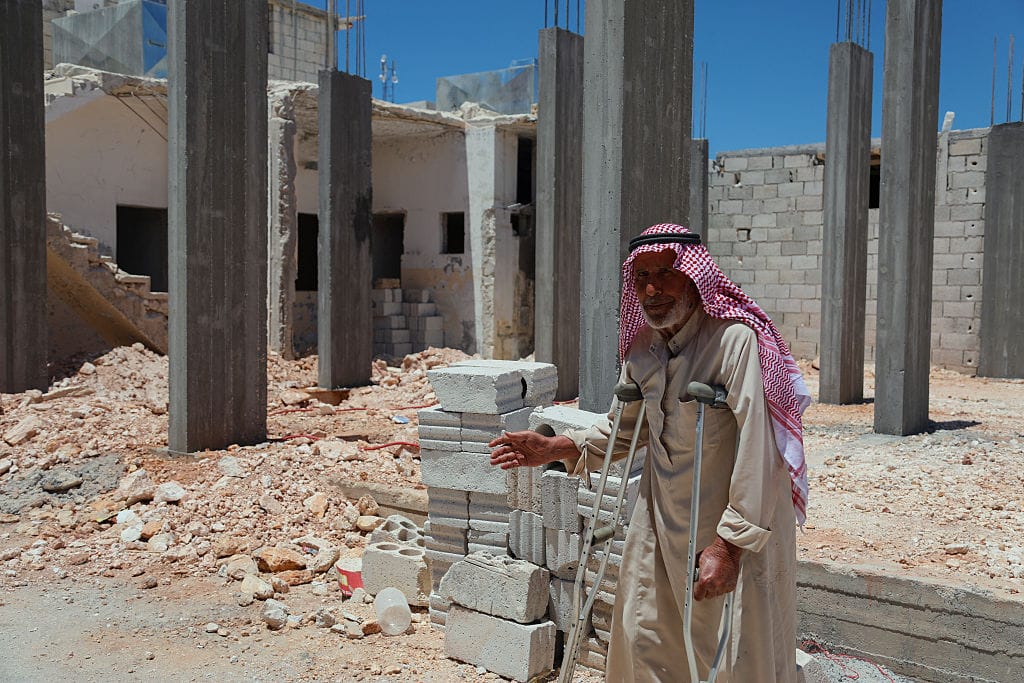
Reimagining and rebuilding
In Syria, the fall of the Assad regime in December 2024 opened many questions about the country's future. One of those is the place of disabled people, including the 1.5 million who acquired war-related disabilities.
Salma Daoudi reflects on disability and the political afterlife of violence, and how it leads to reimagining justice and what the country will become. Daoudi writes about the need to embrace “embodied histories of loss and resistance”. This means that addressing disability:
“Is therefore to confront the political economy of harm that outlives the regime change, including the institutions that decide who is rendered legible as a victim, which injuries count as public wrongs, and how rights are made operable, or withheld.”
This recognition isn't a “peripheral humanitarian issue, but a core political question for a just transition”. And disabled people themselves are among the political actors shaping where the country goes:
“Through grassroots organizing, mutual aid networks, and advocacy campaigns, [war-disabled Syrians] are insisting on accessibility, inclusion, and accountability as foundational principles for Syria’s future. In doing so, they challenge binary narratives that cast them only as heroes or victims, asserting instead their right to shape the society they helped bring into being.” (2025, POMEPS)
Falling between the cracks
The question of which disabled people are understood as unjustly treated is on stark display in the Israeli genocide in Gaza.
In Israel, Sharon Althul writes on the country emerging from war and its disability system facing a “defining test”:
“The events of the past year have made clear that accessibility is not a niche issue but a national resilience measure. Emergencies expose weak points quickly: unreadable signage at clinics, inaccessible updates for people with sensory disabilities, insufficient transport options for those with mobility challenges and overstretched mental-health services.”
Meanwhile, in Palestine, Humanity and Inclusion update on the situation of persons with disabilities in the occupied Palestinian territory: Falling within the Cracks.
Paramilitary force terrorizing US cities
In the United States, the Immigration and Customs Enforcement (ICE) agency now has a budget larger than most countries' militaries.
The havoc that ICE is causing poses a danger to the disabled community. Aliya Rahman, disabled and autistic, was dragged out of her car. That assault on her was “nothing compared to what I experienced inside [the] detention center, both what happened to me and what I saw happening to others”.
The American Association of People with Disabilities offers resources and news relating to ICE violence, including mutual support.
In other news from the US, see some rays of hope: Marianne Dhenin spoke to disability justice organizers about where they find their motivation going forward.
“An institutional shift in how disability is perceived”
A global directory of disability legislation: Valuable 500 and Baker McKenzie have made a guide to disability laws and policy, with a focus on employment, across 100 countries.
In Armenia, it's great to see reform of the system for classifying disability, described by the Center for Inclusive Policy. Armenia was one of many countries using the Soviet system of classifying disability into three groups. This causes many issues today, including that of corruption (see previously in Ukraine). As such, reform of this system is an important example for post-Soviet countries, as well as what it did for the country itself:
“What Armenia has accomplished is not just a technical upgrade, but an institutional shift in how disability is perceived and addressed.”
In Norway, the Parliament incorporated the UN Convention on the Rights of Persons with Disabilities into its Human Rights Act.
However, in Indonesia, a newly ratified Criminal Procedure Code creates concerns about due process for people with disabilities, explored on Disability Justice Project.
Shaping the future of journalism
Reframing Disability asked disabled journalists how they saw the future of journalism.
Cara Reedy, who founded the Disabled Journalists Association, shared where she sees innovation happening, and the Debrief's place in that. As well as media outlets that include disability in their coverage:
“There is also a growing ecosystem of Disabled-led newsrooms, Disability Debrief, New Mobility, The Sick Times and our newsroom at the Disabled Journalists Association to name a few. These small newsrooms are covering disabled people in the most organic, rigorous and thorough way. They are experimenting with accommodations and work flows to create spaces that work for everyone while operating on small budgets. Disabled people are the ultimate system hackers. Imagine what they could do with full investment.”
“Don't mourn, organize”
Bob Kafka, US disability organizer, passed away in December. He ended his emails with the call: “Don’t mourn, organize.”
Graham Findlay, a UK disability rights activist, passed away this month. Graham was a Debriefer, and I will miss his insightful and encouraging comments.
Parking, playtime and lift-off
In the United Kingdom, Vera Kubenz's research on the politics of disabled parking shows the toll of daily encounters and needing to prove one's disability to strangers:
“Two thirds (67%) of disabled people taking part in the survey had experienced hate and harassment in accessible parking spaces. People with chronic illness were particularly likely to report this type of encounter.”
In the United States, Mattel launched an autistic Barbie complete with ear defenders and fidget spinner. Sarah Kurchak writes that the Barbie doesn't represent her and “she shouldn't have to”. Kurchak also does an intriguing run-down of criticisms of the Barbie from other autistic people. Meanwhile, the D*List shares the other Barbies they'd love to see.
And in space news, Michaela Benthaus became the first wheelchair user to go into space in a trip with Jeff Bezos' Blue Origin.
Closing out...
More from me: I really enjoyed speaking to Zubee and Raya on the My Voice Podcast about my own disability journey (no transcript, sorry).
And in case you missed them, see recent Debriefs:
- Searching for silence, Tharā Gabriel's evocative personal essay on hearing loss and tinnitus in Trinidad and Tobago.
- You can’t pick palm nuts without your hands getting oily, Alexander Ogheneruemu coming to terms with the liberation and flaws of the Deaf community in Nigeria.
That's all from me for today. Do enjoy your own adventures in disability news, and if you haven't already, fill out the Debrief survey,
Peter
Outro
Further reading. All the links from these curated editions go into the Debrief library, which now has over 7,100 links from over 170 countries. See below for contents from this month's update.
Let your friends know. Sharing the newsletter is how people find it!
Connect. Get in touch. You can find me on Linkedin and Bluesky.
Help us do more. The Debrief is free thanks to reader support.
Recent News
This update has 116 curated links from 40 countries and regions, organized across 36 subjects.
You can explore it organized by subject or by country.
Subjects
- Accessibility and Design
- Assistive Technology
- Civil Society and Community
- Climate Crisis and Environment
- Communication and Language
- Conflict and Peace
- Culture, Entertainment and Media
- Data and Research
- Digital Accessibility and Technology
- Disaster Risk Reduction and Crisis Response
- Economics and Social Protection
- Education and Childhood
- Employment, Business and Work
- Gender Equality and Women with Disabilities
- History and Memorial
- Humanitarian, Migrants and Refugees
- Independent Living and Deinstitutionalization
- International Cooperation
- Justice Systems and Legal Capacity
- Lived Experience and Opinion
- Mobility, Travel, Transport and Tourism
- Policy and Rights
- Politics and Elections
- Relationships, Sex and Reproductive Rights
- Space Exploration
- Sport and Paralympics
Countries
Acknowledgements
Photo by Hibatullah Barakat / Middle East Images/AFP via Getty Images. Thanks to Celestine Fraser for selecting it.
And as always many thanks to everyone who shares links, news and reports, and the readers and organisations whose support makes this work possible.