What do disability rights mean to you?
Dear Debriefers,
Hello from Brussels! I'm in the middle of the European Network for Independent Living's Freedom Drive – tomorrow we march on the European Parliament.
In the meantime, this edition has some of my favourite insights from the last month or two of disability reading, from our science fiction futures, to reflections on (in)visibility, comedy and flirting.
And I'm excited to launch our next open call for writing, which looks to understand how disability rights play out on a personal level. As always, we're looking for perspectives from around the world, so please do share it in your networks.
About this edition
Disability Debrief is published through a pay-what-you-can model. Thanks to Andrea and Anna for new contributions and to Women Enabled International for a renewed subscription.
Peter Torres Fremlin is editor of Disability Debrief and is from the UK.
Kinanty Andini is an illustrator and digital artist from Indonesia.
What do disability rights mean to you?
How have disability rights have shaped your life, for better or worse?
This is the prompt for our next open call for writing, Writing Disability Rights. Entries are up to 500 words, with a deadline of 2nd November. We'll publish our favourite submissions, and pay each person published £100.
I design these open calls together with Celestine Fraser (who then does the very hard work of shortlisting favourites). We've both been blown away by the diversity and intimacy of writing that people share. Last week we published our favourite responses to Dear Disability Diary in Today is the day I realised.
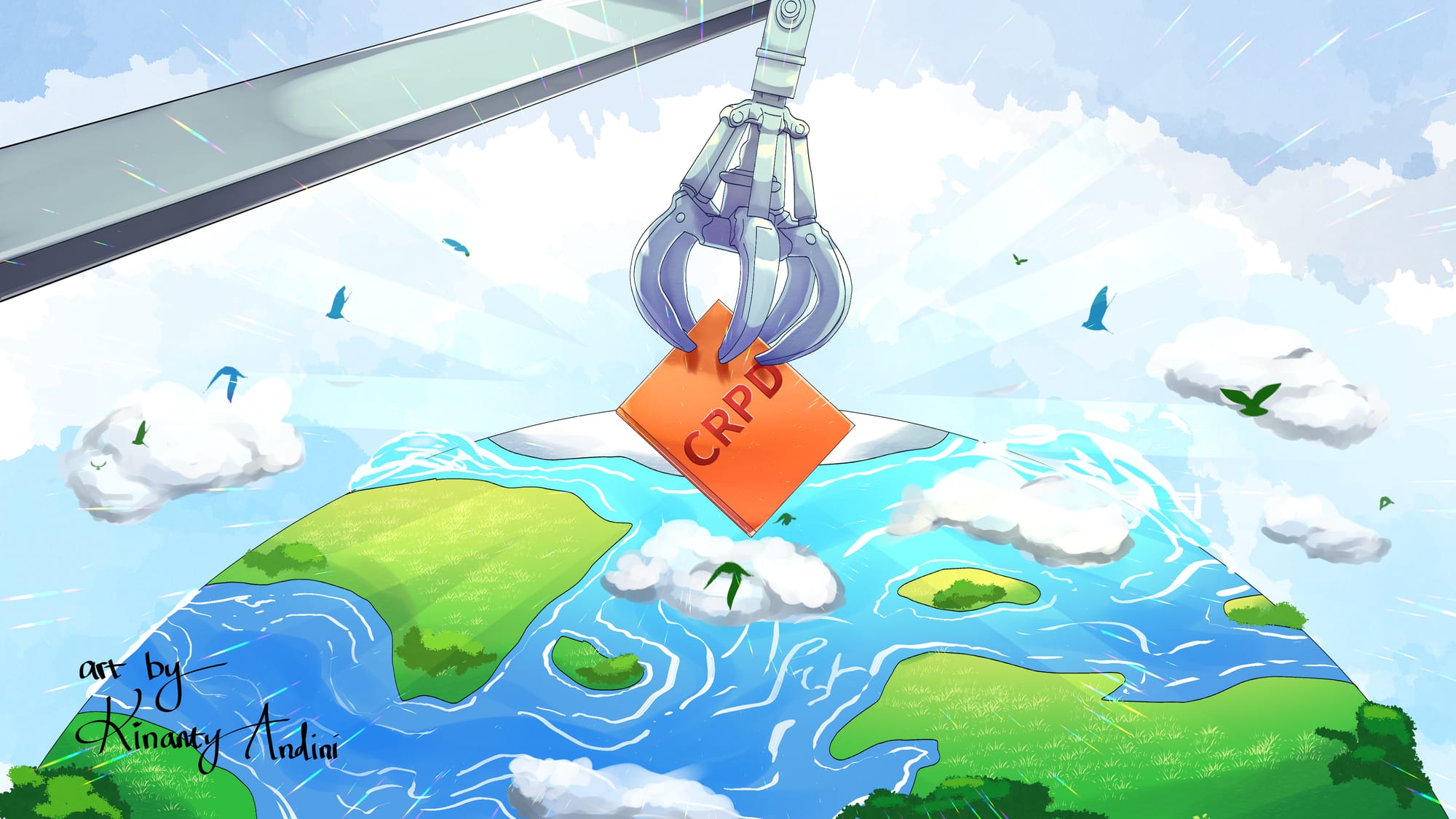
And so, on the twentieth anniversary of the UN Convention on the Rights of Persons with Disabilities, we wanted to hear a range of experiences from the Debrief community on how these rights have (or haven't) made your life different.
See the full details, and make your submission on the page for the call. Submissions are made through a form that's linked there.
“Just launched yourself in”
Stephanie Thomas, who has spent five decades in disability organising in the United States, told New Mobility about life before civil rights legislation on disability:
“One thing I think about a lot is how in the old days you could never assume there was a bathroom you could use. You had to memorize routes to get anywhere, because there were no curb cuts — you had to know which driveway to use, or you rolled in traffic, because there wasn’t any other option. You just launched yourself in and hoped for the best.”
“Like a science-fiction writer”
I recently read Andrew Leland's book The Country of the Blind: A Memoir at the End of Sight. It's one of my favourite disability reads, and in it Leland anticipates slowly going blind from his progressive sight loss:
“The most painful part so far has been the not-knowing. I live much of my life these days in a speculative mode, like a science-fiction writer who looks at the present and tries to imagine the future. As I cook dinner, or walk my son, Oscar, home from school, or find my way from the airport to a train station in an unfamiliar city, I ask myself: What will this be like when I can’t see? I perceive everything with this paradoxical double vision: through sighted eyes, and through blind ones. While most futures are difficult to see, shrouded as they are beneath the fog of contingency, mine is doubly difficult to visualize. The crystal ball remains clouded over.”
“Talk about my pain with this silly bot”
Also on Time, Rebekah Taussig writes about how AI helped her appreciate her own body. As she tells her in-laws, she “can’t believe how much easier it is for me to talk about my pain with this silly bot”:
‘When I relate my pain to my device, there is no need to control how it “sees” me, because it doesn’t. It doesn’t worry about me. It doesn’t think I’m weak or strong or dramatic or inspirational. It doesn’t care about me at all. The only job I’ve given it is to help me pay attention to my body and attempt to decipher its messages, so there’s no reason to withhold information.
‘I couldn’t sleep last night because the pain was so bad. I don’t think I’m dying, but I haven’t been able to take a deep breath for hours. Yes, the pain is getting worse, and while I’ve heard your suggestion to take a break, no, I will not be slowing down.
‘All the things I’ve always known, but never put into words, even to myself.’
“Proof I'm not a bomb? Check”
Kamil Goungor recently went to a workshop on accessible air travel. Writing on his new newsletter, The Trawheeler, Goungor shares his reflections from the discussions:
“The responsibility for making air travel possible for disabled people is still often shifted onto disabled travellers ourselves. The message seemed to be that if we want to travel independently, we need to become experts. We need to understand battery regulations, know the technical specifications of our wheelchairs and of the aircrafts we are flying, contact airlines days before travelling and be prepared to explain everything again at check-in or even at the gate. A kind of constant negotiation for our right to fly.”
“Being seen is not the same as being kept alive”
Over on Time, actor Steve Way wrote about his “year in a split-screen”. As well as 2026 being the best professional year of his life it is also the year that the Trump administration makes changes to the Medicaid that he needs for his wheelchair, ventilator and care assistance. Writing as his show Furious debuted on Hulu:
“You can be celebrated on a streaming service and defunded by a signature in the same summer. The issue: being seen is not the same as being kept alive.
“Many people genuinely believe those are the same thing. Visibility is a form of protection and a society putting disabled people on television would surely not also strip away the thing that gets them out of bed. It’s a comforting belief, but in modern America, it is false. Visibility is cheap. It costs the country nothing. Care is what costs, and care is what was cut.”
Way also writes on Substack and I recommend his newsletter there.
“Do I immediately appear disabled or not?”
I'm also still enjoying Jamie Hale's newsletter (see previously). I particularly appreciated Hale's critique of the contrast sometimes made between disabled people visibly or invisibly disabled:
‘As a model, it’s centred on vision, making sight the master sense for sorting disability. We register disability through many channels, through what we hear of someone’s speech or the sounds they make, or how someone moves through space. A blind friend can hear my wheelchair and know I’m approaching. But the in/visibility model collapses all of that into the visual, which feels ironic as a way of organising a community that includes blind people and people with low vision, for whom “visibility” is neither how they navigate nor a meaningful axis for sorting disability.
‘It’s also focused on who’s perceiving us. Visibility means visibility to someone, and that someone is usually the non-disabled observer, not the disabled person who can identify another disabled person in a split second, even where they’d have been “invisible” to everyone else. It leans on a frame that centres the non-disabled person’s definition of disability. The binary becomes defined by who is doing the watching and the sorting, which means it centres the perceiver, not the perceived.
‘It isn’t interested in my experience of being read, whether others recognise me as disabled, which of my needs they notice, what they then do about it, only in the reading itself, the perception others have of me - do I immediately appear disabled or not? This is rejected by the social model, which defines disability by barriers rather than by how it appears to the non-disabled. The vocabulary smuggles the abled gaze into the way we narrate our own experience.’
“Not be stared at like zoo animals”
Over on Body Babble, Carolyn Girard-Jaupaj wrote about her both painful and liberating experience at Gallaudet University, a university for deaf and hard of hearing people:
“Gallaudet is located in Washington D.C., so the capital is moulded by the Deaf community’s presence. We could go out in public and not be stared at like zoo animals, because the hearing people in D.C. are used to having Deaf people around. The city is full of talented Deaf professionals, and home to Deaf coffee shops, theatre companies, and dance workshops. It was even easy to get Deaf roommates off-campus.”
“Someone else's rude awakening”
Do you Need Me to Spell It Out, by Anna van Miert is a “guide to help educate those that care about people who are chronically ill”. One of the reasons it's needed is, as van Miert writes in the introduction:
“I’ve found that in my own life all of the losses brought on by illness have been compounded by the breakdown of many of my friendships. I’m sure there are endless reasons for this. Maybe people don’t want to say the wrong thing, maybe they feel awkward, maybe they are ignorant to the reality of what a life interrupted by illness looks like or of the impact their absence has.
“It’s widely understood by the chronically ill and disabled community that people often recoil away from us because we remind them of their own vulnerabilities and mortality. As Sophie Strand says; ‘to be a sick person is to know that you are always, simply by being alive and being unwell, someone else’s rude awakening”.
“The easy and enjoyable aspects of our existence”
Over on Worky and Wheely, Jessi Parrot reflects on the relief (and the luxury) of work:
“For me, as someone with ‘complex’ health and care needs, professional work is a relief.
[...] We value professional opportunities so much.
Not in a way that capitulates to capitalist notions of productivity as the definition of worth.
Far from it.
But because those professional opportunities are, so often, the easy and enjoyable aspects of our existence.
Where we are afforded autonomy, or even something as supposedly simple as a guaranteed structure to our days; both examples of things we might rarely be granted in the rest of our lives.”
“Power does come in the pauses”
Tina Friml, a US comedian with cerebral palsy, talked with Trevor Noah about timing in her way she speaks and does comedy:
“Well, thank God for comedy, because timing is the one thing I can control. I learned that the power does come in the pauses and, a bit like singing, I speak very slowly. And comedy is one of the very few instances where that can be used as an advantage.
“I mean use comedy, as a kid, as a language, quite literally to show other people – kids and adults – that I was cognitively all here.”
“I never think they're flirting with me”
Amanda Soares (@pcdperigosa) talked about dating as a woman with disability in Brazil, in a clip from the documentary Assexybilidade:
“I've given up on the idea of finding someone who'll be anti-ableist. I'm not going to find that.
Of finding someone who's going to feel attracted to a woman with disability. I'm not going to find that.
What I’m going to find is someone who’s open, who opens up. And then, they start to see, oh, yeah, there can be attraction.
So I think when it comes to flirting... First of all, I think the funniest thing is that someone will be looking at me, and I’ll assume they’re looking at me because of my disability.
I never think they’re flirting with me. I'm like, “look at that ableist over there.” [...]
And then, when someone actually approaches me, they’re often really hesitant, like, “Oh... how do I kiss you?”
And I’m like, “With your mouth.” (translated from Portuguese)
Within our power to keep
I was happy to be interviewed by Andrew Pulrang over on his newsletter Disability Thinking Weekly. Pulrang asked me about disability in my own life, and the most promising opportunity I see for disabled people in the future. I replied:
“The thing that has really grown, and that is within our power to keep, is disability community. That meeting on the stairs in Bangladesh changed my life, and I'm a firm believer that connecting with other disabled people shows us how to live and who we can be. Together we're stronger, we can have each other's backs, and we can figure out what we need to do.”
Thanks to you all for being part of that. Until next time,
Peter
Outro
Further reading. There is a back catalogue of Debrief newsletters online, as well as a library of disability news from 170+ countries.
Let your friends know. Sharing the newsletter is how people find it!
For more from Kinanty, see her website.
Connect. Get in touch. You can find me on Linkedin and Bluesky.
Help us do more. The Debrief is free thanks to reader support.
Acknowledgements
With thanks to Kinanty Andini for the illustration. To Celestine Fraser for designing the new call for writing. And to everyone quoted here for helping us see the world a little bit differently.
Thanks, as always, to the readers and organisations who support the Debrief.