
Annotation for Artificial Intelligence
Dear Debriefers,
Today's edition is another world tour of disability news.
We visit North-West China to see where a group of disabled people are working on training artificial intelligence systems. Then we go to the Gulf to see the impacts the Iran war is having on disabled people in the whole region.
Further news explores the fragile infrastructure of disability rights. Yet, even as that infrastructure is being undermined, further work on rights work continues. Plus a wheelchair-user in Palestine who trades Arabic lessons for assistance.
As I press send on this newsletter, Alice Wong's celebration of life is being livestreamed. See previously for the Debrief piece remembering her work.
Explore the full guide of 135 hand-picked links: curated across 40 countries or 38 subjects. This edition continues from the update in February.
About this edition
The Debrief is published through a pay-what-you-can model. Thanks to Ryan for a new contribution.
Peter Torres Fremlin is editor of Disability Debrief and is from the UK.
Annotation for Artificial intelligence
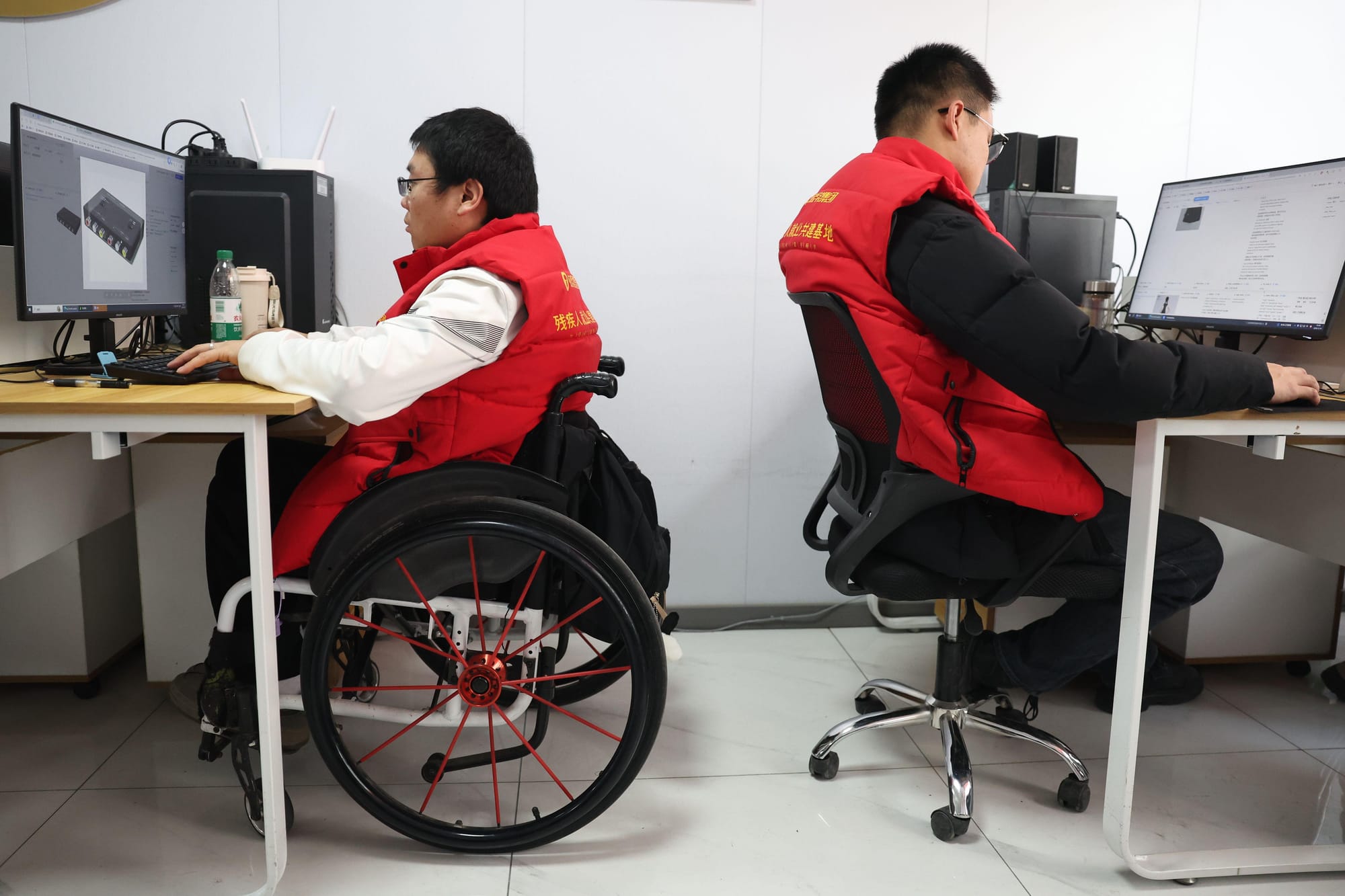
In Lanzhou, a city in North-West China, a small group of people with physical disabilities have been trained to work as data annotators for artificial intelligence systems.
Yang Zhiwen, one of the trainees, told Xinhua that it “enables him to keep pace with the times, rather than being left behind.” Another trainee, Xu Junlin, had been long-term unemployed she can now earn 3,ooo to 4,000 per month (435 to 580 USD): “it feels fulfilling”.
The Xinhua feature presents the initiative in positive light but that should be taken with caution. Annotating data for AI is gruelling work. And it's unclear how much their workplace is segregated for disabled people. Segregated workplaces are common around the world (and, for example, being expanded in Singapore), but not necessarily compatible with rights-based approaches.
In other AI news:
- Last year, Klaus Fürlinger, a member of the Austrian Parliament gave a speech with an AI version of his voice.
- GAAD Foundation checked whether AI models make accessible websites. Open AI models come top, Claude doesn't do well.
- OECD has a report on opportunities and risks for AI and neurodivergent learners in vocational training.
The US-Israel-Iran war and its aftereffects
In Iran, the US-Israeli bombing campaign is creating a growing number of amputees who are forced to ad-hoc solutions, like welding their own wheelchairs from scrap metal. But I didn't find further information on the impact on disabled people more generally.
In Lebanon, Israeli bombing and ground-invasion has led to a mass displacement of over a million people, which is especially complicated for disabled people. The humanitarian response includes an emergency task force on disability and some accessible shelters. Emergency cash support was given to 6,000 families receiving the National Disability Allowance. And just last month, before this phase of conflict ignited, the country approved a new National Strategy for Persons with Disabilities.
In the United Arab Emirates, one of the victims of Iranian attacks was Alaa Mushtaha, who worked at the Zayed Higher Organisation for People of Determination, “where she taught people how to make cheese and other dairy-related products.”
In Qatar the government announced on social media special attention to the safety of people with disabilities.
Meanwhile in Israel, under attack from Iranian missiles, Access Israel has lamented the neglect of disability rights in missile defence. A survey they did found “40% of people with disabilities in Israel do not have accessible shelter options.” (Although if that means that 60% of people with disabilities do have accessible shelter options, that sounds very impressive!)
Outside of these countries, the fuel shortage, supply chain and economic impacts are already being felt around the world. I haven't seen good coverage of the disability dimensions of that yet.
Undercutting the fragile infrastructure of disability rights
In the United States, Allison C. Carey has written a paper that puts the Trump's administration “unprecedented” attack on disability rights into a historical context. Carey shows their precarity and the multiple ways they are being undermined now:
‘The current administration has largely rejected the value of disability rights, as well as a broader set of rights and programs that pursue active pathways to enable opportunities and participation by a range of groups.
‘To undercut disability rights, they define disabled people as unworthy, emphasize and even manufacture conflicts to justify the denial of disability rights, dismantle the infrastructure required for disability rights, and reconfigure power relations across settings to disempower disabled people in claiming rights. [..]
‘The fragile infrastructure of disability rights is indeed easily subverted. As relational claims, rights quickly fall apart if these claims are no longer recognized as legitimate, if the rights holders are again constructed as unworthy, and if the infrastructure for participation and empowerment is decimated. In this context, even rights on paper do little to empower disabled people.’
In a similar vein, New Disabled South has a new report, Project Eugenics, on the rollback of disability rights. Or, looking at backsliding in terms of digital accessibility, Anna E. Cook writes:
“Ignoring accessibility represents regression, a return to earlier assumptions that access is a privilege granted to some, rather than a right owed to all.”
And in India, Vijay K. Tiwari et al explore how authoritarian government impulses are visible in state surveillance and suspicion of disabled people, manifested in a directive from Maharashtra state for disabled employees to reverify their disabilities.
But work on human rights continues
For a global view on human rights setbacks and the place of disability rights within those, see the Human Rights Watch World Report 2026, which includes extensive information on disability.
And an international view on disability rights in developing countries comes from the Global Disability Fund's review of situation analyses from 51 countries. They find that 40 of those 51 countries have dedicated disability laws or comprehensive policies. However:
“49 countries assign [Convention on the Rights of Persons with Disabilities] responsibility to social welfare ministries that lack authority or resources. Only five of 36 national disability councils function effectively.”
But also, further rights frameworks are under development. The UN Human Rights Council has opened negotiations for an international treaty on the rights of older persons. There are important questions to explore around decision-making. And, a group of scholars outline on Opinio Juris, the need for the treaty:
“There are some issues of particular relevance to the rights and wellbeing of older persons—such as access to long-term care, caregiving responsibilities that often arise in later life, and the ability to both continue working and receive a pension—that existing conventions do not address. Meanwhile, evidence that older persons’ rights and needs are going unmet is found across low- and high-income settings alike.”
Free choice or forced choice? Discussing assisted dying
There was a vigorous reader response to this month's Debrief on how countries approach assisted dying by Joe Wood. More on that in an upcoming edition.
For now, thanks to Maria and Alberto for a correction: the article mentioned Colombia among the countries where doctors aren’t allowed to help patients die. But this is incorrect, as assisted dying has been regulated there since 2015.
In further news from Europe, the European Network for Independent Living (ENIL) has a position paper on assisted dying: free choice or forced choice? Because of the context of structural inequalities and lack of support for disabled people, they conclude that “assisted dying cannot currently be considered a safe or rights-based option.”
Join a further discussion on this with ENIL, who are hosting a webinar on Wednesday 8th April, 3pm CEST. I'll be one of the speakers.
And, from the Netherlands see a disturbing profile on a psychiatrist who gives lethal injections to patients with mental suffering.
Assistance for Arabic and other news
In Palestine, Ekhlas Al-Azzah is a wheelchair user in the West Bank. Ekhlas has taught over 700 women from around the world Arabic, in exchange for care and assistance.
In India, a man allegedly cut off part of his foot to qualify under a disability quota.
From the United States, a practical checklist on dealing with winter storms.
From the United Kingdom, a report on creating news for and with people with learning disabilities.
Breaking the silence
And in case you missed last month's Debriefs, as well as the piece on assisted dying, see also:
- Spotlight or substance? My view from the Zero Project 2026.
- Together as a collective force: Debrief readers have their say.
- Roots of Belonging, Nyuki Msimulizi breaks the silence on cultural practices in Tanzania.
And that's all from me for today. Enjoy your adventures in disability news,
Peter
Outro
Further reading. All the links from these curated editions go into the Debrief library, which now has over 7,300 links from over 170 countries. See below for contents from this month's update.
Let your friends know. Sharing the newsletter is how people find it!
Connect. Get in touch. You can find me on Linkedin and Bluesky.
Help us do more. The Debrief is free thanks to reader support.
Recent News
This update has 135 curated links from 40 countries and regions, organized across 38 subjects.
You can explore it organized by subject or by country.
Subjects
- Accessibility and Design
- Ageing
- Civil Society and Community
- Climate Crisis and Environment
- Communication and Language
- Conflict and Peace
- Culture, Entertainment and Media
- Data and Research
- Digital Accessibility and Technology
- Disaster Risk Reduction and Crisis Response
- Economics and Social Protection
- Education and Childhood
- Employment, Business and Work
- Gender Equality and Women with Disabilities
- Health
- History and Memorial
- Humanitarian, Migrants and Refugees
- Independent Living and Deinstitutionalization
- International Cooperation
- Justice Systems and Legal Capacity
- Lived Experience and Opinion
- Mental Health
- Mobility, Travel, Transport and Tourism
- Policy and Rights
- Politics and Elections
- Relationships, Sex and Reproductive Rights
- Sport and Paralympics
- Violence and Harassment
- War in Ukraine
Countries
Acknowledgements
Photograph by by Chen Bin/Xinhua/Alamy.
Thanks to Celestine Fraser for help with photograph selection.
Many thanks to everyone who shares links, news and reports, and the readers and organisations whose support makes this work possible.