
Progress is real, but fragile
Dear Debriefers,
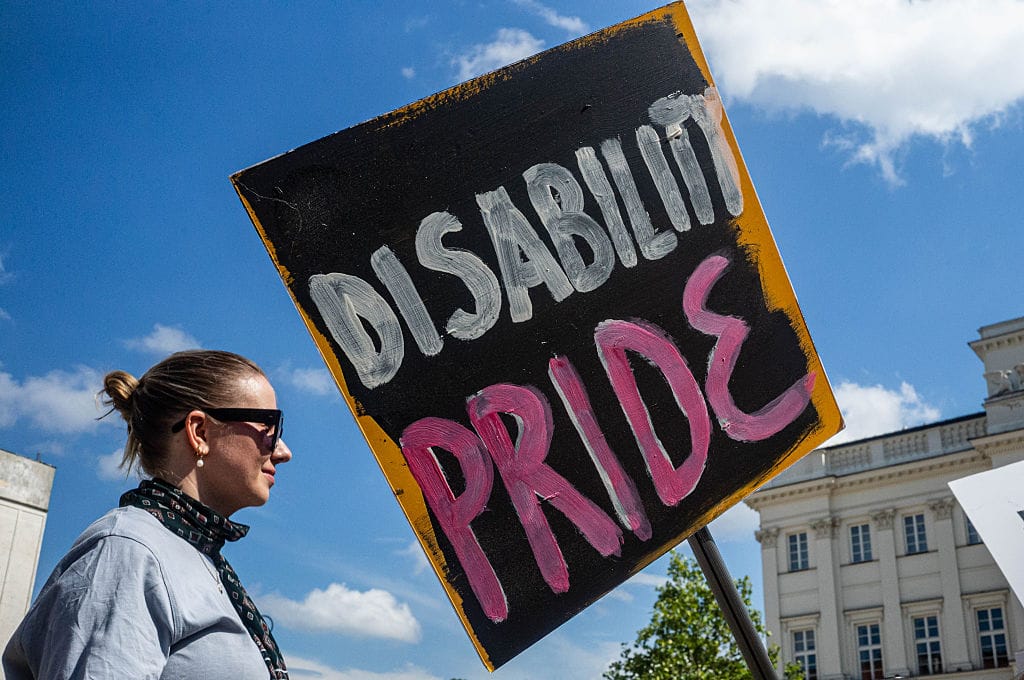
Happy disability pride month!
We're back on a world tour of disability news. Many of the pieces are in a reflective mood, on disability news in the past decade, the twenty years since the UN Convention, or 250 since the birth of the United States.
As well as retrospectives, there are insights from Uzbekistan, two countries that are increasing disability benefits (!), and a disability scholar suing an AI company. Plus, those moments when everyone is just better looking.
Explore the full guide of 100 hand-picked links: browse across 39 countries or 38 subjects. This edition continues from the update in June.
About this edition
The Debrief curates disability news from around the world with support from readers. Thanks to Becky, Elane, Meghan and CBM Global for new contributions.
Peter Torres Fremlin is editor of Disability Debrief and is from the UK.
Progress is real, but fragile
Accessibility in the News is perhaps the longest running disability newsletter, and it's just celebrated it's 10th anniversary. Its creator Jack McElaney, a role model in consistency, shared his reflections on curating the past decade of disability news:
“Progress is real, but fragile. The past decade brought stronger standards, more public awareness, better tools, major legal developments, and more organizations taking accessibility seriously. But rights can be delayed, narrowed, ignored, underfunded, or treated as optional unless people keep paying attention, continue being educated and informed, and become active and speak up.”
Even when things seemed most dire
As the United States celebrated its 250th birthday, writers reflect on the place of disabled people in its history.
One of them is Sari Altschuler whose new book Before Disability looks at the history of American Citizenship. In an interview by Julia Métraux, Altschuler gave an overview:
“Mental and physical differences played a key role in shaping citizenship from the beginning; the fight for disability rights and justice was meaningfully waged and victories won even when things seemed most dire. As we seek to imagine the relationship between disability and citizenship more equitably and expansively today, we should begin by remembering that many disabled and non-disabled Americans before us did too.”
Also looking back on the past two and a half centuries, Carrie Gillispie describes the history of disability politics and how disabled people have been excluded from the American dream.
“What kind of human being society had in mind”
There is also a reflective mood in international disability rights circles as the UN Convention on the Rights of Persons with Disabilities (CRPD) reaches its twentieth anniversary.
José María Viera, of the International Disability Alliance, writes on the “revolution of the ordinary” where he describes the CRPD as “a treaty about how we understand ourselves”:
“It asks what kind of human being society had in mind when it built its schools, courts, homes, transport systems, workplaces, families, and communities. It asks whether the world was designed only for those who can walk, see, hear, speak, learn, decide, work and communicate in expected ways, or whether it can be transformed to welcome the full diversity of humanity. Perhaps this is why the Convention still feels so radical. It asks society not simply to repair the old structure, but to rebuild its foundations.”
“Disability inclusion tests the genuineness of reform”
Meanwhile in Uzbekistan, a wide-ranging interview with researcher and activist Dilmurad Yusupov discusses the slow development of a disability rights movement. As well as steps from the government, Yusupov sees “more Uzbek women and men with disabilities present in public life speaking at forums, running NGOs, appearing in media”.
However, in the context of the government's wider economic and social reforms, Yusupov sees a still-limited transformation:
“Disability inclusion tests the genuineness of reform because it requires changing entrenched institutions, not just policies. It requires breaking the paternalistic logic of Soviet social protection which assumed that the state knows best, provides a minimal subsidy, and keeps “abnormal” people out of public life. If Uzbekistan’s reforms are real, we should see deinstitutionalisation people leaving boarding houses and living independently in communities. We should see more disabled people in parliament, on advisory committees, in leadership of public institutions. We should see the disability assessment system overhauled from a purely medical examination into a needs-assessment that actually enables meaningful participation. These things have not happened yet. The reforms are real, but they are still mostly skin-deep when it comes to disability.”
Cuts continue, but some countries are increasing disability benefits
For sure, many countries are cutting support to disabled people or disability services.
- Australia's reform of its National Disability Insurance Scheme (NDIS) anticipates “brutal” cuts.
- Iran, torn by war, has halted payments of living allowances.
- Finland a previous leader in disability rights, will cut 30% of its funding for organisations of persons with disabilities.
However there is a pleasing contrast in countries that are increasing support:
- Bangladesh plans to increase its disability allowance from 900 to 1000 BDT (from 7.3 to 8.1 USD) per month, and expand its coverage by hundreds of thousands of people. The State Minister for Health says the country can become a global role model.
- Thailand has increased its disability allowance to 1,000 baht ($30 USD).
The impacts of inclusion
In the United States, Laura Caron used some clever gathering of data sources and statistical analysis to show the long-term impacts of inclusive education.
Every U.S. state mandated public education to provide educational services for disabled students between 1949 and 1980. Based on this variation, Caron can see that provision led to increased education and work opportunities for disabled people. And, furthermore:
“Although this policy could have taken away resources from non-disabled students, in fact, education and employment also increased for non-disabled individuals. These effects align with evidence that the mandates increased spending per student by up to 15%. Families were also impacted: the mandates increased employment among mothers of disabled children and the probability that disabled individuals became household heads. Over the long term, the mandates paid for themselves by generating government revenues in excess of their cost.”
Also in the US, Michelle Yin and other researchers looked at the impact of US States ending subminimum wages for disabled people. They found that doing so decreased sheltered workshop employment for disabled people. And rather than that setting people adrift (as critics warned), “welfare dependence among workers with disabilities dropped by 12.4 percent”.
In Germany, this BBC piece is a good write-up on the legal fight to get equal pay for disabled workers. (See previously on the Debrief).
How could I escape by crawling?
“How could I escape by crawling” The Road to Til is a video documentary from Rajan Kathet on risks faced by disabled people after flooding in a mountain village in Nepal.
Without warning: Debrief writer Alexander Ogheneruemu has just made his first video documentary, Without Warning, interviews with Deaf Nigerians and their access to information in emergencies.
Both of these documentaries are produced by the wonderful Disability Justice Project, who are looking for participants in their Disability Justice Film Lab. The Lab is for disabled storytellers who have stories at the intersection of climate justice and disability justice. There's a $500 stipend and no prior filmmaking experience is required. Deadline 7th August.
After the storm. A feature from Human Rights Watch on planned relocation from Sirago, Philippines, after a Typhoon in 2021. For persons with disabilities: “relocation sites are often inaccessible and far from their livelihoods and support networks.”
“And EVERYONE looks extremely ATTRACTIVE”
AI Wrongs Revisited. Disability researcher Tom Shakespeare is suing Anthropic for $150,000 for allegedly pirating his book Disability Rights and Wrongs Revisited (2013) and using it to train its AI models. Shakespeare is joined by over 100 other authors alleging copyright infringement of their work also.
“The card entry screen is where things fall apart for me.” Michael Taylor describes what it's like to Pay A Healthcare Bill When You're Blind.
“And EVERYONE looks extremely ATTRACTIVE”. It's wonderful to see Celestine Fraser, also a key part of the Debrief, branch out into comics: After the flare is about relapse and recovery.
A drive to freedom
Freedom Drive. Registration closes today, but I hope to see some Debriefers at the European Network on Independent Living's Freedom Drive in Brussels at the end of September.
More from me. I spoke about making Disability Debrief with Claudia Walder over on Ablezine.
And catch up with any Debriefs you've missed in the past month:
- To sit under the rain: Teodor Mladenov on what the Independent Living Movement taught him about freedom.
- A new kind of clock: crip time, understanding hearing aids, and my other favourite quotes from recent reading.
- Oh, it's happening to me: conversation with Ashton Applewhite on ageism, ableism and adaptation.
- Disability Debrief at 200: five reader favourites from the first two hundred editions.
Enjoy your travels in disability news and let me know what you find,
Peter
Recent News
This update has 100 curated links from 39 countries and regions, organized across 38 subjects.
You can explore it organized by subject or by country.
Subjects
- Accessibility and Design
- Assistive Technology
- Civil Society and Community
- Climate Crisis and Environment
- Communication and Language
- Conflict and Peace
- Culture, Entertainment and Media
- Data and Research
- Digital Accessibility and Technology
- Disaster Risk Reduction and Crisis Response
- Economics and Social Protection
- Education and Childhood
- Employment, Business and Work
- Gender Equality and Women with Disabilities
- Health
- History and Memorial
- Humanitarian, Migrants and Refugees
- Independent Living and Deinstitutionalization
- International Cooperation
- Justice Systems and Legal Capacity
- Lived Experience and Opinion
- Mental Health
- Mobility, Travel, Transport and Tourism
- Policy and Rights
- Politics and Elections
- Space Exploration
- Sport and Paralympics
- Violence and Harassment
- War in Ukraine
- Water and Sanitation (WASH)
Countries
Outro
Further reading. All the links from these curated editions go into the Debrief library, which now has over 7,700 links from over 170 countries.
Let your friends know. Sharing the newsletter is how people find it!
Connect. Get in touch. You can find me on Linkedin and Bluesky.
Help us do more. The Debrief is free thanks to reader support.
Acknowledgements
Photo by Neil Milton/SOPA Images/LightRocket via Getty Images. Thanks to Celestine Fraser for help with its selection,.
And many thanks to everyone who shares links, news and reports, and the readers and organisations whose support makes this work possible.