
The United Nations isn't doing enough on disability
Dear Debriefers,
In 2011 I got on a plane to go to Dhaka, Bangladesh for my first job. I had a six-month consultancy – on “Differently able People” – with a United Nations agency. I was working to make sure disabled people were included in a poverty reduction programme.
It was a time when there was an emerging appetite for the work but confusion about how it might be done. But in the years that followed, international momentum on disability inclusion grew, and I myself spent over a decade doing assignments with different parts of the UN.
In 2019 this momentum became formalised into the UN Disability Inclusion Strategy. It was a bold plan to make efforts on disability more consistent and systematic across the sprawling collection of agencies that make up the UN system.
Last month the UN published its evaluation of the strategy. It found it had successfully pushed forward disability inclusion in many areas and “served as a catalyst for systematic change”. However it found a disconnect between policy change and the experience of disabled people, and progress to meeting ambitions on disability rights “extremely slow”.
These results come at a pivotal time for international cooperation, as funding cuts have left the UN reeling and frantically downsizing. Years of work are in danger of being lost. In my view, that means we need to rethink what we mean and how we approach disability inclusion. At its best, it can be a blueprint for more inclusive and accessible approaches that benefit us all.
About this edition
The Debrief takes an independent view thanks to support from readers. Thanks to Sonia for a new contribution.
Peter Torres Fremlin is editor of Disability Debrief and is from the UK.
Show us your future: the Debrief open call for writing, Letters from the Future runs until 1st November.
Figuring it out
I landed in Dhaka not knowing very much about how disabled people could be included in development work. I'd learned to speak Bangla and had just finished a Masters degree on disability but, more importantly, I knew people. Through a contact of a contact my CV was put, by the donor, in front of the manager of a large project.
I started with some concern that I didn't know what I was doing but I soon found out that not many other people did either. The project I joined had some initiatives on disability, but they were often things like handing out wheelchairs (on a one-size-fits-all basis). But in the bread-and-butter of its main programmes, supporting people in poverty improve their lives and communities, it didn't have measures to make sure disabled people benefitted also.
This was a few years after the UN Convention on the Rights of Persons with Disabilities had set radical and ambitious aspirations. It gave a powerful reference, but raising disability with colleagues was still often difficult or downplayed.
While my job was in a neighbouring government building, I felt the exclusion viscerally whenever I went to visit the UN offices in Dhaka. Security was unwelcoming and I then had a choice between struggling with stairs or a steep ramp down into the basement and lift. It was alienating for me as a privileged foreigner, and I guessed it would be even more hostile for a Bangladeshi person with a disability.
Indeed, at one point I argued to a colleague they should ask disabled Bangladeshis about what was needed for access. He was bewildered: why would he need to consult disabled people about the UN office premises?
The UN is a many-headed monster
Not only is the UN a many-headed monster, but the different heads don't necessarily talk to each other.
For some decades the UN has done important political and rights work on disability, from Decade of Disabled Persons (1983-1992) up to the Convention on the Rights of Persons with Disabilities (2006). But the focus of the UN disability strategy and its evaluation refers to the work of the UN system.
The UN “system” is made up of a sprawling network of agencies and country teams. Some set norms and standards, others are doing development, humanitarian or peacekeeping work. Well known parts of system include the World Health Organisation or UNICEF, but there are many more, and over a hundred were covered by the disability strategy.
Systematizing the hustle
The part of the monster I started work for in Dhaka was the United Nations Development Programme. From there I continued a mostly freelance career, for many years working with the International Labour Organisation, the UN agency focussing on work.
My career grew, riding the wave of steadily increasing momentum on disability inclusion. The work took me to the troubling comforts of Geneva, and sent me on trips around the world, from Santiago to Yangon.
I enjoyed the hustle of raising attention and convincing colleagues. Over coffees, lunches or meeting people on the bus to work I would encourage them to take action on disability. It was becoming easier to get people to pay attention and it was less likely they would respond rudely. (Whether they did anything afterwards is a different matter.)
That was the context in which the UN Disability Inclusion Strategy (UNDIS) was made in 2019. It set out to make the UN system “fit for purpose in relation to disability inclusion”, aiming for “sustainable and transformative change”. Measures on disability would be less optional, less dependent on the hustle factor. And an accountability and reporting framework would track whether the work was done.
“A catalyst for systematic change”
The recent evaluation of the UNDIS shows important progress was made, and that the many-headed monster is changing:
“Over the past five years, the UNDIS has proven to be a relevant and timely instrument for advancing disability inclusion across the United Nations system. The strategy, anchored by its accountability framework, has served as a catalyst for systematic change, creating momentum and accelerating efforts to embrace disability inclusion throughout United Nations entities and country teams.”
The evaluation notes that success came when different factors reinforced each other: the accountability framework, leadership commitment, technical expertise, and working with organisations representing disabled people.
Agencies across the world are doing new initiatives to support disabled people, with the Global Disability Fund having supported work in over one hundred countries. And persons with disabilities are more involved in the work.
There are more provisions for disabled staff, and an increasing range of employee groups. Hundreds of persons with disabilities have gotten positions through United Nations Volunteers. And alongside this, consultation of organisations representative of persons with disabilities is increasingly frequent.
And I can see that a lot of the change is driven by a relatively small group of committed professionals, with and without disabilities. The evaluation credits these focal points as having a “critical brokering role”, and that UN employees with disabilities “raised visibility and created a sense of urgency that is often absent without their presence.”
But progress is still limited
This systematic change means that the UN system has made important steps. But the evaluation cautions that it is still far from change on the ground:
“Progress toward meaningful outcomes for persons with disabilities remains limited. It is nearly 20 years since the approval of the CRPD and progress of the United Nations towards achieving the level of disability inclusion that is expected of Member States has been extremely slow. The United Nations has not achieved its ambition of becoming an employer of choice for persons with disabilities or effectively mainstreaming disability inclusion across development, humanitarian, peace and security programming.”
So while the progress was important, it was short of being “fully transformative”. Resource allocation was “largely insufficient and inconsistent across United Nations entities, significantly impacting timely and efficient implementation”.
This inconsistency across the system leaves “islands of success”. Some agencies used UNDIS to upgrade their pre-existing disability work, while others are still yet to start. 18% of entities covered by the UNDIS did not implement or report on it at all.
“Significant disconnect” faced by disabled people
Even though disabled people were more involved we see the familiar patterns of tokenism and limited engagement. Representative organisations were consulted more but skeptical about how much their input was taken on.
Employees with disabilities faced a “significant disconnect” with the declared policies, with less than a third of them believing that their UN entity was inclusive and accessible. They had a consistently lower level of satisfaction than employees without disabilities. And some felt being under “higher pressure to perform in order to demonstrate that disability inclusion is possible and beneficial”.
Does specialising on disability solve our problems?
The conclusions of the evaluation have important insights – about the need for a clearer vision, an external accountability mechanism, or the “untapped” opportunity of new partnerships.
But largely these recommendations push in familiar directions: carry on doing the same, but more intersectionally, more systematically, and with more funding. And A recent Secretary General report on the UNDIS had similar conclusions about the need to “scale up” the work.
Of course, as someone loyal to my tribe, I've worked as a disability specialist in these organisations, so I am duty-bound to agree that there should be more funding for disability specialists.
But over the past years I gradually phased out my assignments within the UN system. Like others with disabilities working in the system, I felt some of that same disconnect with profoundly rigid (and ableist) organisations.
Working on the Debrief gave me an escape from those bureaucracies, and also left me more free to question their assumptions. It allows me to take a step back to ask whether these these formal approaches on disability inclusion are the best way to achieve results for disabled people.
What latrines taught me about inclusion
I always go back to an example from my first job in Bangladesh. The project I worked for was improving sanitation in poor urban areas, and to that end made thousands of latrines. But these latrines usually didn't have any accessibility provision.
A disability inclusion view would be to say that the project should learn more about disability, get some better designs, and consult with the disabled people that would use the latrines. That was the argument I made, but there's an important way it misses the point, and keeps our response separated into silos.
If the project wasn't what disabled people needed, then that's a symptom that they weren't doing a good job about asking about anyone else's specific needs either. Latrine designs were provided in a top-down way and pre-approved by a central management far away from the communities in which they were built.
The project needed to be implemented in a different way, not just have disability sensitivity put on top of existing processes. Making it more responsive to local needs would better serve disabled people, and everyone else.
A blueprint for better
Refreshing the way we see disability inclusion is especially important in a context where the UN system is reeling. Powerful countries are turning their back on international cooperation, and disability is caught in the anti-diversity backlash.
Agencies are cutting thousands of staff and the UN itself is in a “race to bankruptcy”. Among those losing their jobs are disability specialists responsible for taking this work forward. I don't understand calls to scale up the work in a context where downsizing is letting go of those that made it happen.
I prefer the argument recently made by Mark Barrell and Elizabeth Sidell about maintaining disability inclusion in UK aid. They position disability inclusion as a “multiplier” that strengthens other development outcomes.
When it works best, disability inclusion can be a blueprint of how development and humanitarian assistance could be remade. Inclusive and accessible approaches are based upon responding to individual and community needs, and listening to the voices of those affected.
The people making the change
The UN has made important progress on disability inclusion in the past years. It's not enough, but it makes the UN today unrecognisable from the one I joined in 2011.
Among those making the changes happen are many who I am proud to count as friends and colleagues. I admire their passion, skill and tenacity in winning allies to the cause and getting disability on the agenda.
And in our turbulent world of today, these qualities will be called on more than ever. Fuerza,
Peter
Outro
Further reading. See more reporting from the Debrief on the international disability movement. Or for more reflections on my work in Bangladesh, see my prayer to failure.
Let your friends know. Sharing the newsletter is how people find it!
Connect. Get in touch. You can find me on Linkedin and Bluesky.
Help us do more. The Debrief is free thanks to reader support.
Acknowledgements
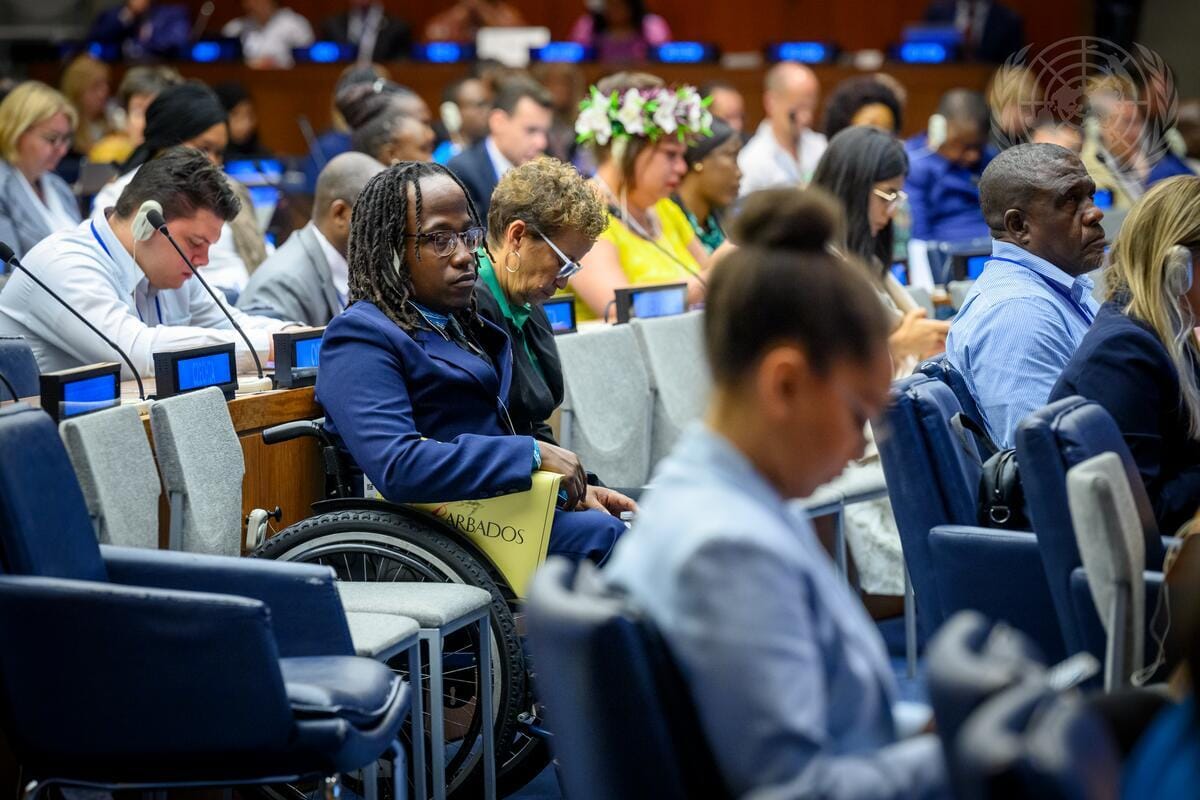
The photograph is a UN Photo by Loey Felipe. Thanks to Celestine Fraser for selecting it and for detailed revisions of earlier drafts. Thanks also to Áine Kelly-Costello for feedback.
My appreciation to Steven M., who recently articulated to me the point about how disability inclusion can be the blueprint of future work.
And thanks to the readers and organisations who support this work.