
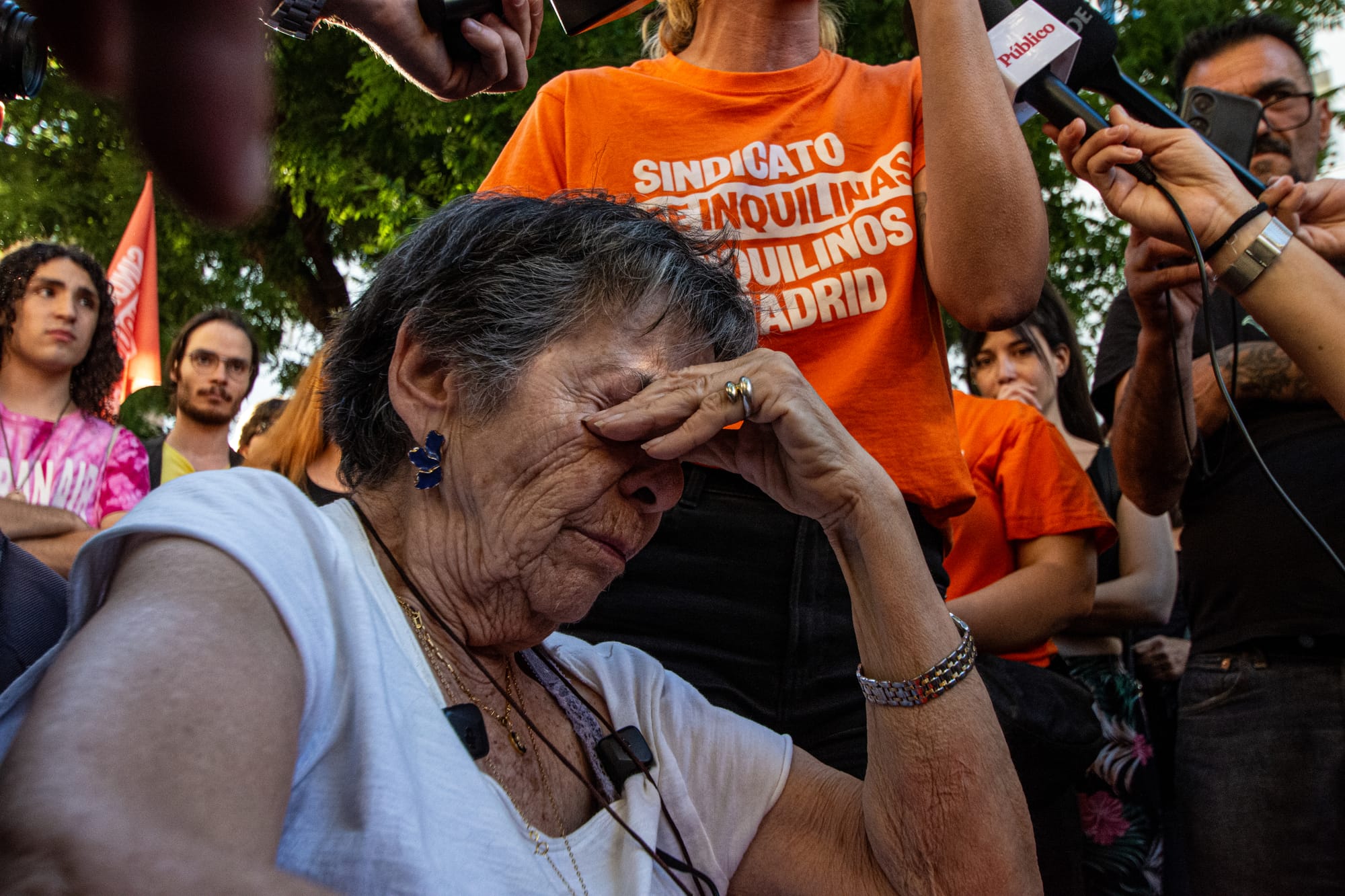
“It isn’t fair that they throw us out onto the streets”
Dear Debriefers,
I'm back in Colchester after the bumpy roads in Brussels. More on the conference and the cobblestones in a couple of weeks.
In the meantime it's another tour of curated disability news from around the world. We start in Spain where the eviction of a disabled 87 year old woman from her home led to nationwide protests over housing.
From there we see the latest research on inclusive education, reports on feminist fightback, and even research that says something nice about the United Nations' efforts on disability (who would have thought?!).
All this plus evacuating from the towers on September 11th and, with the biopic of Judy Heumann's life, nuances in how she's remembered.
What do disability rights mean to you? Enter our open call for writing. Up to 500 word entries by 2nd November, favourites published and will receive £100.
Explore the full guide of 93 hand-picked links: browse across 30 countries or 32 subjects. This edition continues from the update in September.
About this edition
The Debrief curates disability news from around the world with support from readers.
Peter Torres Fremlin is creator of Disability Debrief and is from the UK.
“A bunch of vultures can throw us out on the street”
María del Carmen Abascal (“Maricarmen”), an 87 year old whose eviction from her home of 70 years sparked protests across Spain, died yesterday.
After an investment firm bought her property in 2018 they attempted to raise the rent from €500 to €2,650 before then trying for €1,350. Multiple attempts to evict Maricarmen, and court proceedings, led to a dramatic eviction two weeks ago, where she was carried out of her house in a stretcher.
Her eviction led to nationwide protests about the long-running housing crisis in Spain, with protestors holding banners “Todos Somos Maricarmen”, we are all Maricarmen. Maricarmen herself was a forceful voice against property speculation and tourist rentals:
“We have a right to housing. And it isn’t fair that they throw us out onto the streets so that some vultures can come along and suck our blood, all the years we’ve spent fighting to have what is rightfully ours: a home, a roof over our heads.” (Translation from Spanish)
Maricarmen used a wheelchair, and one question in the legal battles over her eviction was the so-called percentage of her disability. She inherited the lease from her parents, and according to Spanish rental law this can be held indefinitely if the child has a disability of 65% or more. Maricarmen's was only 50%. (No, I don't think percentage systems of disability make sense.)
Maricarmen is unfortunately not the only older disabled person evicted from their home in Spain. The right to housing was recently affirmed as the basis of independent living by the Spanish Committee of Representatives of Persons with Disabilities (CERMI).
National outcry led to the investment firm saying Maricarmen could return to her home. But she died in hospital before she could go back.
“Mainstream education benefits all learners”
A lot of reports are written about inclusive education, but they don't always further my own education. A welcome contrast comes in Learning is For Everyone, a global report from UNICEF, which is refreshingly direct. Based on research from six countries, it characterises the current situation:
“Children with disabilities remain under-enrolled, under-supported and often segregated into special schools, despite clear evidence that inclusive mainstream education benefits all learners. Misconceptions about the challenges of inclusion, combined with insufficient teacher training, inadequate physical accessibility and limited resources, reinforce inequities. These barriers do not only affect children with disabilities, they undermine learning environments for all students and weaken the performance of education systems overall.”
The report proposes three action areas: recognising learner's needs, reforming education systems and resourcing inclusion.
Meanwhile, in China, the government's action plan for disabled children aims for 97% school enrolment, albeit through use of special education.
A more inclusive approach is suggested by teachers in Fiji who said that sign language and Braille should be taught to all learners, with and without disabilities. (I'm not quite sure why everyone benefits from Braille, but sign language sounds great.)
And, from Syria, some concrete examples of disabled students in inclusive education.
Feminist Fightback
Women Enabled International published a trend report on Feminist Disabled Leaders and showing, for different areas of challenges to the rights agenda, how they are responding.
Disability Rights Fund has also published reports on priorities, challenges, and leadership of women with disabilities across Africa. The report from East and Southern Africa looks in particular at the leadership of Deaf women:
“Representation within leadership structures remains uneven and, in many cases, superficial. Deaf women are frequently concentrated in lower-level roles, with limited progression into senior leadership positions. In some contexts, including Deaf-led organizations, leadership remains male-dominated, reflecting persistent gender inequalities within both mainstream and disability-specific systems.”
And the United Nations Committee on the Rights of Persons with Disabilities has adopted new guidelines on addressing intersectional discrimination against girls and women with disabilities.
Advocating for Admission
Advocating for Admission is the title of a PhD thesis by Rachel Kaye McNally, who looks at the history of the UN agency for refugees (UNCHR) on disability since it's founding in 1950.
Migration rules often have disability-based restrictions, so I wasn't expecting a positive review. But McNally argues that:
“UNHCR has been surprisingly persistent in advocating for the resettlement of refugees with disabilities from 1951 to 2011 by promoting policy change and building a coalition of smaller resettlement states willing to resettle this group of refugees, which highlights the need for a more nuanced understanding of UNHCR’s behaviour. UNHCR staff interpreted the resettlement of refugees with disabilities as a critical component of their mandate to find solutions to displacement and protect refugees.”
“Here I don't know where anything is”
In Nepal, Kathmandu Post reports on people with disabilities surviving the flood. But survival is just the first barrier. Dahal, a blind man, could get about independently at home. But in the shelter:
“Here, I don’t know where anything is, so I have to rely on other people. There’s no separate arrangement for people with disabilities. We’re all staying in the same place. This isn’t our home, where we can make things work for ourselves. We’re just trying to get by.”
And in the United States, on the twentieth anniversary of the September 11th attacks, Tina Argetsinger shares some cases of successful (and, sadly, unsuccessful) evacuation, and the advocacy it led to afterwards.
One of the amazing stories of escape is that of John Abruzzo, who was also in the building in the 1993 attack on the World Trade Centre. In 1993 he was carried down 25 floors in his electric wheelchair. In 2001 he was on the 69th floor of the North Tower. A group of ten coworkers took turns carrying him in an evacuation chair down to safety, which took ninety minutes. They got to the sidewalk just ten minutes before the tower collapsed.
Meanwhile in South Sudan, see a photo-essay on rehabilitation (I don't think it has alternate text, sorry).
“Oh wait, I thought I could be in a vintage wheelchair”
Being Heumann, a film adaptation of Judy Heumann's memoir premiered last month. (It will be out on Apple TV in November.)
Over on the Film Maven, Kristen Lopez gave it a positive review, saying it shows a nuanced view on Judy's life, including her flaws. Lopez concludes:
“Being Heumann is an essential piece of disabled cinema, laying out a stark foundation for the fight for disability rights. It doesn't the heartwarming charm of director Sian Heder's previous film, CODA, but has far more power and impact. Ruth Madeley is a revelation as Judy Heumann. Do I believe this movie will compel Hollywood to tell more disabled stories? No, sadly. But the fact that this movie exists at all is kind of a miracle.”
Speaking of nuances in Judy's legacy, Nathan Tankus' recent profile of her on the American Prospect raises questions about the contradictions about her career:
“Heumann’s story is, however, not simply one of activism. It is also the story of the long march through the institutions, for better or worse. [...] These kinds of roles are always fraught. While Heumann fought for disability rights at home and abroad [in her role in US State Department] President Obama ordered drone strikes and other military horrors that caused mass disablement and death.”
They are questions I share, and like Tankus, I never got to ask Judy herself.
As for the making of the film, part of the miracle of its existence was crossing the access barriers for its disabled cast. Jeremy Fuster reports on The Wrap how they managed it. Director Siân Heder said:
“A lot of our cast were learning about their own bodies and going, ‘Oh wait, I thought I could be in a vintage wheelchair, but I wasn’t feeling what that would be like after 10 hours.’”
Disability storytelling and creative practice
I was honoured to be interviewed by Rachel Kolb on her Switchbacks newsletter. We talked about storytelling and creative practice in today's uncertain media landscape.
And in case you missed them do catch-up on recent Debriefs:
- Returning the Gaze, Athenkosi Kwinana on how she uses art to transform representations of people with albinism.
- Today is the day I realised, disability diaries from around the world, from catching a keke in Abuja to staying in bed in Delhi.
- What do disability rights mean to you, our new call for writing and reflections on (in)visibility, and flirting.
All best wishes and enjoy your tours through disability news,
Peter
Recent News
This update has 93 curated links from 30 countries and regions, organized across 32 subjects.
You can explore it organized by subject or by country.
Subjects
- Accessibility and Design
- Assistive Technology
- Civil Society and Community
- Communication and Language
- Conflict and Peace
- Culture, Entertainment and Media
- Data and Research
- Digital Accessibility and Technology
- Disaster Risk Reduction and Crisis Response
- Economics and Social Protection
- Education and Childhood
- Employment, Business and Work
- Gender Equality and Women with Disabilities
- Health
- History and Memorial
- Humanitarian, Migrants and Refugees
- Independent Living and Deinstitutionalization
- International Cooperation
- Lived Experience and Opinion
- Mobility, Travel, Transport and Tourism
- Policy and Rights
- Politics and Elections
- War in Ukraine
Countries
Outro
Further reading. All the links from these curated editions go into the Debrief library, which now has almost 8,000 links from over 170 countries.
Let your friends know. Sharing the newsletter is how people find it.
Connect. Get in touch. You can find me on Linkedin and Bluesky.
Help us do more. The Debrief is free thanks to reader support.
Acknowledgements
Photo by Francesco Militello Mirto/NurPhoto via Getty Images. Thanks to Celestine Fraser for help with its selection,.
And many thanks to everyone who shares links, news and reports, and the readers and organisations whose support makes this work possible.