
“We used to live like kings”
Dear Debriefers,
Today's edition is another world tour with the latest in geopolitics and fighting with government offices.
We start with the wars in Iran and Lebanon and their wider impact. From there we go to rich countries cutting disability benefits, but it's not all bad news (especially when we see how we can take revenge).
And then we have other highs and lows in disability news, from air-travel to downhill skiing. And, in Ethiopia, climbing to the eighth floor of a government office to prove you're disabled.
Explore the full guide of 125 hand-picked links: curated across 36 countries or 43 subjects. This edition continues from the update in March.
About this edition
The Debrief is published through a pay-what-you-can model. Thanks to Kelly and Maria for new contributions.
Peter Torres Fremlin is editor of Disability Debrief and is from the UK.
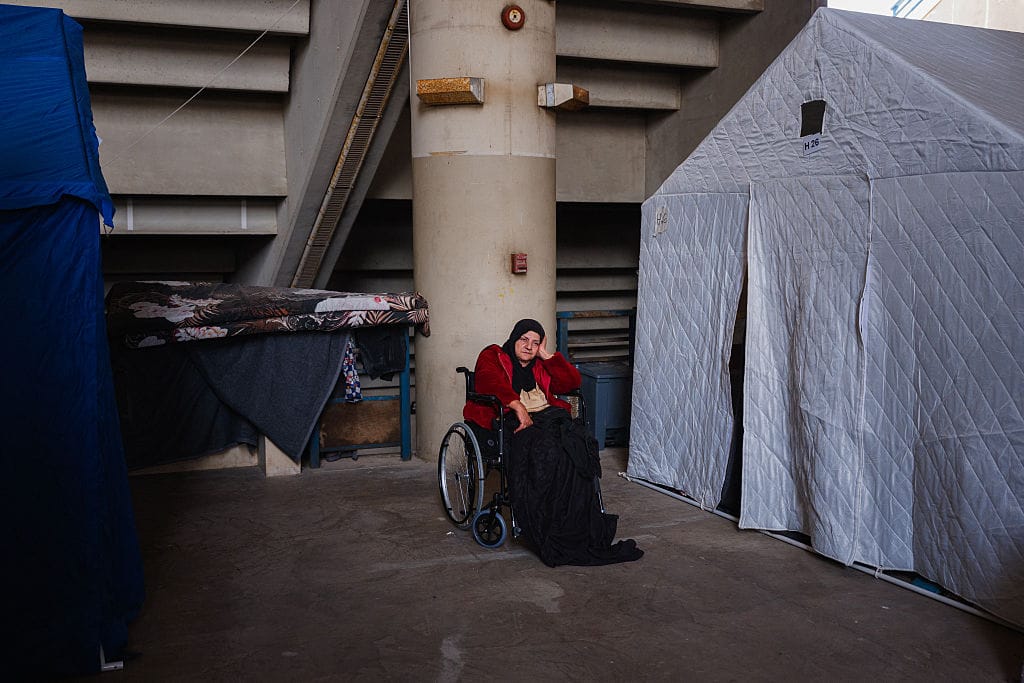
“We used to live like kings”
In Lebanon, the Camille Chamoun Sports City Stadium in Beirut is sheltering over a thousand displaced people. It is one of the few sites with some adjustments made for displaced people with disabilities, according to Handicap.fr. The article quotes Khodr Salem, who walks with a crutch: “We used to live like kings in our homes. Our life has become a nightmare.” (Translated).
The emergency task force for persons with disabilities has made an emergency checklist to address disability. And local disability organisations are making efforts for the overall humanitarian response to be inclusive. For example, Friends of the Disabled Association is featured in this protection situation report for providing shelter, rehab services, and psychosocial support.
In Iran. Exclusive reporting from Solmaz Nazari Orakani on the D*List shares information about how the attacks on Iran are impacting disabled people. Disability facilities and institutions have been heavily damaged. And the government isn't able to continue these residential services, so 17,000 disabled people have been sent home (although I guess many might not have families they can go back to).
Meanwhile, the Iranian government continues its crackdowns on its citizens, and among its victims was Hossein Ghavi, a 28-year-old with a physical disability, according to Iran Human Rights Monitor.
Meanwhile, in the wider world, the conflict knocks over energy and economic dominoes that will affect us all. The D*list takes a look at the impact on disability communities in New Zealand.
“The real strain on taxpayer money”
In Australia, the government has announced it needs to cut the costs of its National Disability Insurance Scheme (NDIS). It aim to reduce the numbers supported from 760,000 to 600,000 disabled people by the end of the decade, and reform the eligibility test.
The idea of not being able to afford disability supports raises the question of what can be afforded. Or, as John Delmenico writes in the Shot:
“In a country where billionaires avoid tax, fossil fuel companies avoid tax, social media companies avoid tax and media empires avoid tax, apparently the real strain on taxpayer money is disabled people who have the nerve to want to be alive.”
As with other rich countries looking to cut disability benefits, the justifications for the cuts are based on misunderstandings, ableism and disinformation spread by politicians and the media.
But there are also many real reasons to reform the NDIS. And, as with disability benefits in many rich countries (including the UK) there is a snowballing bill, a widening scope of who qualifies for them, and escalating projections of future costs.
If we put the bad faith arguments for cuts to one side, I wonder how the disability sector should advise governments about how to realistically budget for these supports.
“Pervasive Chaos”
In the United States, disability benefits are also under serious threat. The Trump administration floats cruel rule changes. But even where the rules stay the same, the social security administration has gone through cuts and reforms that make it at even more hostile than before. A report from the Disability Rights Education & Defense Fund (DREDF) shares the new barriers to disability benefits:
“Although navigating SSA’s complex rules has always required determination, respondents told us that changes initiated by the second Trump administration in 2025 have undermined their sense that persistence and deep knowledge of program rules could eventually make the system work. They described how longstanding challenges, such as application processing delays, understaffing, and long wait times on the phone and in the field office, have intensified. In addition to this worsening of long-term issues, respondents described rapidly changing policies, unprecedented errors, and pervasive chaos to a degree that longtime service providers had never seen before.”
However, it's not all bad news on disability benefits. In Zambia, A UNICEF budget analysis of disability spending shows “important progress in increasing public expenditure”. The increase largely comes through a cash benefit for households with a person with disability, which now has widened eligibility and has a “more proactive outreach”.
“Department for Scapegoating & Frustration”
A welcome antidote to news of benefit cuts comes from these responses...
In the US, Robert Kingett faces a disability review from a government department that won't accept communication in email. He has a story of joyful revenge.
And from the UK, Blossom HB (Debrief agony-aunt) wrote a satirical letter from the Department for Scapegoating & Frustration:
“We have considered your claim but have decided you don't qualify for Human Dignity. We made our decision using the information you gave us.”
Housing
This week I learned about the Integrated Housing Development Programme in Ethiopia. Over the past twenty years it has provided half a million subsidised flats in new condominiums, housing around two million people.
And since 2021, five percent of these units are reserved for persons with disabilities. Great idea, but as Biruk Eshetu G/Kidan writes, there are many barriers to accessing this in practice.
The authorities seem to have no idea how to even register disabled people properly. Applicants must plunge into the chaos of a government office on the eighth floor and hope their documents somehow get into the system:
“There is no dedicated disability service desk or officer assigned to assist applicants with disabilities. Instead, they must navigate crowded offices and long queues alongside hundreds of other applicants. For individuals with mobility challenges, climbing to the eighth floor and waiting in crowded spaces can be physically exhausting.”
Disability caused by road accidents
A new paper from Nora Groce et al looks at Road Traffic Accidents and Disability as a global health concern. The authors argue that the subject is overlooked by those interested in road safety as well as those in the disability community:
“When asked why they had not previously considered people disabled in an [road traffic accident], the Road Traffic Safety experts interviewed reported assuming some disability organization, government program or medical service would be there to help. Disability experts had not considered the psychological, social and economic implications of being faced with sudden catastrophic disability and assumed that their experiences were no different than that of people disabled through other causes.”
It might seem obvious that it's important how disability is caused, but it's one of the realisations that has come to me through writing the Debrief. I come from a disability rights background where the causes of disability are deliberately seen as a separate concern, to be dealt with through health and other areas. But whether it's a road accident, or, say, protests, roots of the climate crisis, or ageing, how you become disabled matters a good ideal.
International cooperation digest
In humanitarian issues: how the humanitarian reset relates to organisations of persons with disabilities. (Disability Reference Group)
In development work: a collection of articles with lessons from building disability-inclusive futures. (IDS Bulletin)
In rights issues: catch-up on the UN Committee on the Rights of Persons with Disabilities (IDA). And how the Committee condemned “grave and systemic” rights violations against children and adults with disabilities confined in institutions in Mexico.
Take-off
Take-off. Good news for a prototype of a wheelchair securement system on Airbus planes. And a “Metamorphic” accessible toilet. (Wheelchair Travel)
All downhill from here: an animated explainer of Paralympic winter sports. (Channel 4)
A history I knew nothing about: the experiences of disabled Japanese Americans incarcerated during World War II. (Densho)
Giving Alice her flowers... folk sharing their memories of Alice Wong. (Disabled Journalists Association).
Building disability culture... How the D*List has grown in three years, publishing disability stories and developing community. (The D*List)
Finding their freedom. For those following the story of Austrian nuns who escaped from their care home to break back into the convent they were taken away from... they are closer to being able to stay. (The Guardian).
Let me know your journeys in disability news! All best,
Peter
Recent News
This update has 125 curated links from 36 countries and regions, organized across 43 subjects.
You can explore it organized by subject or by country.
Subjects
- Accessibility and Design
- Assistive Technology
- COVID-19
- Civil Society and Community
- Climate Crisis and Environment
- Communication and Language
- Conflict and Peace
- Culture, Entertainment and Media
- Data and Research
- Digital Accessibility and Technology
- Disaster Risk Reduction and Crisis Response
- Economics and Social Protection
- Education and Childhood
- Employment, Business and Work
- Gender Equality and Women with Disabilities
- Health
- History and Memorial
- Humanitarian, Migrants and Refugees
- Independent Living and Deinstitutionalization
- International Cooperation
- Justice Systems and Legal Capacity
- Lived Experience and Opinion
- Mental Health
- Mobility, Travel, Transport and Tourism
- Policy and Rights
- Politics and Elections
- Relationships, Sex and Reproductive Rights
- Sport and Paralympics
- Violence and Harassment
- Water and Sanitation (WASH)
Countries
Outro
Explore Further. All the links from these curated editions go into the Debrief library, which now has over 7,400 links from over 170 countries.
Let your friends know. Sharing the newsletter is how people find it!
Connect. Get in touch. You can find me on Linkedin and Bluesky.
Help us do more. The Debrief is free thanks to reader support.
Acknowledgements
Photo by Dimitar Dilkoff / AFP via Getty Images. Thanks to Celestine Fraser for help with its selection.
Many thanks to everyone who shares links, news and reports, and the readers and organisations whose support makes this work possible.