
How did disability shape your day?
Dear Debriefers,
What images pop-up in your diary? Today's edition has a new open call for writing, and opens the Debrief mailbag to see reader responses to recent editions.
Readers had quite a bit to say – and different views – on assisted dying (this section is marked clearly). Following that, readers explore questions about organisations that “represent” disabled people.
Read on for all that and insights exploring AI, institutionalisation and turning the table on tokenism.
About this edition
The Debrief shares voices from our community thanks to reader support.
Peter Torres Fremlin is editor of Disability Debrief and is from the UK.
Kinanty Andini is an illustrator and digital artist from Indonesia.
How did disability shape your day?
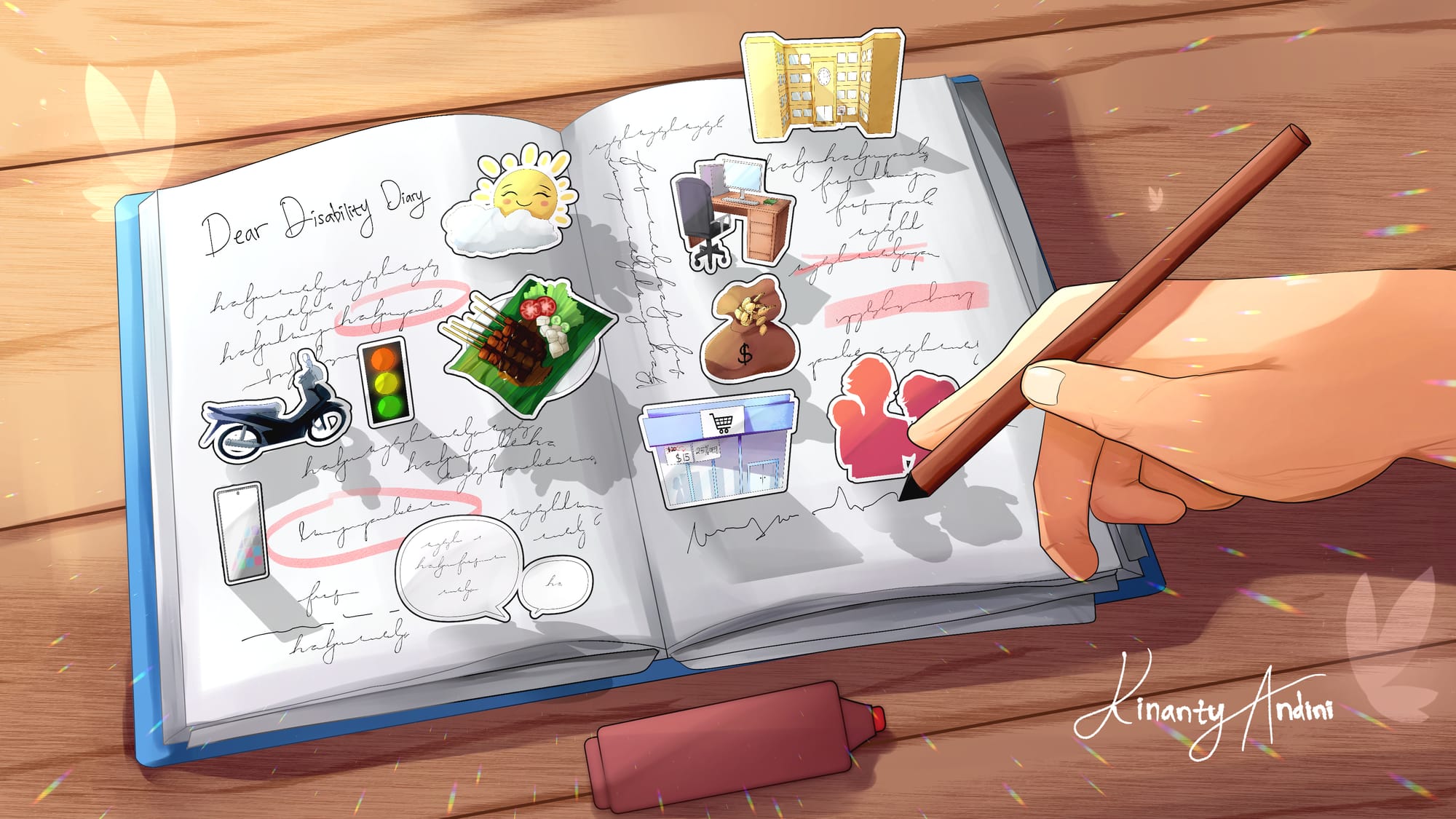
You’re writing in your diary before you go to sleep. How did disability shape your day?
That's the prompt for our new open call for writing: Dear Disability Diary. If it grabs you, please send us a page from your journal!
This is our second call for writing from our community. The first one we did led to the beautiful Broken then Blooming where we published 6 writers' vision of a future where disability rights exist.
Entries for the diary prompt are up to 500 words, and they can be fiction or non-fiction. The call is open to people with and without disabilities – after all, there's many ways that disability shows up in life.
The deadline is 20th July. We'll publish our favourite entries (and pay £100 for each one published). See full details and make a submission on the page for the call.
“Happy to be aboard”
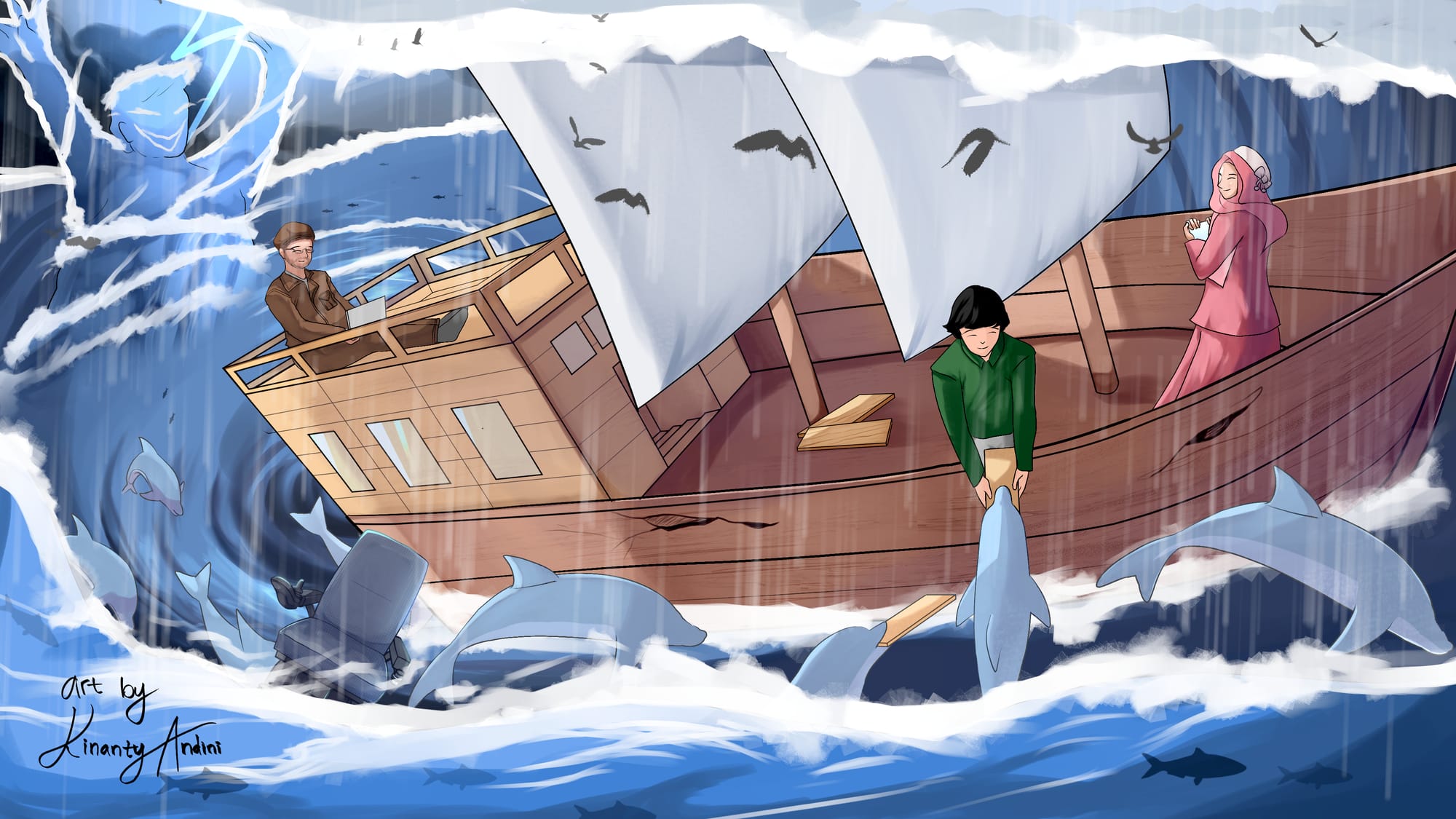
Last month's Weathering the Storm asked for help sailing against the winds that push against an independent publication covering disability issues.
The Debrief can invite new writing and feature original work by writers and artists from around the globe thanks to the support it gets from readers. Claire was one of the many readers who made a contribution:
“A quick note to say - you wrote so fearlessly that I am not sure whether the latest Debrief felt in any way vulnerable to put out there, but I’m glad you did.
I finally signed up, after long threatening to do so! After a period of unemployment affected by exactly the forces you outline in the issue, I’m grateful to be in my first week of a new job and capable of doing so.
All the best with the Debrief moving forward, and I hope you’re suitably proud of what you and collaborators have and will continue to achieve through it.
Happy to be aboard!”
If it's comfortable to do so, do join Claire and other readers in supporting the Debrief.
Discussions of assisted dying
Readers had quite a bit to say about Joe Wood's piece on how different countries approach assisted dying. And just out yesterday is the discussion Joe and I had with Vanessa Rampton on the Assisted Lab podcast.
Taking back control of our own lives. Many responded to say how they are firmly against legalising assisted dying. Among them, Phil Friend commented that “the talk about ‘dignity’ in dying feels like it’s missing the point of how we actually live”:
“The Canadian example you shared about the Paralympian offered death instead of a stairlift really hits home. When a system makes it easier to access a needle than a decent care package or a ramp, “choice’ is just a fancy word for an ultimatum.
At Not Dead Yet UK, we don’t see the ‘slippery slope’ as an academic theory. It’s a real danger for people already fighting systemic barriers. For us, true dignity is about taking back control of our lives and having the agency to stay in the game.
Let’s focus on helping people live well first. Offering an exit before we’ve offered a way forward is a failure of imagination. We shouldn't be making it easier to die until we've made it equally easy to live.”
In a similar line, Andrew Pulrang in the US said that he is “strongly against” assisted dying:
“However, my position on this is heavily influenced by the fact that I live in a country, (one of the few), that doesn't have a comprehensive health care system for all, regardless of ability to pay. We do have a somewhat more developed and I would say empowering system of long-term care than some countries that have better health care systems. But our long term care systems are in the process of falling apart and being defunded right now. So that leaves little reason to feel confident that killing myself could really be purely a choice here in the U.S.”
Not waiting for change. Also writing from the US, Bella Radant, a disabled medical student, shared some of her experiences and the dilemmas it presented:
“For me, I think that the point brought up by Joe (and others of course) regarding the potential for medical assistance in dying (MAiD) to be used as a societal excuse for failing to provide adequate care and accommodations is one of the biggest sticking points for those less supportive of MAiD.
At the same time, the real suffering people experience deserves timely decisions, oftentimes on a much shorter timescale than broad strokes infrastructure changes. [...]
In my personal experience, I have met a variety of patients experiencing what I and most others would consider to be horrific quality of life in near complete despair of altering those circumstances.
A non-zero number of them have died either by suicide or other ‘deaths of despair’ (e.g overdose, refusing treatment) and my reaction has varied from gut-punching anger at systemic failing to near-relief that the patient was able to exert some form of control and dignity over their circumstances.
I am obviously all for creating the systemic changes needed to prevent such deaths, but I also can understand and support people who don't want to wait for such change.”
Dignified circumstances. Debrief faithful Alexander Ogheneruemu, wasn't ready to make an overall judgement but responded on the question of dignity:
“Agency is the keyword but it's equally important to hold in mind how both external and internal dynamics come in to influence even that.
I leave with a counter to one phrase from the article, [a quote of Marianne Karner, opposing assisted dying]: “There is no such thing as an undignified life. What does exist are undignified circumstances”.
I think it's more complicated than that. There are certain dignified circumstances where the subject, for [their] own dignity just feels it best to throw in the towel.”
And as well as these comments, it was moving to hear from several readers how the article helped them understand or discuss questions of assisted dying within their own families.
“What we still aren't able to say out loud”
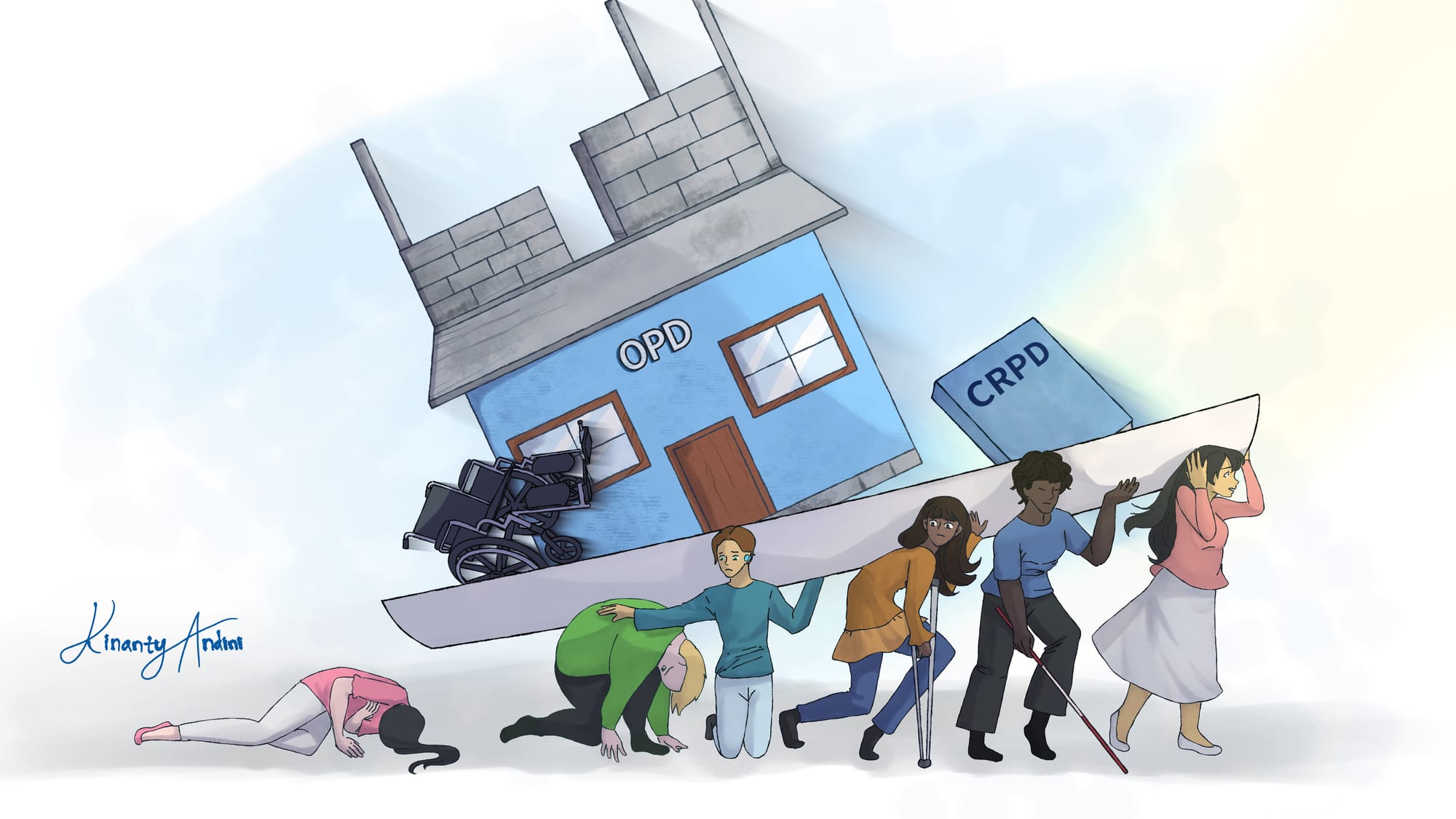
Alberto Vásquez Encalada's piece rethinking representation of people with disabilities also sparked a lively set of reactions.
Who continues to be left out? From Brazil, Luciana Viegas called it a “necessary outcry” about disabled-people's organisations, and about “what we still aren’t able to say out loud within our own movements”:
“The debate about Organizations of People with Disabilities cannot continue to be just a celebration. We need to talk about real representation, about who is included and who continues to be left out, even within our own spaces.
And when I say ‘left out,‘ I’m talking about Black people with disabilities. About non-verbal people. About people who live at the intersection of multiple oppressions and who rarely see themselves reflected in the leaders who are supposed to represent them.
Disability activism that doesn’t question itself is activism that reproduces the status quo.”
See previously on the Debrief for my interview with Luciana which also explored some of these questions: “Without us, you won't move forward”
Burnout and ableist structures. Sara Rocha also found Alberto's article a “fantastic piece” that “encapsulates a lot of my frustration with the way the need to organise in the disability movement”:
“In Portugal (and elsewhere), if we want to develop something that is funded, we have to create rigid, ultra-bureaucratic, institutionalising structures and rely on a lot (A LOT) of volunteer work.
As autistic and neurodivergent people, we have less energy, and I don’t know any autistic advocate who doesn’t burnout at some point. Working 8 hours on another job a day to put food on the table, sometimes caring for children or people with disabilities (or both), and still doing unpaid activism for years, isn’t for everyone. In fact, it isn’t for autistic people.
When we try to make the way we organize and work more flexible to be more accessible, we aren’t funded, and we’re penalized. [...] So even associations led by people with disabilities—which aren’t even formally distinguished from those that speak on our behalf—end up being forced to implement ableist, institutionalizing structures with exclusionary and oppressive policies just to have, perhaps, and with luck, the money to pay some people with disabilities to work.”
Turning the spotlight inwards. Mark Carew, in the UK, shared the importance of going deeper on questions of what makes organisations representative:
“All policymaking and influencing is, of course, influenced by power and resources (as is pointed out in the article). It therefore makes complete sense, in my mind, to turn the searchlight inwards occasionally and have a look at the structures and categories of people that often most directly lobby the generalist, high power policy actors on disability issues. The Debrief is one of the only places I see this done, through multiple articles. ”
Indeed, as Mark highlights, I see providing an independent view on the international disability movement as a key contribution of the Debrief. And as editor, I'm keen to publish a diversity of viewpoints on the topic. I'd love to hear, for example, a defence of the structures that Alberto critiques in his article.
“Lived experiences should not be re-packaged”
In April I wrote how Disability Debrief mostly doesn't use artificial intelligence (and when it does). It's a tricky and fluid subject.
AI curious. It was great to see Andrew Pulrang over on Disability Thinking Weekly take it as inspiration to do his own AI audit:
“I guess you could say I am AI curious, especially as a tool of accessibility, though not really for me and my particular disabilities. I am also concerned, though not yet panicked, about the social, economic, political, and environmental implications of AI. And I am committed to AI-free originality in my own writing, including for this newsletter.”
Lived realities. Dorodi Sharma responded to note how the article “deeply resonated” with her:
“Increasingly, I am seeing so much of AI generated content and imagery around disability rights. Social media graphics are full of images that do not reflect the lived realities of persons with disabilities. Bizarrely, sometimes they seem like whoever generated those images put a prompt asking for ‘persons with disabilities in xyz setting, with visible prosthetics or assistive devices' and for added measure , ‘include people of different ethnicities and race’. I would any day prefer real life photos that are not polished, taken in settings where people with disabilities live and thrive, over these AI generated images. The same holds true for narrative. Lived experiences should not be re-packaged, they are raw, they are not always polished. The disability movement, including leading organizations, need to reflect on the overuse of AI.”
And again, on this subject and others, I'm interested in a diversity of views. I would love to hear from those who are using AI to share disabilities stories and the way they navigate questions of authenticity.
“Hasta la victoria, siempre”
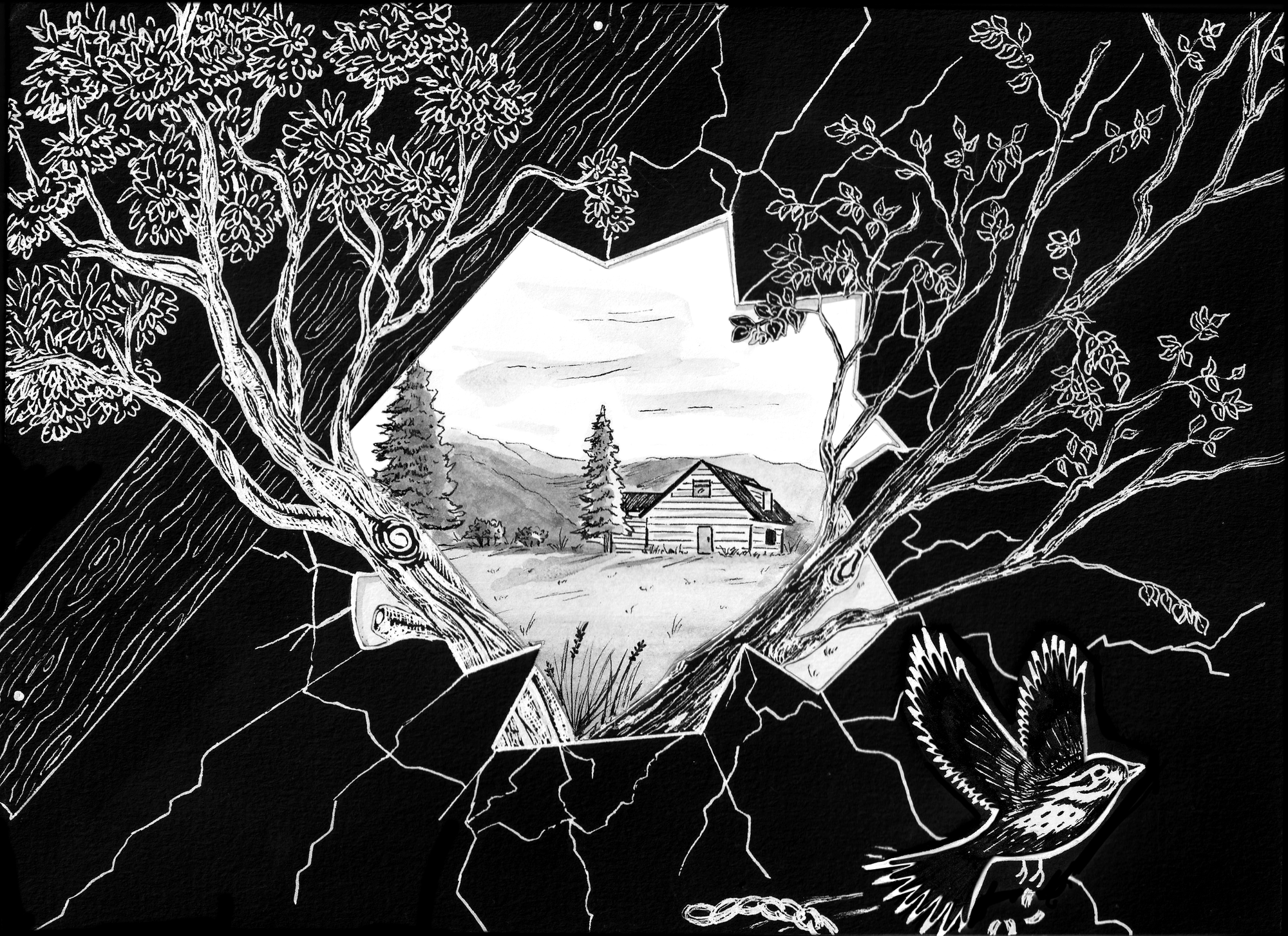
In last week's edition Rachel Litchman wrote about the lessons of resistance she learned from being institutionalised as a child.
One of the responses came from Alan Robinson, who says he went through very similar situations as a teenager in Argentina (translated from Spanish):
“It did me good to read your description of how they try to convince us that the only way to get out of a psychiatric institution is through obedience. It's not easy to find people who can express this openly. Thank you.
In Argentina, the Milei administration is also trying to change the laws to allow for more involuntary hospitalizations and forced mental health treatments.
Ernesto ‘Che‘ Guevara, the revolutionary, popularized the expression ‘Hasta la victoria, siempre’ [Onwards towards victory, always!]
Among my mad friends in Latin America, we sometimes like to say ‘Hasta la locura, siempre!’ [Onwards towards madness, always!]”
Who is using whom?
Escape my reality. Fulltime Hedgehog's illustrated essay on her childhood dreams was welcomed by Yashmi Prasad:
“It helped me escape my reality and filled my heart with all those childhood memories which are lost in the daily din of urban Mumbai madness.”
Embedded throughout the exhibition. Writing about inclusion of disabled people at the Met Gala led to questions of tokenism in elite spaces. Eleonora Censorii responded to describe how the Met museum has been pursuing accessibility for decades, and that:
“The fact that this exhibition was created in collaboration with professionals with disabilities—as it should be—and that inclusion is embedded throughout the exhibition, from the team involved up to the mannequins, is definitively not ‘purple washing’ in any way.”
And Kamil Goungor argued that, even if the inclusion had been superficial, it can still be beneficial:
“It is still better to be there rather than not. Bad publicity is still good publicity etc. This whole discussion brings disabled people to the epicenter, and even if only one person gets the message right (many did in this case), it's a win.
And in the end of the day, who is using whom? 😉 ”
An agony aunt with disability. Indeed the question of how to know if someone is using you was also explored by Blossom in her debut advice column. Thanks to all the readers who welcomed our new agony-aunt-in-constant-agony, and please do share further questions with Blossom.
That's all for today. Thanks all for such thoughtful reactions to these newsletters. Stay in touch,
Peter
Outro
Further reading. There is a back catalogue of Debrief newsletters online, as well as a library of disability news from 170+ countries.
Let your friends know. Sharing the newsletter is how people find it!
For more from Kinanty, see her website.
Connect. Get in touch. You can find me on Linkedin and Bluesky.
Help us do more. The Debrief is free thanks to reader support.
Acknowledgements
Thanks to Kinanty Andini for the beautiful illustration of a diary entry, and for her other images. And to Rachel Litchman for her drawing of Breaking Free.
Thanks to Celestine Fraser for designing the Dear Diary call. And as always, thanks to all you Debriefers for being in touch, and the readers and organisations whose support makes this project possible.